Hard lessons through beautiful words

The poor always believe there is room enough for all of us; the very rich never seem to have heard of this.
In us there is wisdom of how to share loaves and fishes however few; we do this everyday.
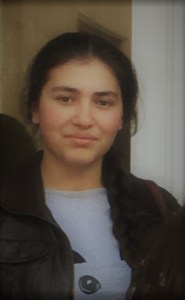
2018-02-11 16.40.49I thought Gohar had been hasty. She had looked at the list of poems for her form, and had quickly settled on the first.

“Why this one?” I said

“I like it”. She shrugged.

“What do you think it means?” I asked, pretty certain that she had taken in only a few of the easier words. I thought the poem, and its provenance, would be difficult for even the most accomplished of 11th form English-language students in Armenia to understand…

“It is about poor people who are really rich because they have pride and love” she said.

I gulped and nodded. “Good choice”.

Gohar is 16 and lives in a small village in a deep gorge in the south of Armenia. At first sight, she does not seem to have a lot in common with Alice Walker, (Yes, Color Purple Alice Walker. THAT Alice Walker) but Gohar has chosen to recite Alice Walker’s poem To Change the World Enough  in the Goris English-language poetry contest next Saturday.

Our conversation about the poem took place a week or so ago. Since then Walker’s words, given meaning through Gohar, have sounded in my head.

Winter is nearly over here and so there is not much food left in my family’s store room. The jars of tomato sauce and pickled beets and peach preserves are largely gone. The wood pile is depleted and so this week, the coldest of the year, Haykush has been taking the axe to the remaining logs and splitting them in half in the hope they will go twice as far.

I was invited upstairs today, because Aleta’s mom and sister were visiting from their village, and one of Haykush’s daughters was also stopping by. We would be ladies who lunched.

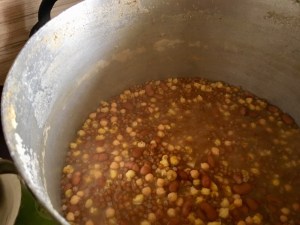
Together we ate Kjackhash– a homemade soup of buckwheat, yellow lentils, kidney beans and chickpeas. The family sprinkled several large spoonfuls of sugar on each bowl before they tucked in–the proper way to eat it, I am told. I stuck to salt. The soup, which didn’t appear to have any onion, garlic, herbs or stock was as filling as you might imagine, and much more delicious than seems likely. As always the company was warm and welcoming, the talk was lively, and we had a few good laughs.

More sugar — cubed this time– appeared on the table as coffee was served. No self- respecting Armenian would drink coffee without a little something sweet. At this time of year, there are no mini Twix and Grand Candy bon-bons. It is time to fall back on any dry goods in the back of the cupboard.

One of my fellow Peace Corps volunteers lives with a herdsman’s family in a village not far from here. One of the family’s cows was sick a week or so ago and there was no money for medicine. My friend, recognizing the need, fronted his rent money by a week. The medicine was bought and administered, and the cow recovered. The family call it Clay’s cow now—it wouldn’t have lived without his help.
 

img_1533

In addition to the theme picked up by Gohar, Walker’s poem also talks about how the rich are afraid of the poor: We experience your fear as the least pardonable of
humiliations; in the past it has sent us scurrying off daunted and ashamed into the shadows. 
Walker then informs the rich: we seek the same fresh light you do:
the same high place and ample table. At the end of the poem there is a call to action: Learn from us, we ask you. We enter now the dreaded location of Earth’s reckoning; no longer far off or hidden in books that claim to disclose revelations; 
it is here. We must walk together without fear. There is no path without us. 

I may have read Walker’s poem before–I don’t remember. Now, thanks to Gohar and my family upstairs, the soup, and Clay and his cow I will never forget. This is the kind of lesson you join Peace Corps to learn.

Someday soon, I will post a video of Gohar reading To Change The World Enough. For now, listen to my friend Valerie reading it. She donated this recording because she knows it is so helpful for our learners to hear native English speakers. I thank her for walking together with Gohar.


Posted in Alice Walker, Armenia, Beauty, Blessings, Cross-cultural understanding, Education, family, Food, gratitude, identity, Language learning, life lessons, National Poetry Recitation Contest, Peace Corps, Poetry, Rich and Poor, Things that gladden the heart, Things that make a difference, travel, Village life | 2 Comments

The Joys of (Nearly) Spring: Artistic life in our part of Armenia.

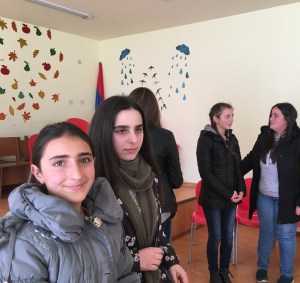
2018-02-11 16.06.36Later this afternoon I will travel in the bumpy backseat of a spring green Lada to meet the young women of Halidzor, a village about 20km from here. The taxi comes courtesy of a former resident of Halidzor who asked me to run an English club in her village. She speaks fluent English and now works in Yerevan. Narine wants the young people coming after her to have the chances she has made for herself—and the girls, (for most of the students are girls) are all keen to learn. These teenagers, who already speak elementary English, are like the flowers of spring, fresh-faced and beaming. They are full of life and hope and imagination. Last week we were discussing ambition and professions and I asked them to mime career activities so the others could guess what their dream job was. We had dentists, and lawyers, and nurses, and teachers, a guitarist and a journalist. It was all enormously good fun. I have a pack of playing cards in my purse. Each card is illustrated with a photo of an Irish landscape and so each student will be asked to describe the picture on her card. Lots of talk of rivers, lakes, mountains, castles, grass, sheep, mist and rain. The vocabulary is as useful here as it is in Ireland. Next week we are discussing feelings and actions. I sense a rendition of “Brown Girl in the Ring” in my near future.

Younger children come to English clubs too. Every Sunday in Goris I read stories to a group of kids aged 7-10. To check their comprehension of the story, I ask them to draw a picture as I read. We have had three little pigs and their various houses, and Raggedy Ann, found in the attic with only one button eye. Again, the students are usually girls and are very concerned to get the details of the picture just right. Left to their own devices, they will copy the picture from the book,  but I do my best to encourage a more freeform approach to illustration. Last week we had a sudden influx of boys who I could tell were tiring of the details of Raggedy Ann’s attire. The story explained that the little girl who found the doll had been climbing over old chairs and tables in the attic. Time for a challenge to see who could move around the room without touching the floor. The boys loved it. Anush, who’s probably 8, looked rather disapproving.

img_1312img_1272

My organization hosted the Goris Write On contest a couple of weeks ago, so I had a chance to read some of what the students produced.  Write On is an international creative writing contest administered by Peace Corps. The students are given a prompt to spark their imagination and then an hour to write their story. Access to phones and dictionaries is forbidden. On student wrote an allegory about a monster and the insects clinging to its back–a government and its people. We had the invention of a season of opportunity, and a dystopic world where robots ruled. I could not have written any one of these stories in Armenian. I suspect that stories written by  kids of the same age in the UK or in the US would not have had the uniform high moral tone–exhortations to love one another, be kind, and work hard. Students here are educated to please, not shock.

Earlier today, I coached a 10th form girl–16 years old–who will recite May Sarton’s poem “For My Mother” at the Goris poetry recitation contest on Saturday March 10. Nane does learn English at school but her teacher is not involved with her decision to enter the contest. This is something she does all by herself. She is a previous 2nd prize winner at national level. She was word-perfect today and so we worked on emphasis and emotion, and a hand movement or two. She is amazing and a pleasure to work with. I am so proud of her.

The visual arts are flowering too in Goris. We have not one but two art schools and a an art gallery–the resident artist there also tutors proteges. My organization came up with a good idea: we asked some of the most talented young people to paint locally themed paintings and framed these up in colorful sets of four. Local businesses will be given the opportunity to buy the paintings for display in their offices–a wonderful way to show their link to both the landscape and the community. The money raised will help local families get over various bumps. I want one of those paintings myself…

Watch the 90 second video below and marvel at the talent of Goris’ Most Talented. The sale of pictures will take place at 3pm on Friday March 2 at the Art Gallery. Phone bids will be accepted. The music track on the video is written and performed by one of our young, local musicians. If you can, join us for the poetry contest in Goris on Saturday, March 10 from 12 noon. It’s at our local theater–yes, we do acting too.

Posted in Armenia, Armenian art, Armenian writers, art, Beauty, creative writing, Fundraising, joy, Peace Corps, philanthropy, spring, story-telling, Syunik Marz, Things that gladden the heart, Things that make a difference, travel, Village life, young women | 1 Comment

Going for world domination— please help

I made a video to be showcased on the Peace Corps global website. It has been shortlisted as a finalist in the Peace Corps Week Video Challenge. In addition to the formal judging, there is a public vote via You Tube. I hope you will exercise your franchise and vote for me. It is quite disturbing how much your vote– and therefore my near-certain victory– means to me.


Voting on You Tube is a painful process and near-impossible for people in Armenia. Owned by Google, You Tube only allows login with a gmail email account and password. Gmail is not common here. Of course, it is possible to create a gmail address and password and never use it again (may I suggest humorliz@gmail.com. Password: pander) but that is hard to explain to people not raised in a grasping capitalist culture where data is the new gold. You, all too familiar with the wiles of Silicon Valley, can help: your vote will bring meaning and purpose to my pathetically needy life.

I am not even claiming my video is the best of the 18 on display. My two fellow Armenian Peace Corps Volunteers Jim and Thong have beautifully shot and edited videos on show. Vote for them too.

All the videos are worth a look. Learn a little about life in Timor Leste and Guinea and other places I can’t place on a map. I want to go to Guatemala, and Malawi now , or Mongolia or Albania, and I bet you will too.

You can see, and vote for the videos here.    Thank you for your vote.

Posted in Armenia, Peace Corps Video Week Challenge 2018, You Tube | 3 Comments

Reasons to be Cheerful: Barekendan

IMG_3089

Liz, Anna and Mariam at a recent work event

Mariam is baking cakes for 70 children this weekend. The priest at Tatev Monastery asked her to do it to mark Barekendan, the festival of freedom and happiness that presages the start of Lent. Barekendan takes place on the 7th Sunday before Easter and is an occasion for eating cake and dancing in the streets, in advance of 40 days of abstinence in the run-up to Good Friday.

During Lent, members of the Apostolic church do much as Christians in the rest of the world. It is a time for purification of the soul, for giving up meat, and for trying to at least cut back on the bad stuff. In the past, Armenians took this very seriously, sometimes partaking of only bread, salt and water.

As Mariam prepares for her baking marathon, she sings a song associated with Barekendan–this Sunday’s carnival. The song is along the lines of the Old Lady Who Swallowed A Fly but involves a sheep who eats grass, a wolf who eats the sheep, the bear who  eats the wolf and so on. You can hear the song by clicking below.

Mariam also told me a folk tale associated with Barekendan. A man asked his wife to stock up with oil and rice for Barekendan. She did so, without knowing what or who Barekendan was. (Perhaps she was an American who came to Armenia with Peace Corps and knew nothing of local habits?). Soon after, a stranger arrived at her door and asked for food.

“Are you Barekendan?” the housewife asked, causing the stranger, familiar with the Apostolic calendar, to consider her a little touched in the head. To humor the befuddled woman he replied “Yes, I am Barekendan” and was thus promptly supplied with oil and rice. He left, feeling well pleased with the turn of events.

The woman’s husband came home and, discovering both his wife’s mistake and the empty cupboard, went off in search of the stranger. He rode his horse, and soon caught up with the stranger, who had had the good sense to stash his spoils somewhere out of sight.

“Have you seen the stranger who took off with our oil and rice for Barekendan?” asked the husband, astride his horse.

“Yes” replied the stranger, prepared to play along with the second member of this eccentric family. “He went that way, but the road  is very narrow. You’d be better off on foot”.

The husband relinquished his reins and set off as the stranger directed. The stranger congratulated himself on ending his day with not only oil and rice, but also a horse on which to ride home.

What the legend of Barekendan has to do with Lent I am not quite sure, but Mariam and I had a lovely time discussing it, and listening to the song. With luck there will be leftover cake on Monday. Oh wait, shouldn’t I be giving up sugar for Lent?

Posted in Apostolic church, Armenia, Barekendan, Cooking, Cross-cultural understanding, Easter, Food, friendship, Happiness, Legends, Lent, travel, Village life | Leave a comment

Spoor me

“How’s your poop?” was almost always Hanna’s first inquiry of the day when we 15 Community Youth Development Volunteers were training together in Ararat marz last spring. The question always sparked a wide and fairly disgusting range of answers–a running commentary if you like–for American guts previously used to digesting large hunks of meat, and mountains of processed food, didn’t always adapt well to an all-natural vegetable diet, and food perhaps prepared with more oil and salt than most of us were used to. By the time we moved to our permanent sites in June, most of our intestines had made their peace with Armenia, but Hanna would still often text or email “HYP?” just to check in on our movements. She was good like that.

I miss Hanna for many reasons and you should too: you wouldn’t be subjected to this post if I still had her to confide in. Sorry about that.

2017-11-04 10.41.24

For the love of God, where are the bananas?

It is often said that Peace Corps Volunteers must expect embarrassing accidents as part of their service–the downside of overseas adventure. I will spare you the details of my own, err,  slippages up to now, suffice it to say that there is a taxi driver in Dubai who was definitely glad to see the back of me after much from the back of me was unfortunately—oh well, no need to explain. Then there was that time in the school with the squat toilet. And in the hostel with the  line for the bathroom. And the all time low this week in my own apartment when violent throwing up at one end made it impossible to stay clenched at the other…

2018-01-10 13.30.23

I’ll take the ginger and the mint please

I should stress that I have only myself to blame for any foodborne illness I suffer here. Armenians are clean freaks and indeed my office mate Mariam refuses to allow me to wash dishes at work, because she think I don’t wait for the water to get hot enough, and that I don’t scrub the china hard enough. My family here, seeing me once more whey-faced and armed with a bottle of bleach, will urge a cutback on wine, and a new fondness for mint tea. They light the fire, fill my hot water bottle, and presumably say a prayer that their carpeting will survive my tenure.

In the course of 6 months, I am pleased to say that we can now discuss my delicate condition without recourse to unattractive mime. Luts լուծ and vortskal ործկալ are two important words to know.

I think back to the time that one of our predecessors here advised us to secrete some adult diapers in our Peace Corps packing, in case of emergency. I shuddered at the time, laughed, and ignored her Dependsable advice. ‘Better safe than sorry’ she said, ruefully. Incoming volunteers: you have been warned.


Posted in accident, Advice, Armenia, Embarrassment, Illness, Peace Corps, personal failings, Sickness, Toilet talk, travel | 2 Comments

Walking-Talking Back to Happiness

“Ari, Gayoush, Ari” Arsen screamed into his walkie-talkie “Come, Gayane Come”

“Kgam” she bellowed back, and came. It turns out the 4-year-old is much more receptive to her big brother’s commands when they are issued through one of the yellow, plastic radio transmitters I brought home from Dubai.

The two were sitting about 4 feet apart and so the volume of their call and response wasn’t strictly necessary. Neither, for that matter, were the walkie-talkies, which had no batteries. The play was the important thing, and gave enormous pleasure to the kids, although the rest of us may have permanent hearing damage.

The ” no batteries–no difference” incident was just one of the moments in the last week when I have stopped to think about the contrast between Armenia, and Dubai, a three hour flight to the south of here– and economic worlds away.

img_1078img_0895-1img_0818

A week ago, I basked in the sun, sipping cocktails and marveling at water rendered artificially and attractively blue by tile imported from God Knows Where. The sparkle on the water was enhanced by reflections from giant sheets of glass manipulated to impossible angles–3D CVs for leading architects. Sitting in the back of a dilapidated taxi on the way to Elsa’s house from the Yerevan airport, I looked out on a snow-filled purple-grey sky and breeze-block walls interspersed with sheets of rusted, corrugated iron. Here flowers imported from the Netherlands are carnations, bought only to decorate graves. A happy hour is when the baby doesn’t cry, or when someone stops to buy your apples, or when the car keeps going, and the fire stays lit.

img_0507-1img_0364img_0071

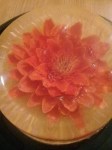
At Elsa’s there was eggplant roasted on the stovetop, because they know I like it. Home-grown walnuts and home-dried raisins left over from the New Year’s celebration, and a marvelous jelly with an intricate flower inside–this is Alla’s latest hobby.*

img_0157

When I left the next day, I was given 3 bags of grapes, one of apples, some dried rose-hips, frozen green beans (from the garden, not from a packet), and jars of eggplant caviar, tomato puree and apricot jam. Oh, and about 5 liters of red wine in old Coke bottles. Elsa also added some lavash. “There won’t be anything in the house when you get home” she said “Best to take it”.  Funny, they didn’t worry about this when I checked out of my hotel in Dubai–and I’d been paying them to take care of me.
img_0741

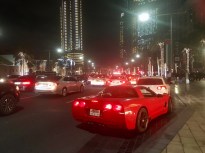
In Dubai, small children go racing at the Dubai Kartdrome. Many of them have their own karts, and helmets and leathers. When they get a bit older they can race a Lamborghini for a day. Many of Dubai’s drivers have their own Aston Martin, Ferrari or Lamborghini–we routinely saw them in parking lots and by the side of the  road.  It is hard to believe that even a four-year-old in UAE would be entertained too long by a toy walkie-talkie that wasn’t working.

Speaking of not working, a recent poll of Armenian adults –the Caucasus Barometer–conducted by the Caucasus Research Resource Center (see the survey here–really worth a look) shows that 36% cite unemployment as the biggest problem facing the country, with 17% identifying poverty as the biggest challenge. In Dubai, they are importing skilled workers, probably at an even greater rate than they are leaving here. In the UAE, they have appointed a Minister for Happiness, knowing that mental ease and satisfaction makes for a more productive society. In the 2017 World Happiness Report, UAE ranks 21st, whereas Armenia is 121st, out of 155. (You can see all the rankings here--the UK and US both make it into the top 20). It’s a little tricky to work out what the UN-produced World Happiness Report is actually measuring, because the data comes from many sources, and, as always, any batch of data can always be contradicted by another. In the Caucasus Barometer 2017 report for example, 21% of Armenians say they are “very happy” on a scale of 1-10, with many higher scores in categories 5-10 than on the downer side of the see-saw. I don’t know if the same would be true in Dubai.

I am glad to have had the privilege of visiting Dubai, and I certainly enjoyed myself there. I would not want to live there, because after the shine wears off, the place feels brassy and transient and artificial. I am glad to benefit from the warmth and generosity of people here, but despite the everyday resilience of those I know, this is not a lovely place to live–the hardship is bitingly real.

We got batteries for the walkie-talkies of course. The fissle and interference was unbearable and no-one could master when to press and release the button. We took the batteries out before long, but the to and fro continued. Sometimes, simple is best.

* I have looked online to see how Alla makes the jelly flowers. I still can’t make head or tail of it. Everything you need to know, you can find here. 


Posted in Armenia, Capitalism, Caucasus Barometer, Caucausus, Cross-cultural understanding, Data Analysis, Design, Dubai, Emigration, family, friendship, gelatin flowers, Happiness, life lessons, love, Play, resilience, Things that gladden the heart, travel, UAE, World Happiness Report | 1 Comment

Big in Bardez

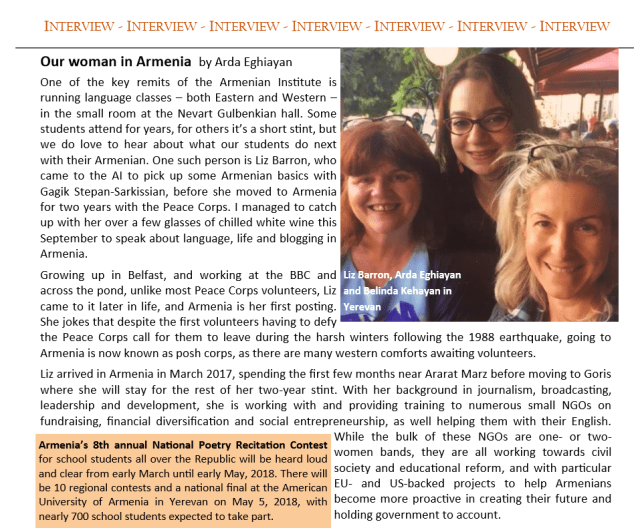
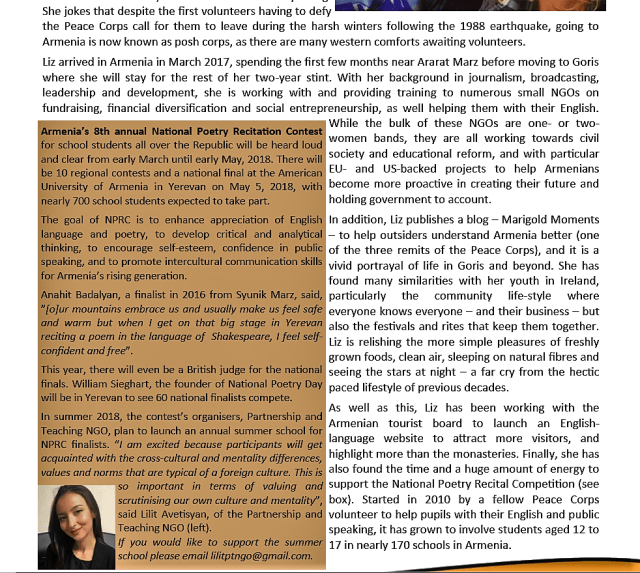
Thanks to the Armenian Institute in London for publishing interviews with me and my colleague Lilit Avetisyan–a great opportunity for me to talk about my Peace Corps service in Armenia, and for Lilit to raise awareness of our beloved National Poetry Recitation Contest. 

You can read the whole newsletter here.

Screenshot 2018-01-26 11.36.49

Screenshot 2018-01-26 11.37.17

Posted in Armenia, Armenian Institute London, Bardez, Peace Corps | 1 Comment

The Ting About Dubai (or “Jamaica?” “No, she drank of her own accord.”)

We found what must surely be the only Jamaican bar in the Middle East. Ting Irie is in a Souk attached to the Manzil Hotel in downtown Dubai. Although the restaurant is the real ting, the Souk is not. It is built as a 30-store extension to the hotel in order to create more licensed space. Here, only hotels can sell alcohol and so the land staked for hospitality continues to grow. 90 massive hotels will be built this year. That’s a lot of cocktails. Tourists and shoppers and skilled workers come here for the sun, the brand names, and the tax-free earnings, but not to embrace Islam culture. We want a drink with everything. The Sheikhs seem unperturbed by this: they know the value of giving the customer what she wants.

The Ting Irie is decorated like a Caribbean beach shack with Rasta colors everywhere. The waiters– cute as conch-shell buttons– are the real Jamaican article, flown in with the akee, salt fish and plantains. The music– modern reggae– was excellent.

We were there on Monday for Happy Hour and went back yesterday evening for Ladies Night.

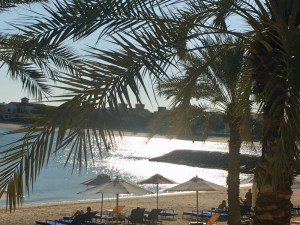
img_0846Brunch (we’re booked for Friday at the Taj hotel), Happy Hour and Ladies nights are a big feature of visitor and ex-pat life in Dubai. This is how it works: drinks on regular menus are priced astronomically high. It therefore feels like a bargain to get them half price (roughly $12 for a cocktail and $10 for a glass of wine) and so we flock to bars by 6pm to snap up and slurp down the “bargains”. Anyone drinking after 8pm is either already too drunk or too rich to mind their wallet– or they are there for Ladies Night. Ladies Night involves dressing up to the nines (you’ll need your hair and nails done too–more outlay). You then commit to a package of food and drink. The Ting Irie asks for $25 each in return for two courses–chicken jerked and barbecued and fried, shrimp with plantain, rice and peas, oxtail—and limitless drinks img_0889from their Ladies Night selection. I had frozen concoctions of rose wine, rose syrup and lemon. The girls had whiskey with Malibu and– oh I don’t know, something, or perhaps some Ting. Given their fragile state this morning, mine was the better choice, but I suppose a bucketful of anything will do you harm– unfair to blame the composition when the villain is really the volume.

 

img_0917


Dubai understands both deals and veiling and so the Ladies Nights offer the veneer of value, rather than actual value. Portions are small and drinks are no-one’s first choice but still they bring out the women in their crowds. Men get some kind of a deal too– it is a cost-effective way of wining and dining a date, and as Ladies Nights progress, packs of men are happy to pay for their own beer at full price for the opportunity to mingle with women whose judgment is impaired.

img_0738Brunch is the same sort of deal but involves a buffet and takes place from 1pm-4pm on a Friday. Beach and pool access can be involved, plus special offers on massage or beauty treatments. This is how incomers spend the Islamic holy day.

It is of course possible to set a budget for your vacation in Dubai. It is NOT possible to stick to it. You will turn up for an evening event advertised on your Happy Hour app and discover the club has been replaced with an Asian Fusion Karaoke Bar with no specials that evening. It will feel like too much trouble to cross town by taxi (prices are good but traffic is terrible) to reach the next place on your list and so, before you know it, you are shelling out for full-price Mai Tais and treating a clan of Glaswegian construction workers to your version of the Top of The World (the Carpenters). This really happened. I am worried my daughter may have video. Now, where’s the nearest cash machine?


Posted in Armenia, Beauty, Capitalism, clothes, Cross-cultural understanding, drinking, eating out, fashion, Food, Jamaica, Marketing, Middle East, Mother/daughter dynamic, personal failings, shopping, Social niceties, travel, UAE, Vacation spots | 1 Comment

Teachable moments in Dubai

I once had a boyfriend who said I could suck the fun out of anything. Fair warning: I am about to give this treatment to Dubai, a place I, perhaps unexpectedly, now adore. Everything you have ever heard about Dubai is true. The largest mall. The tallest building. The whims of oil sheikhs and billionaires indulged thanks to armies of Indian and Filipino workers. The camel-racing track used only once a year. I have seen it all and, at face, it is easy to dismiss as venal and vainglorious. But there are life lessons and leadership lessons to be drawn from the miracle that is Dubai.

Imagine you are the head of the ruling family in charge of Dubai in the 1880s. You have a lot of sand, sundry camels, a lot of sun and, frankly, not much else. But you do have access to open water– you are a gulf state. So you get rid of taxes and tariffs and establish yourself as a trading hub. You read your environment, identify your strengths, come up with a vision and execute it, ignoring all nay-sayers. While you are at it, you teach your son the importance of thinking big, and taking care of your people, and focusing on a goal. He passes his wisdom to his son and so on, down the royal line.

Fast forward nearly 100 years. The British Labour government, in what turned out to be an ill-judged belt-tightening exercise, decides that Britain is no longer needed in the Gulf because piracy is no longer a problem threatening world trade. The Brits in Dubai pack up their buckets and spades and go home. The ruling sheikh, descendent of our original hero, is instrumental in forming the United Arab Emirates. He also begins to implement his vision for Dubai as the go-to spot for the world’s entrepreneurs, innovators and designers. Dubai today is a throbbing, shining example of the value of self-belief, focus and problem-solving. Imagine if you had been asked to invest in creating a super-city built on sand in a part of the world with no drinkable water? You’d think it was crazy, and you’d walk away. You’d be wrong. One after another, the problems facing Dubai have been solved. No water? Build desalination plants. Use the steam generated at various points in the process to power new industry. Spray the run-off on construction sites to combat desert dust. No labor in a state with only 200,000 nationals? Import service and construction workers from the developing world. Invite architects from all over the world to design their most outrageous fantasies. Build these. Make it just as easy as you possibly can for business to succeed here. Let the shoppers of the world know they can find anything they want– anything– here. Sit back and listen to the cash registers ring. Encourage the world’s best doctors to come by investing in medical innovation. Plant the idea of surgery and recovery in luxury and sunshine. Welcome the sick, the halt and the lame, and those who need new noses.

‘Ah’ you say ‘All this imagination and innovation is all very well if you have oil to fuel and fund it’. Well, yes. But oil wasn’t discovered until the 1960s and, in Dubai, will run out by 2040. Plus oil isn’t as fashionable as once it was. Dubai of course is building the world’s largest solar energy plant in what’s left of its desert. Planning for the future and enabling new futures is what today’s ruler Sheikh Mohammed is all about. He sees Dubai as a model for the world.

Now there must of course be ugliness, and pain and need in Dubai. Workers live 8 to a windowless room. Western women worry about the restrictions faced by Arab women here. While the country is pledged to advance knowledge and education, it is a great deal easier to spot 7-star hotels than to see libraries or schools. But it’s hard not to marvel at what has been created. Even if you can’t afford happy hour prices in the big hotels (the only places where alcohol is sold), still visit the Palace and Al Qasar and the Jumeirah Beach just to see what’s possible. The beauty, taste and opulence astounds. Ride the sleek metro. Take a taxi at night to admire the lights on the skyline. Gain a new appreciation of Islamic patterns (symbolising infinity and transformation according to some scholars) rendered with laser beams and angled panes of glass. Every store in the Dubai Mall–yes,the biggest in the world– is obliged to ensure its outlet here is bigger than any of its shops anywhere else on the planet. No point bleating about your British HQ if you are Cath Kidston, or your French allegiance if you are Galeries Lafayette.  If you don’t go big, you go home–or I suppose to one of the many other mega-malls here.  Walk a mile or two of the marbled halls inhaling the smell of vanilla and orange blossom pumped into the air and admiring the glass and lights. This mall has its own aquarium, ice rink, and dancing fountain.  Leave open-mouthed and empty-handed. Pick up a Subway for supper if you must. Just as Payless Shoes jostles with Hermes for retail  space at the mall,  so junk food brands from all over the world can be found between high-end restaurants. Anything you fancy, you can find.

‘Ah but’, you say, perhaps a little piously, “What about culture? There is more to life than shopping after all…” Well UAE has that covered too. Abu Dhabi, less than 150 km from Dubai, is being fashioned as the cultural center. The Louvre has already unfolded its tent in the desert. A visitor from the Pompidou Centre in Paris will give a talk on buying art for those aspiring to their own collection. There are festivals for opera and many other kinds of music, and awards for arts and literature. And of course Islam has its arts and culture too, although  most of us in the West know little about it.

Visiting Dubai is like seeing New York for the first time. I believe I like it better. Try it sometime and see what you think.

Posted in Architecture, Beauty, Capitalism, Cross-cultural understanding, Design, drinking, Dubai, eating out, fashion, Food, Islam, joy, Learning, life lessons, Marketing, Middle East, National pride, shopping, Things that gladden the heart, travel, UAE, Vacation spots, Women | 3 Comments

Glad Tidings of Comfort and Joy?

It is always a white Christmas in my part of Armenia. Last year there was a meter of snow on the ground for the Apostolic celebration of Christ’s birth on January 6, and the first flakes fell back in October. This year though the weather was gloriously warm and bright for the two weeks from December 25 to what I now call Christmas. My family and friends are worried of course. Without snow, will there be enough water to grow fruit and vegetables this spring and summer? I know this is a serious concern but I was glad to enjoy the beautiful weather we had for the New Year holiday.

Water supply is an enduring problem in this part of the world. My 16 year old friend Nane and her mother are bandbox beautiful, always immaculate and well groomed. Their village on the Nagorno-Karabakh border has no paved roads and mud tracks are enlivened by dung from horses and cows, often several inches deep. The village has no running water and so someone, usually Nane, has to brave the piles of ordure at least once a day to fill plastic containers with water from the spring. She lugs these home so the family can wash themselves, their dishes and clothes. There is always water heating in a pan. There is not much talk of drinking 2 liters of liquid a day. What you may see as a chore would be a luxury here.

Nane’s mom, a physics teacher in the local school, is very house-proud, as is everyone else who has hosted me in Armenia. Her New Year spread of fresh-killed pork, baked fish, roast chicken, salads, fruit (dried and fresh), nuts, bread, lavash and every variety of pastry was served on exquisite pink and white china. The table cloth was without spot or stain and the glasses– different sizes for juice, homemade wine and Armenian cognac– shone. I cannot imagine what work it takes to keep everything so lovely and clean.

On the next day we enjoyed another spread, equally lavish, equally beautiful, in a second village on the N-K border. Kornidzor suffered more casualties than any other Armenian town during the war in the early 1990s. Today, you can still see garage doors pock marked by shrapnel and bullet holes. My volunteer friend has been warned not to go hiking because of land mines. We stood in the graveyard and looked out over the buffer zone to the beautiful mountains of Artsakh, the local name for Karabakh. Soldiers — from both sides–die on this border every week.

Nina came with me to the first village. Knatsakh is where she was born and Nane’s family are relatives of hers. The turn of the year is a good time to reminisce and Nina told stories of her early life as we enjoyed fresh mint tea and walnuts wrapped in apricot resin– the original fruit roll-up. Nina clamped her lip and blinked fiercely a couple of times when she talked of an Azerbaijani doctor who had treated her father when he had heart trouble. ” He was a great friend to us. The whole family were” she said. “I would like to see those people again”. She looked at her hands curled helpless in her lap for she knows she will not have her wish. Azeri Muslims and Armenian Christians lived happily together in these border places until about 25 years ago. Ethnic war broke out as the Soviet Union collapsed. In addition to deaths and casualties on both sides many thousands of people were forced to flee the homes they loved. There are no Azeris in Armenia any more. And no Armenians jn Azerbaijan.

Ara remembers going to Baku, capital of Azerbaijan, when he was a little boy 30 years ago. ” it is not good that my children cannot travel there” he said. ” They meet no one different from themselves. Our country is too small” he shrugged.

A generation separates Nina and Ara but they once lived in the same house–a teachers’ house paid for by the Soviet government. Ara’s parents and Nina were teachers at the same village school. “Education was a priority in Soviet days” said Nina ” and teachers were well looked after. We could afford to eat. We could go on trips”. Ara tells the same story ” Now my mother works for $4 a day” he says ruefully. Take note Scotland and Catalonia: independence comes at a price.

Many Armenians Ara’s age and up still miss the Soviets, and that can be hard for Americans raised in the Cold War years to understand. Our walk around Kornidzor took us to a church built overlooking a gorge. The church is abandoned now and hasn’t been used as a place of worship for many years. In the time when Soviets forbade religious expression they commandeered all the churches. 30 years ago, in a stinging act of disrespect, the building was used to store grain. Now the Soviets are gone and the Azeris are gone. One of Armenia’s other borders (with Turkey) is closed–orders of President Erdogan. There is unrest to the South in Iran. In this lonely, lovely part of the Southern Caucasus the few Armenians who still live here must wonder what their future holds.

Posted in America, apricots, Armenia, Beauty, Borders, Christianity, Christmas, Church, Cooking, Cross-cultural understanding, Food, Great weekends, History, identity, Islam, life lessons, Nagorno-Karabakh, National pride, Nostalgia, Peace Corps, Politics, Religion, Soviet Union, Syunik Marz, travel, Village life | Leave a comment