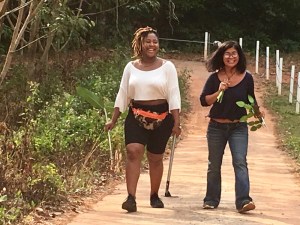
Steph went off with Kang, a hoe, and some secateurs to find galangal root and kaffir lime leaves in the jungle. Star and I were wearing sandals unsuitable for scavenging in the rainforest, so we watched butterflies fluttering above the canopy, and listened to the birds around the banana trees.
Lemongrass, chilies and garlic came from the garden where Durian trees also grow. We were making green papaya salad.
We began by taking a meat cleaver to papayas, inflicting a thousand cuts and then scraping off the shards into a bowl. We found it hard work, but our Thai hosts did it in seconds. The carrot was grated in a more ordinary way.
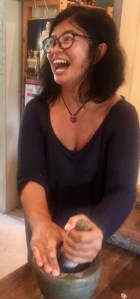
We made the dressing by first by adding dry peppercorns and cilantro seeds to the mortar and pounding them.Kang had suggested we peel about 15 cloves of garlic to do all three portions. The girls misunderstood and added 17 cloves to the mix for just one bowl. Oh well. Then fresh chili, plus coconut sugar, lime juice and fish sauce. Papaya, carrot, snapped green beans and some tomato quarters—all the salad ingredients were mixed in the mortar. On the plate we added some roasted peanuts and tiny dried shrimp and fish for crunch.
The salad– my favorite– was zingy and spicy and refreshing but had been surprisingly labor intensive to make.
“But they must make great bowls of this in restaurants and just dole it out?” I said when Kang said the salad should always we eaten moments after it is made.
“Most Thai cooks can do it in 30 seconds” she laughed “they make each order fresh. You’ll be quicker the next time you do it”.
Then we made Prawn Penang. Into the mortar went pepper and cilantro seed, then cilantro root and lemongrass, followed by garlic and dried chilies. They took a lot of pestle pounding. A few shallots,some cumin, shrimp paste and a few dried shrimp mixed with the hard-to-gather fruit of the kaffir lime tree.
A kilo of shredded coconut meat was mixed with about a liter of warm water. We mixed and squeezed the cottony mess, and then strained the milk into a pan. Our own fresh-made coconut milk. We pounded some already roasted peanuts to a gritty powder in a separate mortar.
The curry paste was added to hot pans and mixed with a little of the coconut milk to make a terra-cotta colored goo. Then the shrimp and more coconut milk and some stirring. Then fish sauce and a little raw sugar. The peanuts. More boiling and stirring until the sauce thickened. Thin shards of lime leaf and whole cilantro leaves to garnish. We ate it with sticky rice steamed in a double boiler that involved a palm leaf basket set into the lip of a boiling pan. The lid of the pot went on top of the rice in the basket.
Time to make Tom Yam Gai. More chopping– chicken, galangal, lemongrass tomatoes. Lime leaves to tear. Cilantro too.
Into the pot went the galangal, lemongrass and lime leaves, and lots of coconut milk. Add the chicken to poach, and stir the mix a few times. Kang then put the soup in bowls and invited us to add our own fresh chilies, smashed with the side of a knife blade. The squeeze of two or three halves of lime. A tablespoon or two of fish sauce. A handful of chopped cilantro. The result was aromatic and comforting– the food of a healing God.
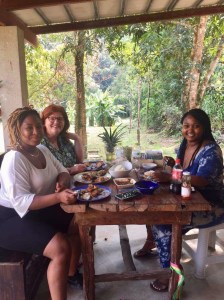
Steph and Star and I have different ideas on what makes a good holiday, but we all love Thai food. Today was a great day for all of us. We came home and slept. Kang’s Homebar Jungle Cooking experience costs 1500 baht per person. You will make and eat four dishes. Kang will pick you up from your hotel on Koh Chang. She is a former restaurant chef who now prefers jungle life with her two dogs Princess and Olive.
I had seen the sign for Dan Mai seafood from the main road when we passed in our songtheaw the other day. Today seemed a good time to check it out. The girls had abandoned me for a much ritzier beach, and were making their own dinner plans. The late afternoon was reasonably cool. I decided to walk.
After about 15 minutes on the main road, I turned right towards the sea, walking past a large school painted bright blue, pink, orange and green. Lurid, but much more alluring than the grey concrete walls of many Western schools. A couple of little girls playing in the street shouted Hello after me, keen to show off their English. The road found a small river going down to the Gulf. The banks were lined with fishing detritus and a few small boats lolled in the almost still water. There was no one around.
I began to worry that the sign had said only seafood, and not seafood restaurant. The village was obviously not any kind of tourist center, and most of the houses were boarded up and falling down. I was getting very sweaty.
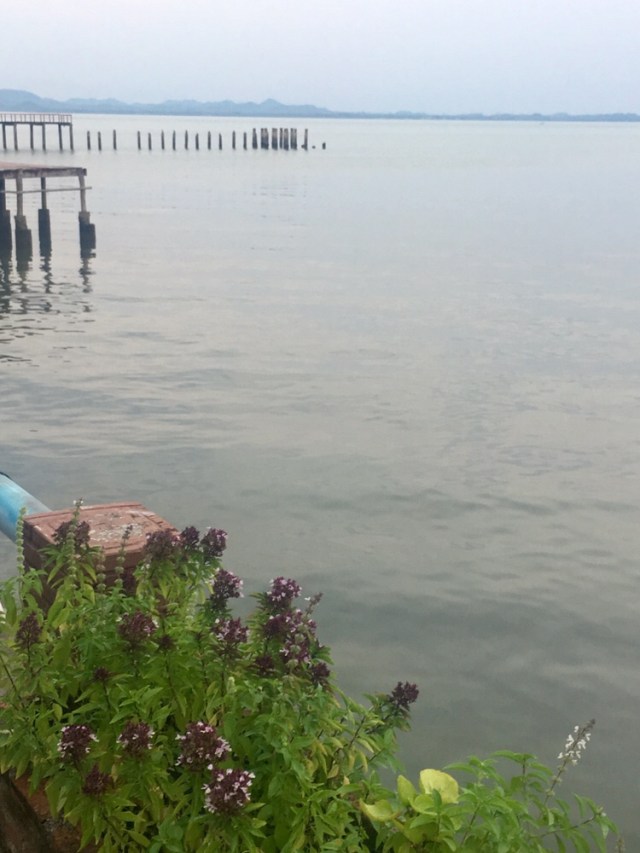
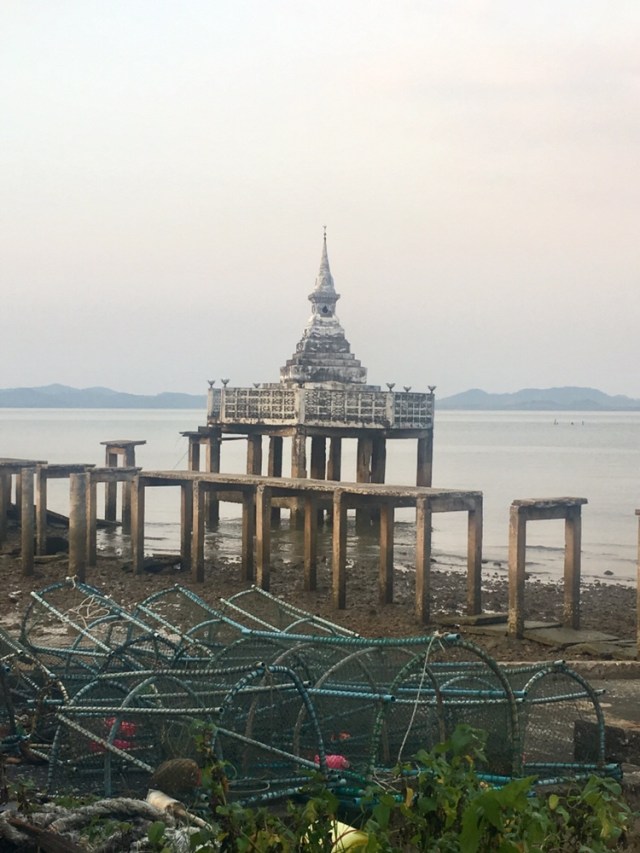
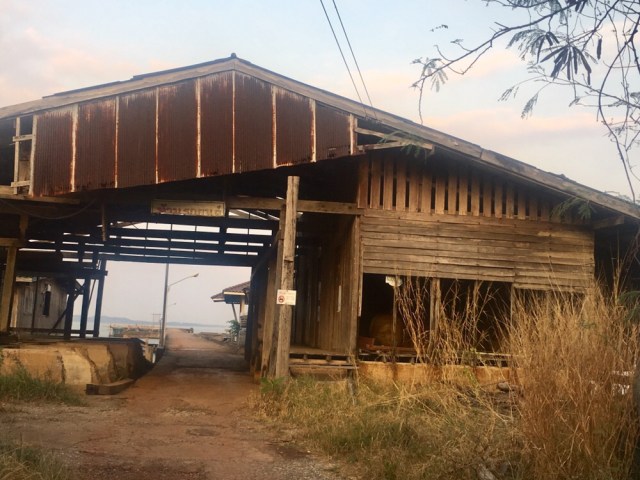
A tip-tilted seafood sign with an arrow could have been suggesting either of two directions. I walked on towards the water– tumble-down buildings on a disused pier, the remains of what might have been an old fish market, and a shrine in the water I thought was made from shells.
I turned back towards the second route suggested by the sign and wondered how I would ever get back to my hotel from this place– I had been walking much longer than I intended, and it was clear there were no taxis within hailing distance.
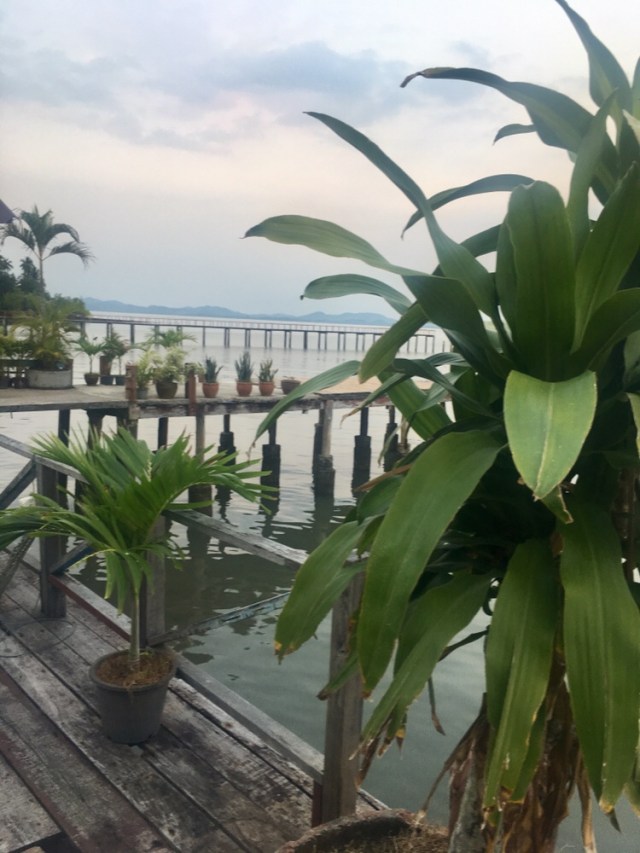
I kept walking and by the water I saw long, low buildings lined with plants. One woman about my age was sitting at a table at a deck on the waterfront. It didn’t look like a restaurant but seemed so charming that I decided to investigate.
“Restaurant? ” I asked
“Seafood?” She replied in that Thai intonation that doesn’t let you know if they are asking you or telling you.
I decided to sit down anyhow. The woman, who I noticed was wearing what looked like expensive frames for her glasses, got up and disappeared into one of the shacks, emerging with a very comprehensive menu in Thai and English.
I ordered Tom Yum fish and crab in yellow curry, and a beer. There was no one else around, but it was only just getting dark, so perhaps I was too early for the rest of the throng?
From the shack, the sound of two voices and some determined action with a pestle and mortar.
The crab– a couple of hard shells chopped into quarters arrived first. Sweet, messy and delicious.
It was dark by the time the fish steamer was set down, together with a second plate for all the debris of lemon grass, galangal, tail and bones. I had another beer and decided to wait to see what would happen next.
Nothing did. It seemed likely I was the only customer for the evening, and my host in the classy specs seemed fine with that.
Now there was only the issue of how I would get home. It was pitch dark and the track was pitted with stones and potholes.
“Taxi?” I asked.
Much gesturing and excited talk that led me to understand a taxi might pass by on the main road, but there was nothing in the village.
Then out of the gloom a young woman appeared, keys in her hand. I don’t know where she came from, or who she was. The older woman didn’t seem surprised to see her, but neither did she greet her. What was she doing there?
I said the name of my resort in a tone of inquiry mixed with supplication.
The young woman gestured to follow her. She took me home, right to the door.
I looked up the place on Trip Advisor. It didn’t have enough reviews for a rating (until I posted mine– the 6th) but the tiny number of us who have eaten there have all raved about the food.
I’d go back, but I am tempted to believe the whole experience was a mirage– a Mary Celestial evening where a deserted restaurant was operated by angels, as a special miracle for me
Soi 18. Sukhumvit 36. An unremarkable Bangkok alley that we came to believe was the magical creation of Thailand’s Lewis Carroll or CS Lewis. We’d booked a couple of nights in the Rembrandt Hotel to give our spines the chance to unroll after our long flights. The hotel helpfully put a third bed in one room, and went out of their way to make us comfortable.
Just a step or two from our hotel, our first good food find. P Kitchen’s cheerful staff served an astonishing range of fresh-cooked food with great depth of flavor. Stephanie ordered mussels with garlic, lime and cilantro. These were served cold with all the garnish piled high on each mussel shell. It hadn’t been quite what Steph had expected, so she approached the first half shell with caution.
“Whoa” she said “Try this”
Star did, and then urged me to have one.
“I’m not sure about cold mussels for breakfast”, I said slightly stiffly. My spine still had some way to unroll.
“No honestly — do it. It’s intense. Refreshing. Really good”
It was— like the jolt of a shooter and the joy of the first chew of a citrus Starburst.
“What’s yours like Ma?” Star gestured to my plate of fried morning glory with a side of red onions in rice vinegar, fish sauce garlic and chili.
“It tastes like air”
“Like air? Let me have some”
The curls and squiggles of green were caressed by a water- washed sunset tempura batter. These were hard to transfer by fork or spoon. All the more for me.
There was so much we liked the look of on the menu that we came back two or three times. We still hadn’t ventured more than 100 yards from the hotel, and it was tempting to stay put.
Culture called however and so on New Year’s Eve we left Soi 18 to take a trip to the Grand Palace. Not one of the taxi drivers was using a meter because the traffic, even by Bangkok standards, was spectacularly bad. We dismissed two drivers who were just being silly, and came to an agreement with a third. We soon worked out why the traffic was so hideous– every Thai seemed to be on their way to temple. We shuffled our way through the turnstiles at the Palace entry and followed the directions of patrol cops with whistles as we moved around the grounds. It was still possible to get good pictures, but only by looking up. Luckily much of the spectacular detail stretches towards the sky. Even the monks have iPhones now. I saw two taking each other’s photos, though they seemed to draw the line at selfies. Good luck with all the “no touching” business in that crowd.
We never saw the Emerald Buddha. There was just too much of a throng. The next taxi driver we negotiated with, managed to trap three of my fingers in his roll-up window, which he chose to close as we were getting into the car. I’ll have a black nail to remind me of this for quite some time.
My memory of Bangkok in the ’90s was that it was all scooters and Tuk-Tuks and buses, with the air a constant black-grey fug. Today there are more cars than any other form of transport and what felt like slightly cleaner air, although we all suffered some dry hacking from the back of our irritated throats. Street signs too have changed. They are in Latin and Thai script today, which makes the whole experience much less overwhelming. Thailand has definitely got the hang of the tourism thing.
No transportation issues at the long tailed boat tour, but I did manage to stumble off the narrow path through the orchid farm, and thus into ankle-depth black mud and green slime. That’s the end of those white sandals.
Reluctantly, we decided we really should venture beyond P Kitchen on New Year’s Eve, but we still found it impossible to make it past the end of the Alley. The Lean On Tree had soft shell crab curry and sea bass poaching in a hot and sour sauce. The restaurant served cocktails. We felt a little disloyal but perhaps we liked it even more than P Kitchen?
On the 31st, in order to maximize space in their rooftop bar, the staff at the Rembrandt had removed all the chairs and scattered spandexed and lurexed hi-top tables where the chairs used to be. When I explained I had trouble standing, the bar manager immediately arranged for the return of an armchair. I sat in state close to a DJ who had almost certainly checked X in answer to the gender question on the hotel’s application form. He or she had blue hair, an enviable waist, and great taste in techno music. The kids criticized me for my shoulder moves saying that all great dancing requires a lead from the hips. I ignored them and grooved in my granny chair. We were up until past 1am. Jet lag was working in our favor.
Star had arrived in Thailand with a bad cold– and a bottle of NyQuil spilled all over the clothes in her checked-in bag. The bottle, which she was sure she had closed with a childproof click, was missing its top completely when she opened her case, and everything she’d packed was stained and sticky. The woman above a small reflexology shop on the Alley offered a laundry service. Everything arrived back on New Year’s Day, immaculate, folded, ironed and wrapped in plastic.
We lunched at the Palm 18 Cafe in the Alley, decorated with cloth light shades in bright colors and walls appliqués with large paper cabbages. The flair expended on interior design sadly did not extend to the kitchen. The food was fine, but not interesting.
“It’s the kind of Thai food you can get at home” Star pronounced “Starts ok but goes nowhere. Bland. Ordinary. Made to make money, when it should be made for love”
On the plus side the cocktails were divine. I had a Na-Palm, a concoction of Thai whisky and fruit juices, described as a perfect afternoon drink. Stephanie had a drink in aquarium colors and Star had a Pina Colada. Her sophisticated taste in food is counterbalanced by a love of sweetie drinks.
The girls went to the hotel pool and I opted for a Tiger Balm massage at Dao in the Alley. Most of the other people being stretched and skewered and pummeled were Thai. It is to be hoped that they weren’t put off by my involuntary cries during much of the neck and shoulder and lower back work. I asked for a liberal application of Tiger Balm, advertised inevitably by Tiger Woods. Star hasn’t felt the lack of the spilt NyQuil because she has my deteriorating joints to sniff. My full-body embrocation could clear all the congestion in Bangkok itself. And of course a bowl of red curry is also helpful when it comes to sinus therapy.
Although there was now no imperative for clothes shopping, the girls decided that a trip to a night market was still warranted. We left the Alley soon after dark, and tussled with a couple more taxi drivers until we found one prepared to run his meter. The market was a bust– filled with faked designer brand watches, sneakers and belts at what still felt like ludicrous prices, and tat that now sells more cheaply at Walmart or Matalan or Claire’s accessories. That’s the trouble with the western world –anyone can get anything anywhere– it takes the fun out of holiday bargain hunting.
The vibe at the market had changed since I was last in Bangkok more than 20 years ago, although mounds of unwanted elephant-patterned drawstring pants still remained. This is a garment that does no-one any favors. In the ’90s, there was a constant scrum of vendors swarming each tourist. Now they wait to see what a shopper touches because she cannot resist. Even then, today’s vendors will wait for an inquiry about the price, and then turn the question back on the prospective buyer:
“What will you pay?”
No suggestion of “for you I make evening price”. I found it disquieting.
Stephanie bought a pair of sunglasses. They’d better be Dior for that’s $12 she’ll never see again.
Leaving the market, we took a disappointing turn and found ourselves in what must be the only stretch of street in Bangkok without a restaurant. Whether it was the after effects of the massage, the many steps at the Grand Palace, or an ill-fated attempt to jump over Star’s suitcase when she left it blocking the bathroom door at the hotel, my back and knees ached. We all wanted to sit down and eat. Eventually we spotted a rainbow-bright sign for a rooftop restaurant accessible by a series of escalators, or by an elevator in a spa.
The early signs weren’t good. The young waiter, who seemed to be working almost alone, was bent in near-constant apology. The extensive menu was printed in a jumbo font so it could be read in the dark. The first two dishes we asked for weren’t available. The Mai-Tais (when they came) were heavy on the orange juice and light on liquor. From there it only got worse.
Not once but three times, a waitress wordlessly dumped a dish we hadn’t ordered on our table, each time turning away before we could point out the mistake. The first was a bowl of fries. The second a chicken dish that Stephanie ate some of, so we could be sure it was something we didn’t want. The third was a large plate of chicken satay. By that stage the ever-so-humble waiter was forced to travel from table to table asking who’s order he’d misplaced, and trying to drum up interest.
Star, half-asleep, had lost all enthusiasm for her cocktail. I decided to move to beer, and Stephanie asked for a shot of rum to see if it could pep up what was left in her glass.
“A rum and coke?” asked the Asian Uriah.
“No, just a rum” said Stephanie, gesturing towards her glass.
We reminded the waiter a second time, about 10 minutes after this exchange. At no point did anyone ask “dark or light? or Thai or Jamaican?” This was not a problem. By then anything would have done.
By the third pass I had decided to be firm.
“Bring us the rum now and check on the food. We have been waiting an hour ”
The waiter scuttled off and came back with a colleague bearing—yes, a rum and coke.
I’m afraid I bellowed at them both.
I finished with another exhortation to bring us our food– although anyone else’s order would have sufficed. The waiter backed away only to return a few minutes later to say another part of our order was unavailable. It seemed our ticket had still to reach the kitchen. Any kind of cooking had yet to commence.
We gathered our belongings
“You can give us the drinks for free” I said “we can’t wait any more”
“No ma’am you have to pay for the drinks, but you don’t have to pay for the food” said the waiter, suddenly showing the beginnings of a spine. Too late.
On the way out of the restaurant we passed the second waiter carrying a glass of rum.
“Too late” I said. He turned away. For a minute it looked like Stephanie might go after him.
As we got into the elevator, a policeman was getting out, presumably to apprehend another group of frustrated would-be diners who’d refused their drinks bill. We exchanged good evenings with him and descended, crossed the spa floor and left the restaurant. It took us a couple of goes to get a taxi driver prepared to use his meter.
By the time we got back to Soi 18, me still savage with hunger and the other two silent and tired, P Kitchen was closed.
“See you in the morning” said our favorite waiter, trying to sound upbeat. He could see our disappointment. Too late.
We walked to Lean On Tree as fast as we could. They had just closed, but because they knew us, they agreed to rustle up a soft shell crab in tamarind sauce, and a couple of red curries. It pays to have friends in the alley.
We had breakfast this morning at P Kitchen. A green curry with shrimp and roti. A shrimp yellow curry. Shrimp fried rice wrapped in an omelette and served with a chopped fresh chili relish.
As we left, a sous-chef in charge of cutting and squeezing a big bag of at least 150 limes turned to us and smiled.
“See you next time” he said. We are allied with the Alley.
Mistletoe. Ara didn’t know the word until today. He’d never noticed the parasitical plant before. He’d never heard of its association both with Christmas and kissing.
I had wanted to visit a church with 17th century frescoes. It’s a long way South, right on the border with Iran, and so we set off early. We hadn’t been driving for more than five minutes before I spotted the mistletoe, the first I have noticed in Armenia. Divine or Druidic intervention? Who knows? Either way, it seemed like a good start to Christmas Day.
The Mistletoe trail soon turned to a vale of tears.
Ara pointed out villages that had once been peopled by Azeris– houses now empty for more than 20 years, since their owners fled
We drove through the village of Shurnukh, where Armenian flags still fly.
“This village was empty during the war” said Ara “it wasn’t safe to be here. The Azeris were firing missiles from just over there”
He told me the story of a friend’s father in another village close to Goris.
” He was hit by a missile and killed in the street” he told me, and then showed me the road to a lake where another disaster had struck the same family.
“Artak’s brother drowned here on a school trip” he said “Another boy died trying to save him. Artak’s mother was there. She saw it all, but there was nothing she could do”
I shivered thinking of all the terrible Christmases that family had endured, but worse was still to come.
“We drivers call this the “bus turn”. After the war in the nineties there were a lot of mines along this road. A bus took a wide turn one day and hit a mine hidden by the side of the road. The driver couldn’t have known. Many, many people died”
I began to feel glad I hadn’t asked Ara to jump over a barrier to pick me some mistletoe.
“And just here. A monument to two young men killed in the April war.”
That was only three years ago– a four-day spat with Azerbaijan over Nagorno-Karabakh. Today the sun shone. The sky was the blue of the Virgin Mary’s stole. But the ground all around us was black with wasted blood.
On the way into Kapan there is what looks like a beautiful lake. Today the snow-capped mountains of Iran were reflected in the water. We stopped to take photos.
“The lake is poisoned” said Ara “it looks beautiful, but it is toxic, filled with run-off from the copper mine.”
We stopped at Vahanavank Monastery for a little solace. Here the dead have lain undisturbed for 10 centuries. There were people here for many, many years before that. There is evidence of Bronze age settlements from nine hundred and something BC.
Past the dispirited mining town of Kajaran, enlivened a little by a Soviet-era statue of a bear with a key in its mouth. Up, up into snow-covered mountains. We had been traveling for nearly four hours and were more than 2300 meters above sea level. Huge trucks carrying sheep were heading for Iran. These sheep will shipped all over the Middle East– Armenian lamb is said to taste sweeter than that raised in drier climes. The sheep are exported live and so the trucks are covered with a sort of twiggy thatch. They poor things can’t see out, but the air can get in. This way to the halal butcher.
The sheep will never know it, but the road passes through the most stunning scenery. The landscape changes every hour of the trip. By the time we dropped down from the mountains I felt that all my available breath had already been taken. And then I saw the jagged mountains of Iran stretching into the sky. And the last persimmons growing on roadside trees. And picked fruit drying in long strings hung on balconies and landings. Kiwi fruit were growing outside the church.
We were the only people in the church with the restored frescoes — which are beautiful and were worth a visit even if every inch of the rest of the trip hadn’t been so interesting. We touched the paintings. There was no sign that said not to. No noticeboard with information. No postcards.
We sat in the sun and had a picnic of lavash, green beans and white cheese. Ara had brought some wine so we could have a Christmas toast. The sun shone. In Kapan we stopped for a festive glass of Armenian champagne with another volunteer and her counterpart.God rest ye merry Gentlewomen. We got back to Goris to see the Christmas tree lit in the city square, and in time for the fireworks. A pretty good Christmas I’d say.
These students,aged 12-17 , are sassy and smart. They are united in a desire to use their spirit, brains and charm to propel themselves into the best universities and jobs–building blocks for the future. Our kids are cultivating confidence in spoken English; the ability to ask good questions and provide intelligent, original, innovative answers; and a certain public poise, because they know these attributes will help them stand out from the crowd.
Our students- 1300 of them in 2019–are not privileged kids. Far from it. Hundreds of them live in border villages overlooked by army outposts, in houses that bear scars from shooting and bombing. The majority live on food that is grown in their own backyard. They are looking forward to New Year because the holiday means there will be pork butt and chicken on most tables–a welcome change from the usual cabbage and potatoes. These are teenagers who share a bedroom with their parents, or their siblings and their gran. They look after younger brothers and sisters. They help their dads chop wood. They bring home the cows.
Because Armenia has almost 100% internet connectivity, most of these kids — and their classmates we don’t yet know–can spend some time online, either at home, on a phone, or through a computer at school.
For this reason — and to help our bright sparks develop digital skills beyond selfies– our organization is working with X-Tech and Peace Corps to launch a poetry contest web app. We hope you’d like to get involved. Here’s how.
make the contest truly accessible to many thousands of English language learners in forms 7-12 in public schools across Armenia. 1300 is the most we can cope with in cars, on buses,and in school halls. 1300 is the most that judges in 13 regional centers can listen to in person. 1300 is the maximum number of mouths we can feed. But if we can hold a preliminary round of the contest online, we’ll then the sky’s the limit. Everyone can take part–and the very best will make it to the stage. Think Armenian Idol. Think Armenia’s Got Talent. Think X-Factor (although Armenian has no X–39 letters and still no x). And you can be an online judge– wherever in the world you are.
Help our savvy communicators become truly smart with their phones, developing the media and digital skills that are essential for so many jobs today. Oh sure, every teen can point their camera phone at their friend — but how many think to turn it sideways? Who notices the overflowing bin in the background, the traffic noise, or the light pouring in from the window? Who thinks about framing and zooming and angles?! Our in-app hints and tips can build new awareness and new skills. Here most teen videos are shared by Facebook. But many teens don’t know how to share the video with a non- Facebook user. Or how to upload it to YouTube. Oldies may scoff, but these skills are useful if you want to work in marketing or communications–in Armenia or anywhere else in the world.
Asking students to register online and upload a video performance allows us to share important information about privacy and personal security. Our judges can’t know a student’s name and where he or she comes from because that wouldn’t be fair. But there are other reasons not to show or tell that information on a video, ever. Working with us is a good way for our students to learn best practices.
Our kids are not sick. They are not sad puppies, or victims of any sort. That may mean they aren’t top of your list for giving, and we respect that choice. But if you’d like to know more about how you can be part of the growth and development of Armenia’s brightest and best, please click here. Thank you for caring.
It isn’t every vegetarian who willingly accepts an invitation to a Khash breakfast. Khash is a bone marrow broth made with cow’s feet. The feet soaked for twelve hours in a large basin in my kitchen, and then were added to the pot to simmer overnight. The water was seasoned, but only slightly. Vegetables weren’t involved.
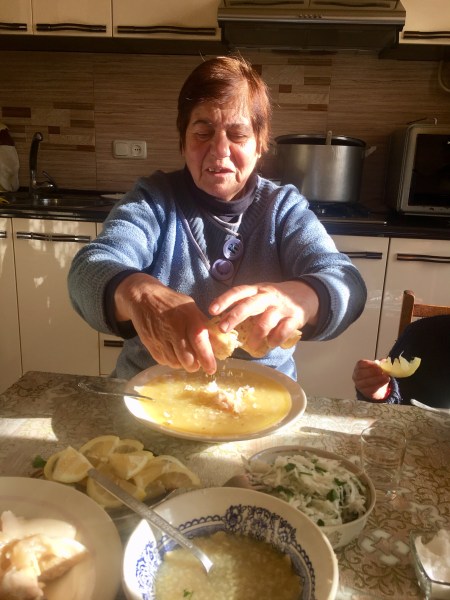
This morning upstairs, Haykush minced many cloves of garlic and mixed them with oil. She made a salad of grated kohlrabi and flat parsley. More kohlrabi and herbs were put on the table, together with homemade gherkins, a couple of sliced lemons , and rolls and rolls of lavash that had been crisped in the toaster oven. The pot was carefully carried upstairs.
Breakfast was served about 11am with tots of mulberry vodka. Aleta couldn’t drink the vodka and had to avoid the garlic because it is her Aunt’s wake this afternoon. She contented herself with sucking the jelly off one of the ankle bones– at least for now.
As I was handed my bowl of the sellotape -yellow broth, I wondered if I would be up to the challenge. The first spoonful was tricky– greasy and redolent of the farmyard, but without much flavor. I followed the family’s lead and added four large spoonfuls of garlic and two pinches of salt. I tore the lavash into old-penny-sized pieces and floated them in the soup. It went down a lot easier after that. There isn’t much that’s not helped by garlic and lavash.
Every so often we had a slice of lemon, a gherkin,or the kohlrabi as a palate cleanser. There were toasts for good health, the cook, and the new year. The vodka made Haykush’s cheeks red and warmed her bones.
“Eat” she told me “Khash will help your sore knees”
Much to everyone’s relief, I passed on the chance to suck the jelly from the bones and chew the tender meat. More for everyone else.
I am a Khash survivor. I might go back to bed for a bit. Shame I am unkissable this Christmas.
We weren’t off to a good start, which was a shame as I had been looking forward to this day for weeks. I had imagined driving over mountains and through gorges with Ara, stopping here and there to take pictures of the glorious winter scenery. Visiting schools to wish the kids a Happy New Year (which comes before Christmas here–Christ’s birth is not celebrated until January 6), and to enthuse them about next year’s Poetry Contest. Perhaps a cosy late lunch in Tatev if our timings worked out right…
But a sea of mist covered all the lower ground, and the mountain roads were bleak and icy. We crawled along the road to Khot, Ara doing his best to keep the windshield clear, and avoid the worst potholes as they loomed up out of the mist. The only car we saw was a green Lada which had spun off the road and into a field. 3 akbers (bros, or mates) were smoking, cursing and stomping their feet on the frozen earth as they tried to work out what to do next. Any driver other than Ara would almost certainly have banged into a second car which had stopped to see what was going on–right on the corner where the accident occured.
“Stupid to stop where people will skid” observed Ara “and of course no lights”
We encountered no other traffic.
The school director in Khot gave us a warm welcome. Her school was at the end of a frosted, muddy path but still she wore immaculate high-heeled black boots and trousers to set off her camel sweater with pearl buttons, a coffee-coloured kerchief, and a very chic dark blonde chignon. She bade us sit at her office table which was filled with African violets in bloom.
We protested that we’d eaten breakfast. Only one of us was telling the truth.
English teacher Shoghik had gathered her 12-17 year old students together so we could talk about the contest. In a warm, cheerful, Christmas decorated classroom, students recited poetry in English and Armenian. Both boys and girls volunteered to take part this spring. I mention this because in most schools the boys loaf and rough-house at the back of the class. It’s not just poetry. It’s not just English. They do it in every class and usually the teachers tell me to ignore them.
“They know nothing. They learn nothing. They will not get involved in anything”.
I have lost count of the times I have been told this. Other volunteers report the same. The boys have given up and their schools–and often their parents–have given up on them.
It was not this way in Khot. One boy volunteered to recite to the class, and did it very well. Another boy’s hand was the first in the air when I asked who would take part in 2019’s contest. It did the heart good.
Back in the director’s office, we were plied with thyme tea, belites–delicious puffed fritters of potato and flour–, the promised zhingalov hats, fresh fruit and chocolate. The day was looking up.
“The hot food came from our cafeteria” said Shoghik proudly “Our volunteer Cindy made the cafeteria happen a few years ago. The small children get a hot meal there every day”
The cafeteria is funded by the World Food Program and run by a woman from Khot who takes a great deal of pride in her work. The cafeteria and kitchen was spotless. A great pot of chicken bits and pieces was on the boil–the beginnings of a soup for lunch.
I have never met Cindy, the Peace Corps volunteer who made this happen. I have never even heard of her. I hope someone who knows her tells her that she is still a hero in Khot, and that the project she started is still going strong, many years after she returned to the United States. Cindy’s cafe gave me a much needed boost this morning. If Volunteers get it right, our work does make a difference. I have seen it with my own eyes.
The road through the gorge from Khot to Tatev usually offers amazing views of a steep waterfall, a ruined monastery and some of the most beautiful changing colors and layered mountain views anywhere in the world. Not this time . We took heart that a lot of work was happening on the road. Stone walls are being erected to safeguard against subsidence. There are signs that miles of asphalt may be on the way. As we wove and bumped and slid and revved our way down and up on the hairpin bends, we waved and nodded to road laborers working in the cold. After an hour’s drive on the churned dirt road it was a pleasure to meet with the delightful young women of Tatev who know the contest and want the chance to win the glory and opportunities that Ani and Lilit earned for themselves last year. More offers of tea and coffee–we promised we’d go back in February to take them up on this. It will probably take this long for the Khot belite to work its way through my tortured intestine.
After Tatev, a village I had never been to before. Martin, a 16-year old who lives there, has won national prizes in our recitation contest in past years. We were lucky to reach Svarants. A bulldozer working as part of the road project had whipped the road into a quagmire. Would we have to turn back? Slowly, slippery, we made it, tires coated in several inches of mud.
Svarants school was built to accommodate 400 students in the Soviet era. Then, there was an iron mine that provided work for the men in the village. Today, most of the houses in this beautifully situated village (1700 meters above sea level) are empty. Now, 15 students study at the barracks of a school. They are used to making the best of things in Svarants. All the way up the stairs to the one occupied corner of the building, house plants are growing in water bottles repurposed as hanging baskets. There are 4 students in Martin’s class. A teacher comes from Goris once a week to work with them on English for two hours. The English room displays only the Russian alphabet. The desktops are gouged with the names of generations of previous students. Everyone wears coats and scarves. Martin has made it to the final round for the FLEX program. In spring, he will learn if he has been selected to study at high school in America for a year. His achievements are remarkable.
The younger forms at the school had grouped together to put on a holiday show. I found myself the guest of honor and was glad I had a sheet of celebratory stickers in my bag–one for the coat of each child.
Martin gave me a plastic bag full of home-grown kidney beans as we left the school. The beans grown in Svarants are better even than those from Goris.
On the slow grind back through the canyon, the workers we had seen on the road called and waved to us. They had parked their giant trucks and were now squatting on the frosty hardcore, enjoying a late lunch.
“Come, sit, eat” they called.
“I’ll get you something” said Ara, and began to pick his way across the rubble. I left the warmth of the car to take photos
“Come, sit, eat” called the men again “we have cutlet, fried potatoes, cheese and beans. Will you have some vodka?”.
Usually I steer clear of homemade vodka because it is 80% proof and burns like bleach. But when was I ever going to be invited to a party like this again? I was handed an adorable cocktail glass made from the upended neck of a water bottle. I held the cap end, and drank from the rim cut with a penknife. I drank the vodka to cheers and claps. Ara declined because he was driving. This did not seem to have deterred the men with the keys to the giant trucks…
My lavash burrito of potato, red onion, white cheese and local beans with garlic was truly great picnic food. On the way home I marveled merrily at the natural decorations provided by frosted wild flowers. The trip wouldn’t be possible today. We had a heavy snowfall last night, and the road to the villages is closed.
The twenty-somethings in the room honestly had no idea what it was. Grant pulled the owl-patterned, flannel cover away from the neck of the hot water bottle and showed its rubbery lips, and the brass thread for its plastic stopper.
“You boil a tea kettle and fill it up with hot water” he said “then you cuddle it and it keeps you warm. Anyone want it? It came in a care package”
No-one did. They looked both mystified and slightly horrified that anyone would consider having such a thing at anything less than arm’s length. I couldn’t work out if they feared a scalding hazard or if it was the cosy covering that was repelling them. Owls did seem an odd choice for a sleep aid. Aren’t they famously up all night?
“But you’ve had hot water bottles growing up?” I said, trying to encourage them. No-one had. These Peace Corps Volunteers, brought up in centrally heated homes, had never seen or heard of such a thing before.
“I have one” I continued. “It’s covered in purple fur and it keeps me lovely and warm in bed. I can really recommend it”. This only seemed to strengthen their resolve to avoid any contact with the contraption.
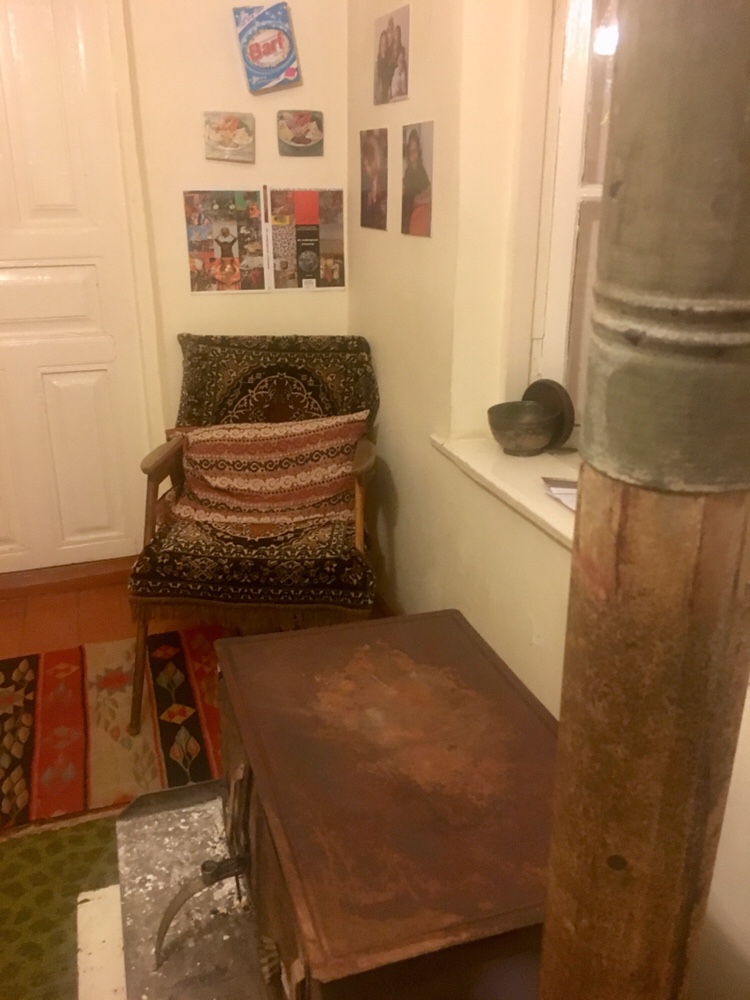
Here in Armenia there is snow on the mountains and every night the wind rattles the rusted sheeting and corrugated iron that patches our walls and roofs. Creatures scuttle, scrabble and shriek behind skirting boards, collecting what they can to keep themselves warm. Our living rooms are heated by wood-burning stoves, but firewood is expensive this year, and so we are encouraged to go early to bed. I am lucky to make it to 9pm. I usually wear a pair of tights under my nightwear—excellent for keeping the toes and the kidneys suitably warm. You’ll be pleased to know that I spared my young colleagues this detail. I imagine they wear yoga or ski accessories from sporting goods stores, or else risk frostbite, considering it preferable to a fashion faux pas. Better to be cold than uncool.
We had gathered, the young and the old, for a holiday celebration at Kate’s small apartment in a town on the main road south to Iran. Kate had made cookies—snickerdoodles, chocolate chip and brownies—welcome reminders of home. I made a vat of punch for under $10. Sparkling wine is about $2.50 a bottle here, and cognac is the national drink. Every family makes their own peach and apricot juice. Oranges are imported for winter. Apart from persimmons and pomegranates which grow wild here, they are the only everyday fruit at this time of year. Clayton had handcrafted personalized Christmas cards. Alex cut out tiny stockings to hang under a construction paper Christmas tree taped to the old plaster of Kate’s apartment wall. Kate hung a tissue paper wreath on the wooden door that protects her studio bedroom from draughts. Grant led a marshmallow and toothpick construction challenge (Alex won). Bianca wore reindeer antlers, and Allen sported a scarf that made him look like a handsome skater on a 1950s Christmas card. It was all almost unbearably festive—our own little family Christmas in our two-year home away from home.
At the village school close to one of Armenia’s most beautiful monasteries, celebrations were well underway. The 12th form girls were constructing a wall decoration with fresh pine branches. The younger kids had made a Santa for the door, although the fat one is not usually feted here. If gifts are given, it will be on New Year’s Day. When families overspend, it is on imported, special-occasion pineapples, kiwis, and special store-bought vodka to impress neighbors and relatives, and not on stocking stuffers for the kids. Apostolic Christmas is on January 6, but it is a religious occasion and no time for red-nosed reindeer, and elf-enabled excess. Then it was back to work. I listened to group of 13-year-olds labor through a story about a governess in English class. A governess? It is hard to imagine this vocabulary will get much use. The English-language materials here are old, irrelevant and inaccurate—a frustration for students and teachers alike.
16-year-old Nane and her mom and dad invited me to come to visit them in their village on the border with Nagorno-Karabakh, just as they did last year at this time. They live with Nane’s maternal grandmother now—their own house burned down a few months ago, one of four homes completely gutted after an arson attack by a neighbor with mental health problems. No recourse, no insurance, no place to call home.
“Where’s your granddad?” I asked, for I’d met him with Nane a year ago.
“He doesn’t live with us anymore” said Nane, upset. The family explained her father’s father can’t get to the outhouse at night, because it’s too far, and there is no outdoor lighting. When they moved in with their “other” grandma, he had to move an hour away, to live in an apartment with his daughter and her family. The house that burned was built by his father, and was the only home he’d ever known. Nane misses him, and he misses her. He’s been in and out of hospital since the fire. She’s had constant stomach problems, caused by stress. Nane’s mother cries as she pours the tea—made with thyme picked from the fields. Her grandmother squeezes my hand and thanks me for coming.
“It’s been terrible for them” she says, and I can see that it really has.
Nane urges me to try some rice, baked with home-dried fruits and local honey. This is winter comfort food, Armenian style.
Nane’s father, handsome, strong and sad, raises a glass of homemade vodka in the first of many toasts.
“2019 will be a better year” he says. We raise our glasses and drink to that.
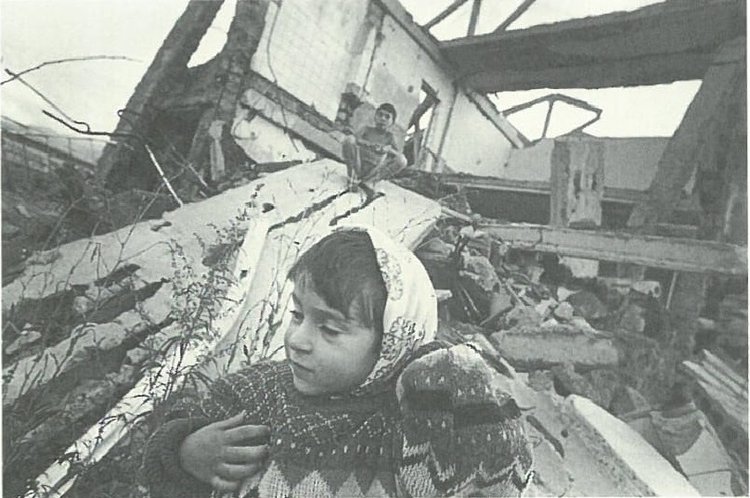
It took an earthquake to shake me out of yesterday’s bout of self-pity. The 1988 earthquake which, 30 years ago tomorrow, destroyed the town of Spitak, and wrecked the city of Gyumri, killing more than 20,000 people in the North of Armenia.
Vahagn and his friends arrived in Gyumri to find the city in ruins. He recounts getting off the bus and joining the rescue workers already there. They worked through the night in the bitter cold, taking breaks to lie on stones heated by small fires. Vahagn quietly retells how calm he was the moment when he found his first body. He would find many more. There was no water at the time, so in order to wash his hands, he used Pepsi-cola bought from a nearby store. Vahagn also remembers stores being looted, and facing the reality that he couldn’t stop all the looters. After three days of grueling rescue work in Gyumri, Vahagn went back to Yerevan to go to Stepanavan, his childhood home. On the way there, he saw the devastation of Spitak. There wasn’t a single building remaining. During the first few weeks after the earthquake, after seeing international rescue teams from Germany and France, Vahagn realized that Armenia needed a trained rescue service. A few days after returning to school, he found an opportunity to join one called Spitak, named after the town that was destroyed.
The account above is from Storybeyondtheruins.com,an oral history site launched by my fellow Peace Corps Volunteers Michael Chen and Max Malter in conjunction with a number of students from the American University of Armenia. The group interviewed survivors of the earthquake, making sure their stories are preserved for new generations of Armenians. The site will have audio interviews, transcribed stories, and photos from 1988. It is in its early stages, and it is important work.
Vahagn, whose story is above, now works at Peace Corps Armenia. He is Safety and Security Manager– a career choice inspired by the terrible disaster on his doorstep at the age of 17. I have heard a number of other people I know tell their stories of horror and loss: Peace Corps staff, a teacher and a principal involved with the poetry contest, a man I met at a party, and another in a class I was teaching. When you hear them talk and see and hear the emotion on their faces and in their voices, you wonder how they picked up and went on. They are Armenians–that’s what they do.
When you hear the figure 20,000 dead (in a country that now has a population of just under 3 million), it doesn’t really sink in what that means. But hear a woman–just a small child at the time–talk of toddling out of the house, following her mother who’d stepped out to see what was causing the rumbling noise. Hear that little girl tell the story of her infant brother crushed to death in his cot as the house fell in just seconds after she crossed the door. Imagine living the lives of that sister and mother after that terrible day… They will never forget, no one who hears their story will ever forget. It is important that the word gets out, and all these stories are told.
Outlook on the BBC World Service had a very powerful story yesterday, told by a woman called Anahit. She was a school girl in class at the time the earthquake struck. Eventually, she was pulled out of the concrete wreckage, her life saved by the dead body of her friend Larisa who had been tossed on top of her, saving Anahit from being crushed by a slab of stone. Anahit’s friend Garik died beside her before he could be rescued. Her brother, in another class on a higher floor, died too. So did their father. I know today’s Larisas and Gariks, young people the same age as those lost children were then. The tragedy is unimaginable. You can listen to the Outlook story here.
Children who survived the devastation in Spitak, December 7, 1988
Another Anahit told me of her niece—17 and newly married–who also died in Gyumri. Ara (in Yerevan–not Goris–it is a common name here) told me about his uncle, killed in Spitak. Ara believes that if the phone system had not failed, if the roads had been passable, they would have been able to save his uncle’s life. So many “what ifs” and “never to bes”.
If you are feeling down and blue today, hug your favorite people tighter and be thankful you have not had to go through what the dead, injured and living of Northern Armenia have endured. Keep Gyumri, Spitak and Armenia in your heart. Check back on Storybeyondtheruins.com or follow them on Facebook, and be glad every day the earth doesn’t come crashing in on you.
There are days when it is tempting to hop online and book a flight home. A flight leaving tomorrow. Today was one of those days:
A day when the person supposed to be my new counterpart messaged me to say she would no longer be coming to work. She lasted one week. The backlog of to-dos stretches for miles.
A day when many of the nearly 300 teachers of English and other volunteers I work with all also decided to get hold of me via Facebook messenger, their preferred means of communication. My screen looked like my head felt.
A day when the satellite phone I was meant to check wouldn’t connect, not even when I stood outside in the cold and jumped to fix the magnet aerial to the highest point on a wrought iron gate.
A day when the bedroom fixtures were draped with sodden clothes, which had had to be rinsed by hand as a result of my latest gastric emergency.
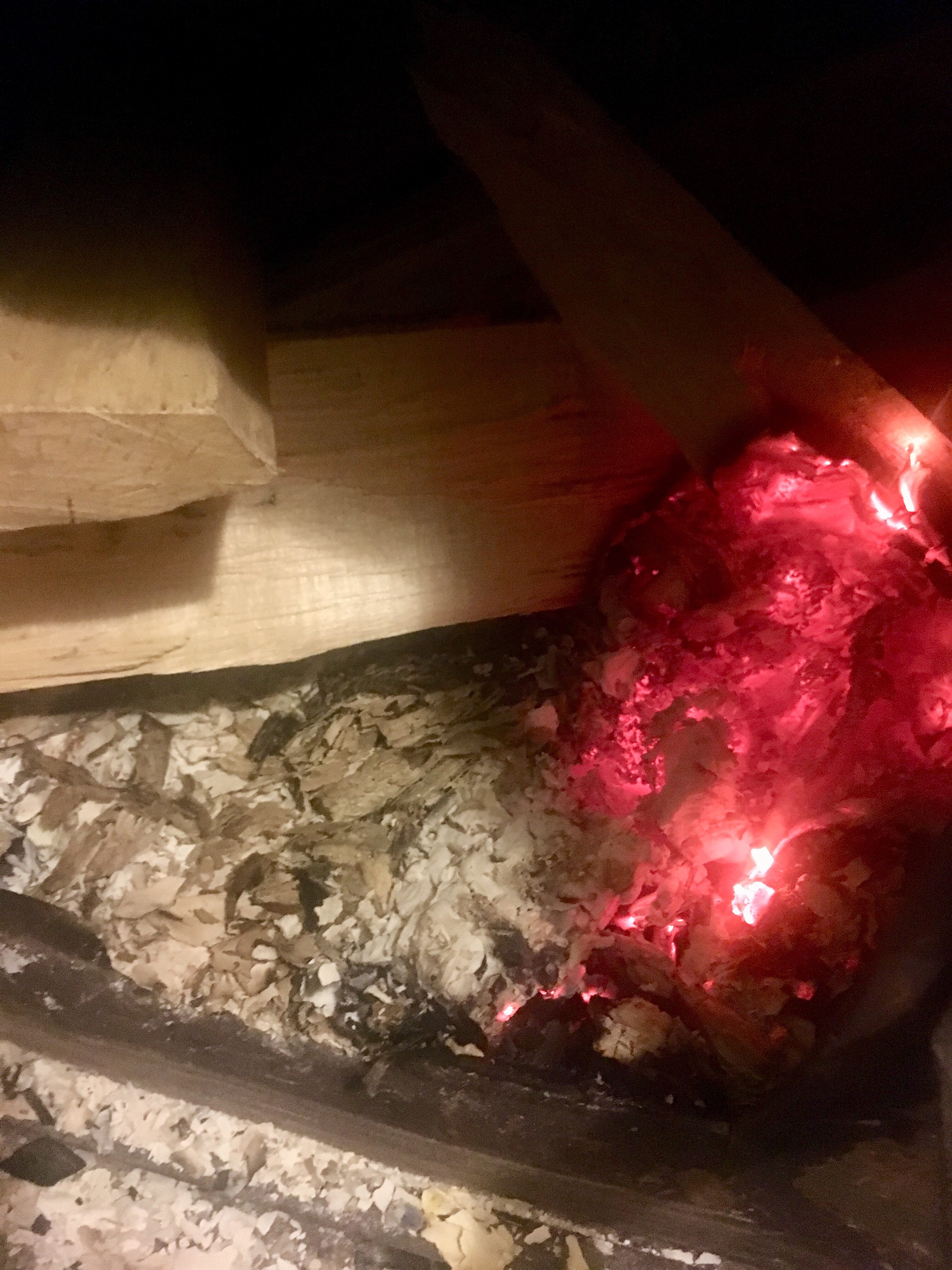
A day when the wood was too wet to catch light in the wood-burning stove. A day it managed to resist the wiles of even Aleta, the flame whisperer.
A day when I had half a cabbage to cook and precious little else.
And then Ara, my personal winemaker, turned up with a liter Soda bottle full of his latest press.
“I want you to have a glass of this one and compare it to a glass of the first type” he said “I think this one is better. Be sure to taste them both”.
I poured a large glass of each wine and you know he was right. The second one is rich and round and mellow with none of the fizziness in the finish that so characterized the first. I poured a second glass of the second wine, just to make sure.
Aleta sacrificed an old chair and a window frame or two to get dry kindling. The stove is now throwing out a rare heat. My clothes may be dry in a couple of days .
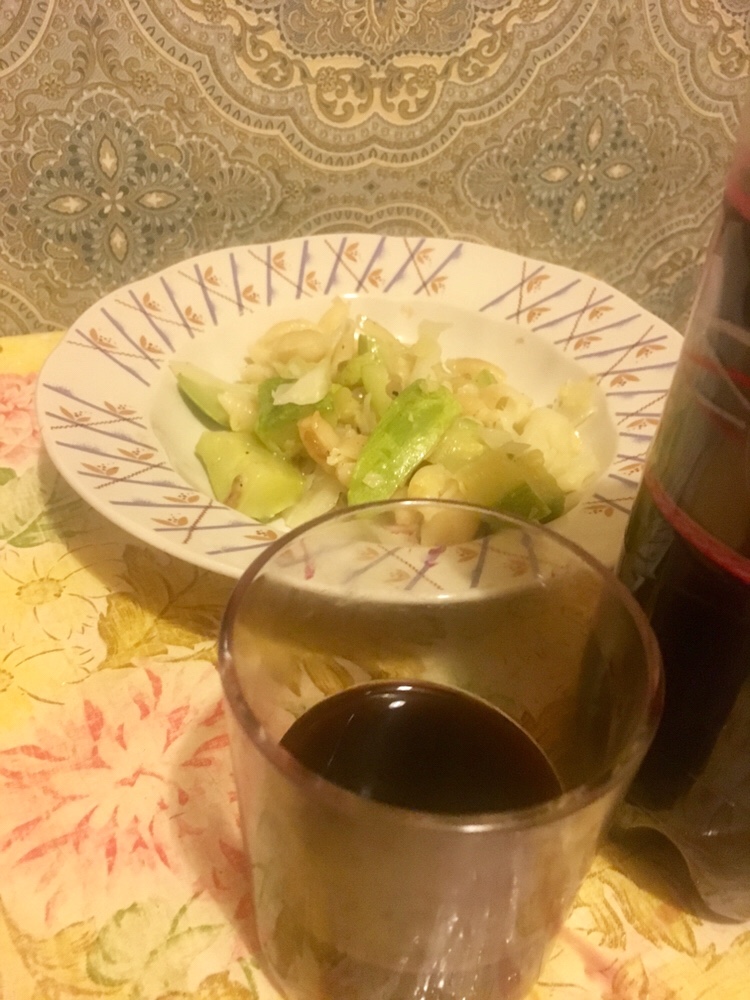
I found a zucchini lurking in the fridge. I chopped it and the cabbage and threw them on top of a pot of pasta shells and boiling salted water. I chopped and fried an onion and some garlic and added them to the drained pasta and steamed vegetables. I even managed to squeeze the last of the sweet chili sauce out of a care package bottle.
I found three sycamore leaves– brown, yellow and green– a really cute kid gave me at the weekend. I arranged them in my window.
I remembered to be glad that we have no actual emergency that would require use of the satellite phone.
I don’t think I’ll book my flight tonight but I’ll stay away from the computer just to be sure. Perhaps I’ll leave it alone tomorrow too…
 Steph went off with Kang, a hoe, and some secateurs to find galangal root and kaffir lime leaves in the jungle. Star and I were wearing sandals unsuitable for scavenging in the rainforest, so we watched butterflies fluttering above the canopy, and listened to the birds around the banana trees.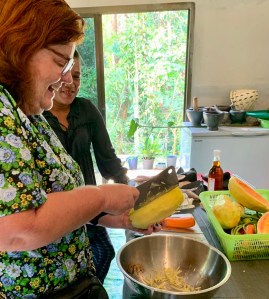
 We began by taking a meat cleaver to papayas, inflicting a thousand cuts and then scraping off the shards into a bowl. We found it hard work, but our Thai hosts did it in seconds. The carrot was grated in a more ordinary way.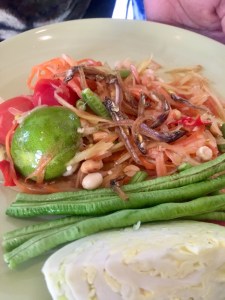
 “Most Thai cooks can do it in 30 seconds” she laughed “they make each order fresh. You’ll be quicker the next time you do it”.











 Although there was now no imperative for clothes shopping, the girls decided that a trip to a night market was still warranted. We left the Alley soon after dark, and tussled with a couple more taxi drivers until we found one prepared to run his meter. The market was a bust– filled with faked designer brand watches, sneakers and belts at what still felt like ludicrous prices, and tat that now sells more cheaply at Walmart or Matalan or Claire’s accessories. That’s the trouble with the western world –anyone can get anything anywhere– it takes the fun out of holiday bargain hunting.


 Ara pointed out villages that had once been peopled by Azeris– houses now empty for more than 20 years, since their owners fled


 a bear with a key in its mouth. Up, up into snow-covered mountains. We had been traveling for nearly four hours and were more than 2300 meters above sea level. Huge trucks carrying sheep were heading for Iran. These sheep will shipped all over the Middle East– Armenian lamb is said to taste sweeter than that raised in drier climes. The sheep are exported live and so the trucks are covered with a sort of twiggy thatch. They poor things can’t see out, but the air can get in. This way to the halal butcher.


 This morning upstairs, Haykush minced many cloves of garlic and mixed them with oil. She made a salad of grated kohlrabi and flat parsley. More kohlrabi and herbs were put on the table, together with homemade gherkins, a couple of sliced lemons , and rolls and rolls of lavash that had been crisped in the toaster oven. The pot was carefully carried upstairs.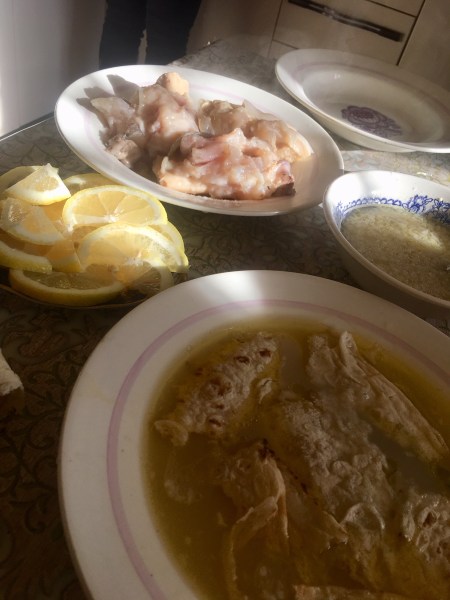


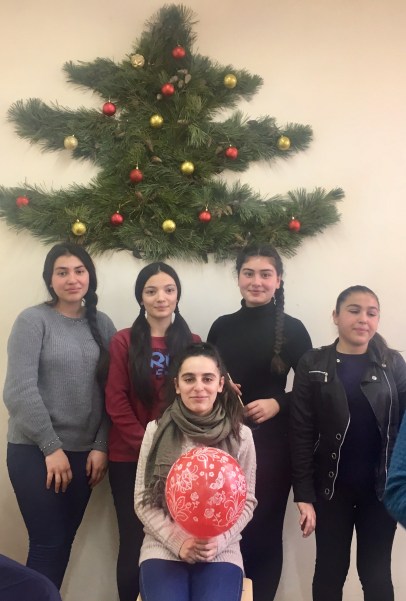 At the village school close to one of Armenia’s most beautiful monasteries, celebrations were well underway. The 12th form girls were constructing a wall decoration with fresh pine branches. The younger kids had made a Santa for the door, although the fat one is not usually feted here. If gifts are given, it will be on New Year’s Day. When families overspend, it is on imported, special-occasion pineapples, kiwis, and special store-bought vodka to impress neighbors and relatives, and not on stocking stuffers for the kids. Apostolic Christmas is on January 6, but it is a religious occasion and no time for red-nosed reindeer, and elf-enabled excess. Then it was back to work. I listened to group of 13-year-olds labor through a story about a governess in English class. A governess? It is hard to imagine this vocabulary will get much use. The English-language materials here are old, irrelevant and inaccurate—a frustration for students and teachers alike.




 Marigold Moment