The money is meant for pot-scrubs,a frying pan and perhaps a liter or two of bleach.Canny volunteers might invest in an electric fan to see them through summer, or a stout pair of boots for winter, plus a potato-peeler, a towel or two, and a bedside light. I refer of course to the $200 that Peace Corps provides to each freshly minted volunteer as they move to their permanent two-year site. It is called settling-in money and I seem to have spent mine on a dress, a porcelain tea-set, and some window paints. I did buy a kettle –oh and let’s not forget the box of fridge magnets depicting six Armenian women in various states of national dress. On reflection these were a mistake as I don’t yet have a fridge, or anywhere it makes sense to plug in a kettle. Armenian power outlets are few and far between, and in my house, oddly, very high up on the wall. I also invested in some pastry forks and about 25 meters of upholstery fabric. (I neither bake nor sew). The worst of it is that I am already wondering how I can do without dish soap, a bath mat and light bulbs in order to squirrel away cash that will one day amount to a hand-made carpet from Nagorno-Karabakh?
Peace Corps volunteers are, by their nature, minimalist. Many have already traveled the world with little more than a box of matches and a Swiss Army knife and most will tell you about their plans to divest the little they do have at the end of their service, because they plan to return to the States via Myanmar, or Gabon or Paraguay. They never travel with more than they can comfortably carry, and are strangers to bubble wrap. The Peace Corps has distributed a survey, asking us to catalogue how we spent our stipend. The results will let them know if they need to adjust the amount next year, should it turn out that volunteers are suffering undue hardship. I think I may be an outlier. Probably best not to submit my shopping list in case I spoil things for everyone.
I was walking back to my hostel when I tripped and fell. I blame a tarpaulin trailing from building site fencing. I slipped on it and ended up splayed on the sidewalk with two torn knees, a twisted wrist, and a scrape on the heel of the other hand. My entire face collided with the pavement and my nose gushed blood.
I had been walking back to my hostel following a most delicious dinner—roast chicken, baked potato and vegetable khorovats from a street BBQ vendor close to the fruit and vegetable market. Before you ask, I had had one large Armenian beer, water-weak and thirst-quenching, and I was wearing sensible shoes.
The street was dark and deserted. The shops sell wooden doors and coffins and close at 6pm. It was now about 9 o’clock. I got myself into a sitting position and tried to stop blood spilling on my dress and shoes. Damn, no hanky. Just as I wondered what to do next, a young woman appeared in front of me, dressed for a night out. “Do you speak Hayeren?” she asked in Hayeren. I am glad that I do. She didn’t have a phone but, by some miracle, I had mine in my bag and it was charged. I directed her to call my hostel, maybe 150 meters away, and ask whoever answered to come and scoop me up from the pavement.
By now, a car had stopped. A young couple got out, clearly very concerned. By now, there was a lot of blood and they thought that perhaps I’d been mugged. I told them what had happened and asked for a towel or some tissues. They had nothing. The woman spoke English and asked sensible questions about whether I had hit the top or side of my head. I had not. All the damage was front and center. She wanted to drive me to the hospital. I explained that my host was on the way to rescue me and with that he arrived.
Together he and the boyfriend of the English speaker hauled me upright and then steered me across the road and up the hill to the hostel. Back in the kitchen, he provided a wet towel, tissues, a glass of water, iodine and a mirror. I have reopened an old scar on my forehead (I have always been accident prone), a badly bruised nose, a thick lip and a chin with road burn. My teeth and glasses are not broken.
The iodine hurt of course, but otherwise, my face looks worse than it feels. I have no pain and slept well last night.
The man who rescued me is the son of the hostel owner. He was minding the shop while his mum and dad attended an out-of-town wedding. He couldn’t have been kinder and more concerned. He called his parents to tell them what happened and they phoned several times across the evening to check on my condition. I got an extra especially nice breakfast this morning. I’ll be back to stay with these lovely people again. They may want to up their liability insurance.
This was my second fall in a week, for last Saturday morning I crashed when walking home from English class. This one was worse in terms of ongoing pain and damage to pride. The sidewalks in Goris are uneven and perilous and so I usually walk in the road. But Mashtots street (named for the man who invented the Armenian alphabet) was surprisingly busy and so I walked downhill to the center of town using the sidewalk. This was a mistake. In one place the path was completely blocked by an inconsiderately dumped pile of gravel. I looked at the gravel and looked at the ditch, 18 inches wide and full of fast running water, sundry trash and weeds. The hill was steep and I decided it would be better to inch my way across the gravel where it bordered the ditch than to try to bridge the torrent and land safely on road with only one foot on firm ground. This was my second mistake. I slipped on the gravel of course, and ended up beached on my back, with one foot deep in the ditch. I was wearing a dress that suddenly thought to behave as though it were a t-shirt, stopping just below my waist. I felt pain in my right ankle and right knee, the ones lying awkwardly on the shale. An elderly man saw what had happened and crossed the road to help me. We both understood that my best approach would be to put the other, dodgy, foot in the water, stand in the ditch and then have the ancient pull me on to the road. This took several attempts and caused quite a stir as cars rode by. At least they slowed down. I limped home, squelching. My arthritic knee still aches and my cankle is the size of a swede.
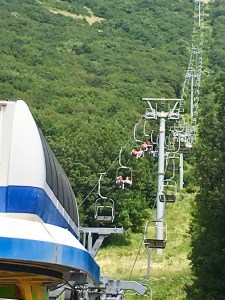
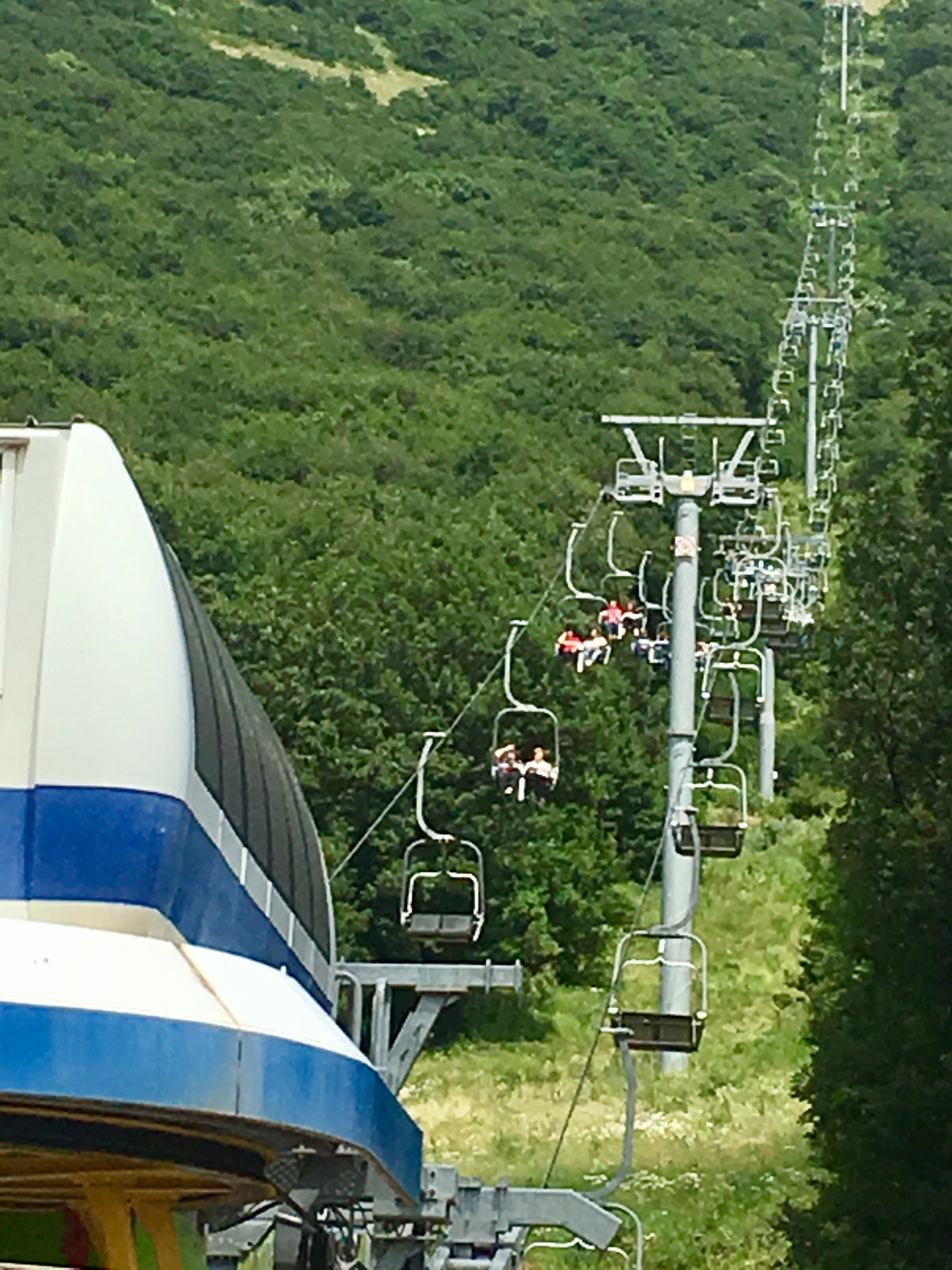
When I first heard I’d been accepted by Peace Corps, my worst fear was falling. I imagined it would happen in winter, and that snow and ice would be involved. Four months in, and at the height of summer, I have already fallen twice. I have also engaged numerous friends and strangers to hold my arm on steps and narrow stretches. On the cable car in Jermuk I screamed so loudly approaching the step-off points both top and bottom that they stopped the entire contraption each time to help me off. Thank goodness it wasn’t busy, but I would have made a fuss even if it had been. I don’t do velocity and forward motion is not my friend.
A friend of mine once survived serious sexual assault and said that she had reason to be thankful for the experience: it had showed her that the worst could happen, and that she could live through it. It took the fear out of everyday living because she knew she was resilient. I feel the same way. Now I know I bounce.
Ara taught himself English from an old phrase book. He was 10 years old and Armenia was at war with Nagorno-Karabakh. His world was an uncertain and dangerous place and Armenia’s economy was in tatters. In 1994 there was nowhere to go and nothing to do so Ara stayed at home and learned English. Later he came by an English grammar book and continued to study. Now he is 33 years old and he still works at his English online at night. He has never had any formal tuition but he’s fluent.
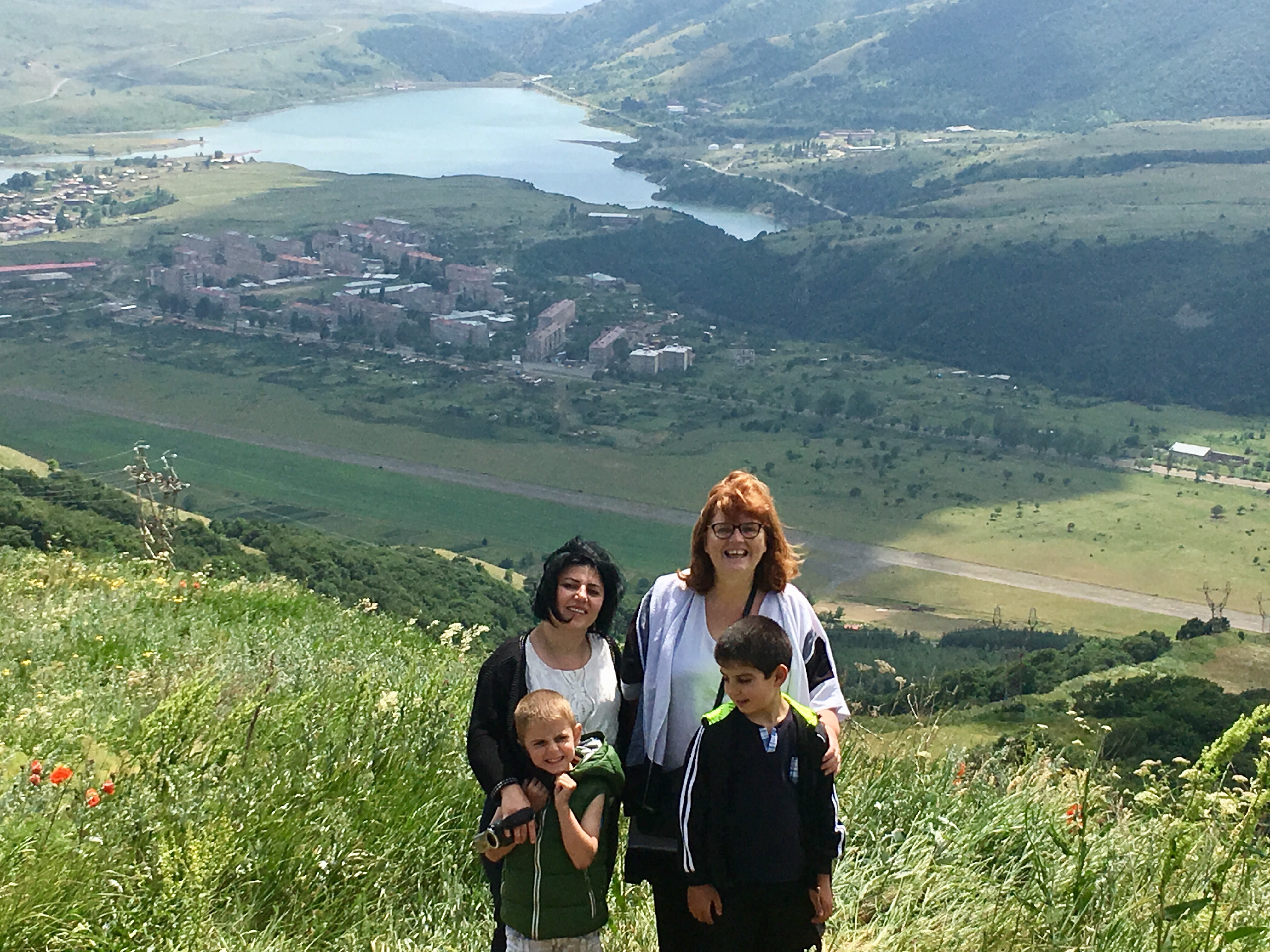
Ara is a taxi driver. Yesterday I asked him to take me to Jermuk for the day. Jermuk is a spa town famous for its scenery and spring water. There was room in Ara’s 21-year-old Mercedes and so his wife and two sons came too. Jermuk is a three hour drive from Goris so Nelli and the boys slept most of the way there and back and I benefited from a guide who both knows his stuff and speaks my language.
Leaving Goris, Ara showed me the new electrical power station being built to supply power to Iran. Big news for the economy in Syunik Marz. He pointed out the remains of the Goris Airport. Flights flew from there to Yerevan in Soviet times– he remembers his father and uncle taking the trip when he was a small boy. Now there is only the road. He shows me the plastic fencing newly erected in preparation for the winter snows.”it’s always windy up here in the mountains” he says ” the snow blows off the slope and closes the road which stops all work from here to Yerevan.” This year they hope the fencing will hold back the drift and allow the road to stay open.
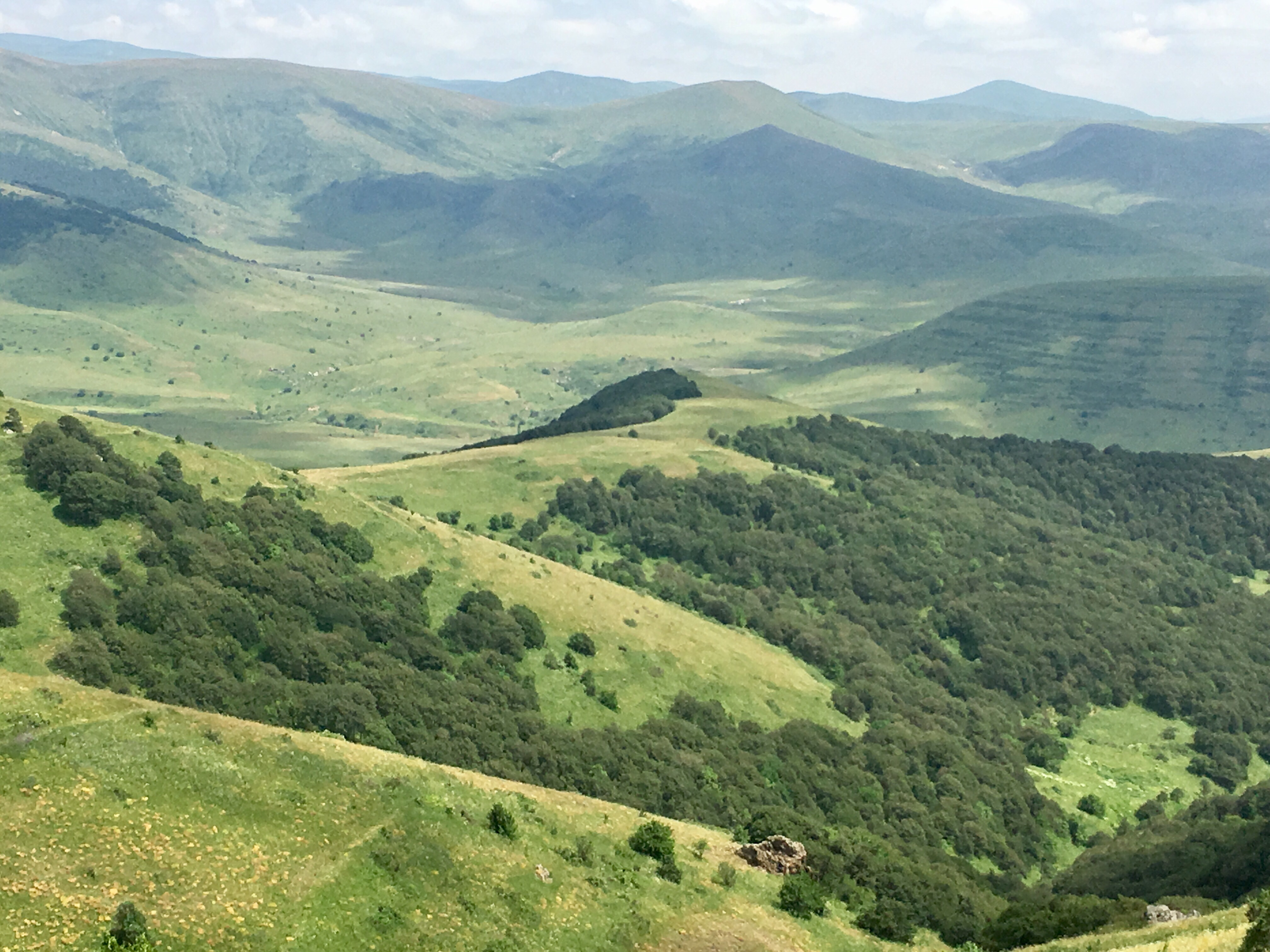
We drive past Sisian the next sizeable town on the road north. “Great mushrooms here” says Ara “and pure honey”. The slopes are covered in wild flowers and boxy beehives form blue and yellow encampments by the roadside. Mist shrouds the top of King Mountain, more than 3000 meters high. Behind it is the Black Lake says Ara, the coldest, clearest, cleanest water you will ever see. Further on there is Camel Mountain. In the mountains beyond it, 7000-year-old petroglyphs can be found. The mountain is accessible only in summer. Ara offers to hire a four wheel drive to take me and some other volunteers. “Most people here have never seen the rock engravings” he says. I will definitely go.
Past Sisian, the landscape becomes more bleak and windswept. There are no trees now. We drive through a small village and Ara shows me cairns of cowclap drying in the sun. “They have no wood here” says Ara “so they dry cow dung to burn”.
“Does it smell bad on the fire?” I ask. Ara shrugs. “Yes, but they are used to it. Sheep dung is better. It burns longer and hotter”. So now we know.
Along this part of the road, only cabbages and potatoes grow. We pass a couple of abandoned villages. It just got too hard to live here Ara says.
We cross into Vayots Dzor Marz. It is even more craggy here. Ara tells me there is a rare kind of mountain goat found only in this part of Armenia. It is called the Kar Ayt or Stone goat and is an endangered species. We don’t see it. Ara tells me to look out for eagles. He often sees them here, but there are no eagles today.
Ara begins to talk about a new gold mine to be opened next year in Amulsar. The Armenian-Canadian owners have a 25 year agreement to extract 200,000 ounces of gold a year from open cast mines. Ara is against the project. “They use cyanide in this kind of mining” he says ” it will ruin the air and pollute the water. It will finish the spring water industry in Jermuk. It will provide fast money for people employed there, but it will kill them slowly”. Ara said he cried when the plans for the mine were approved. He is nearly crying now.
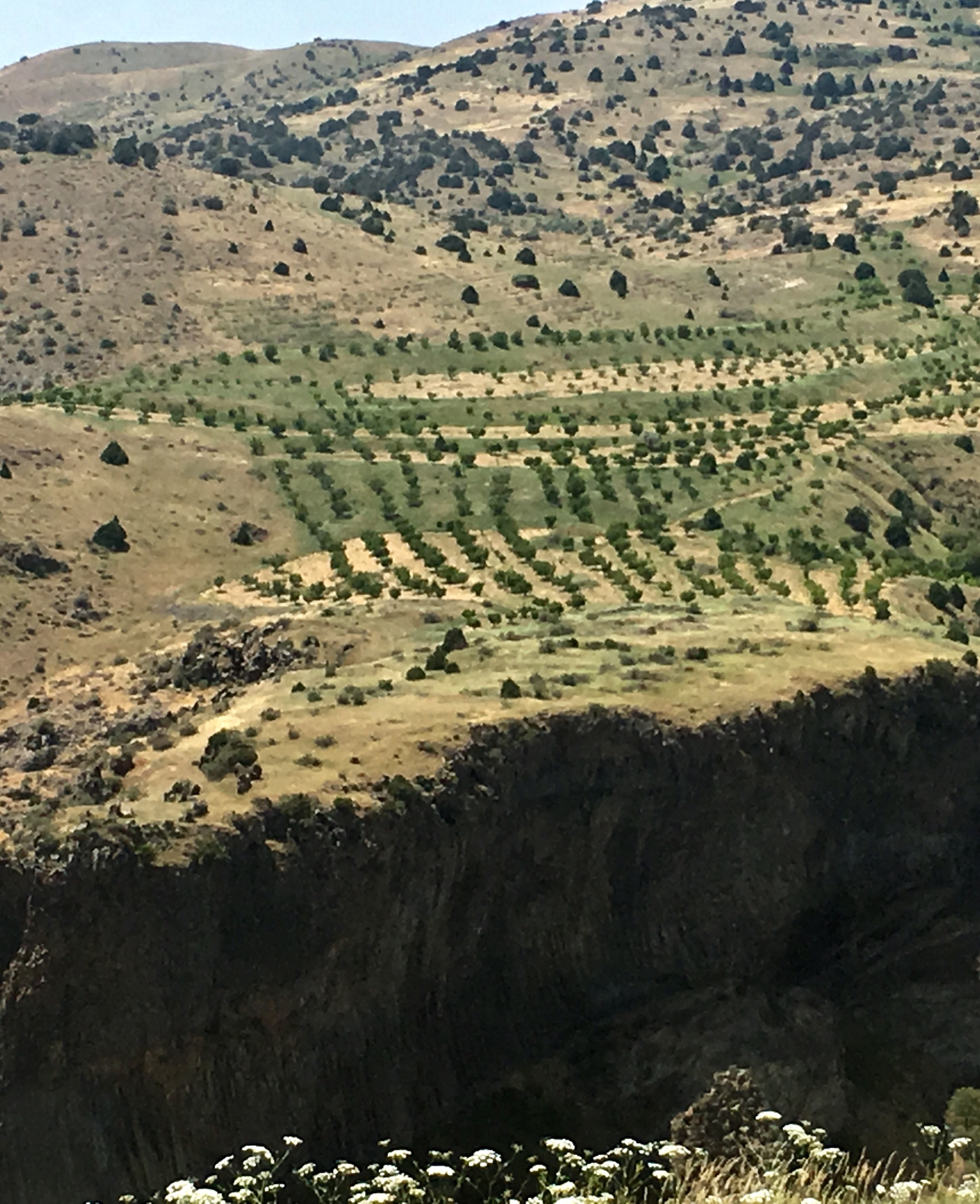
We are now on the road to Jermuk. There are apricot trees and Ara says the area is also famous for its strawberries. We stop by the side of the road and wake the family to look at the view and eat apricots. Forget American apricots with their mouldy stones and mealy texture. Those are not apricots worthy of the name. Armenian apricots are the size of kiwi fruit, cleft like a baby’s bottom and sweet, sweet, sweet. Neither unripe or too ripe as they always are at home, here they manage to be just right. We eat about 6 each. They are heaven.
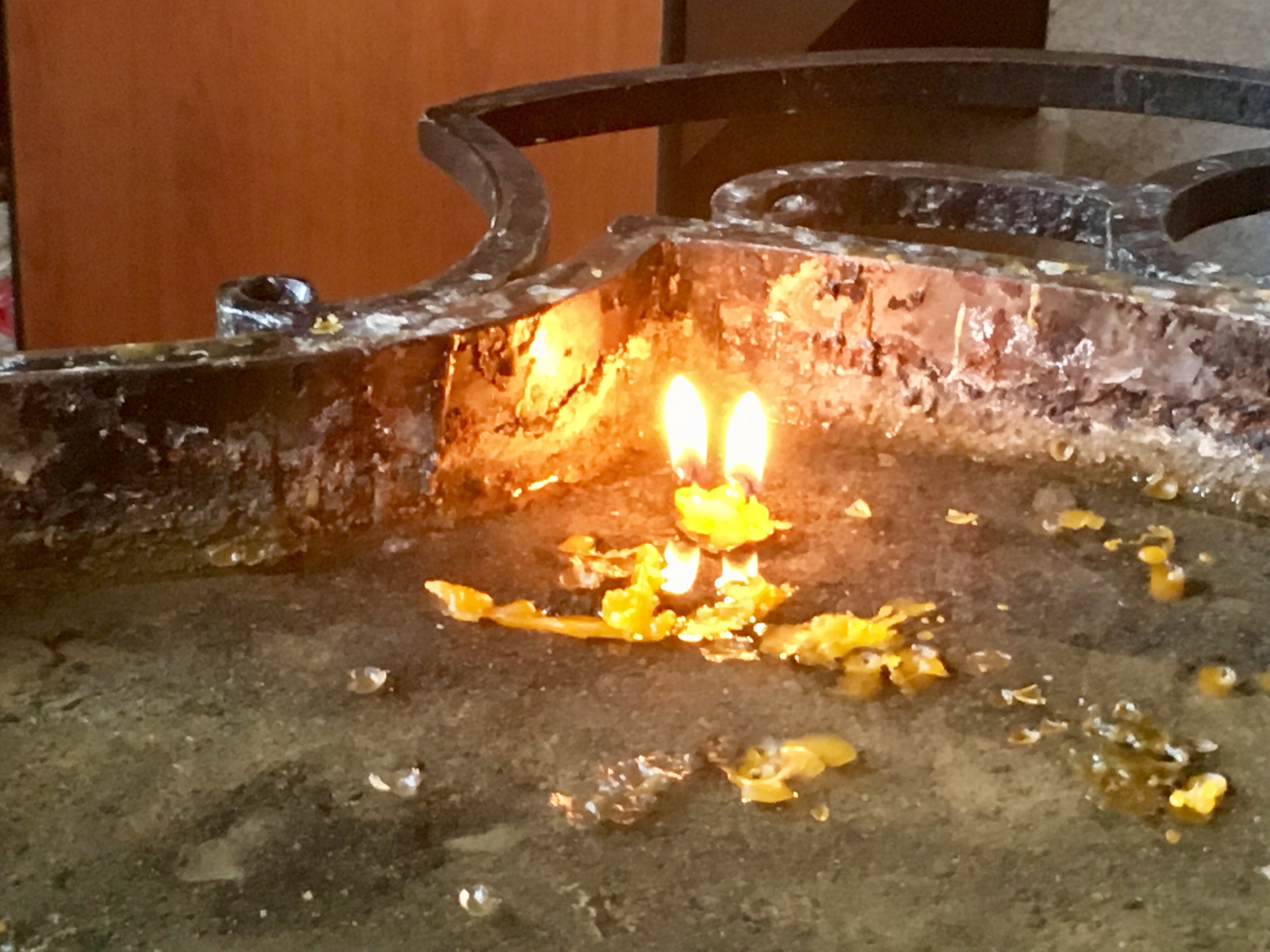
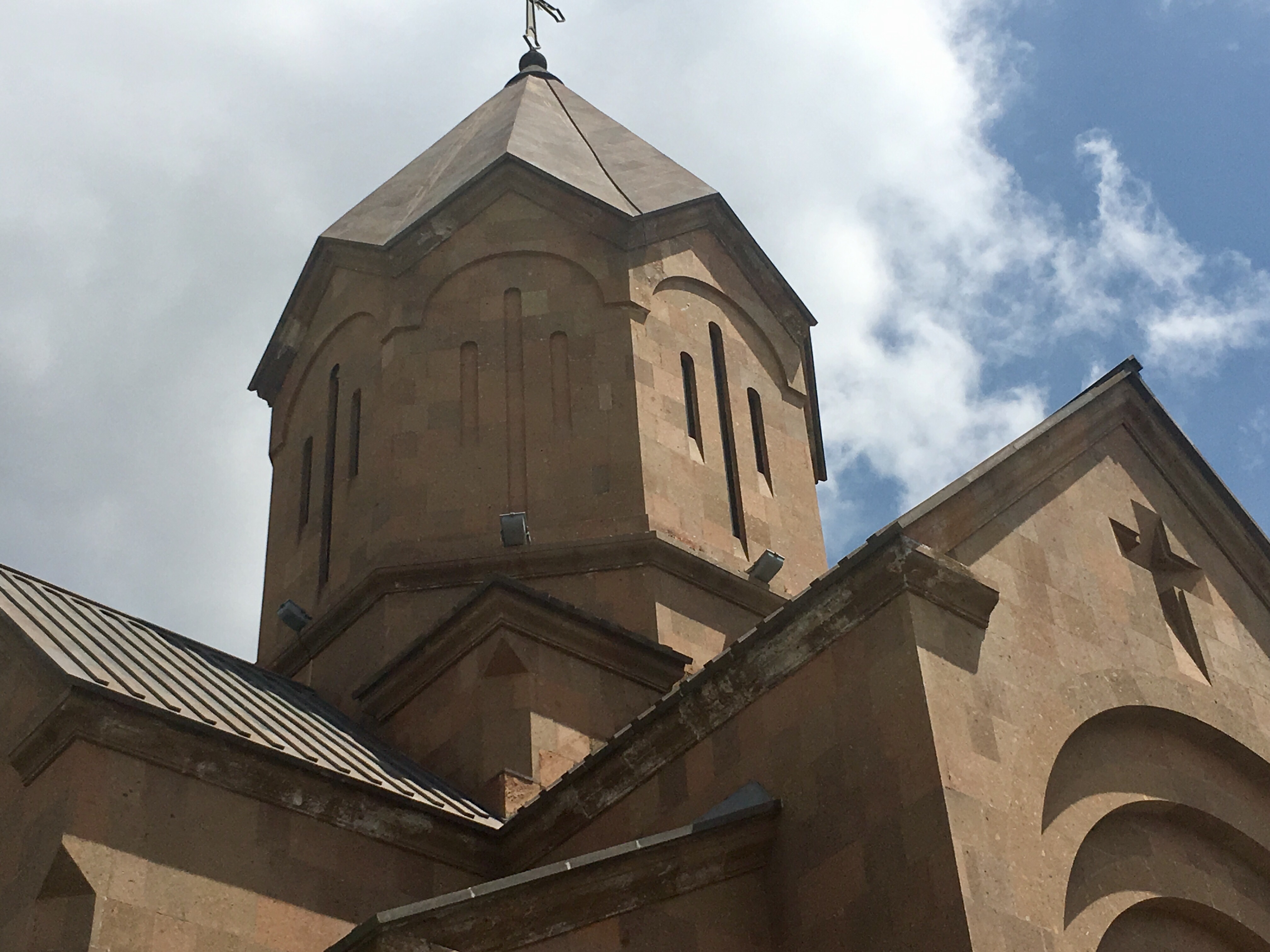
On the way into Jermuk we stop at a small apostolic church and light candles. I take pictures. “Thank you, thank you” say Ara and Nelli. Like most families they find it hard to get pictures of all of them together. Like good Armenians they do not smile as the shutter snaps.
Nelli asks me if I can drive and is excited when I say yes. She wants to learn. Ara is not enthusiastic “I am afraid for her” he says “She does not know the roads the way I do. She won’t know how to get out of the way”. A large truck heavy with Sisian stone lumbers towards us to help him make his point. He pulls into the rose hip hedge to let the truck come through “and she doesn’t know the drunks and the drug addicts” Ara continues “I can see who’s coming. I know who is on the road and I know when they are dangerous. She doesn’t know. She doesn’t know”.
I am firmly on Nelli’s side “You weren’t born knowing” I say ” and you can show her and teach her. She can learn.” When Ara drives to Yerevan and back he is on the road for at least 8 hours. If his passengers want a wait and return service his day can be much,much longer. Nelli works as a teacher and has two boys to take to piano lessons, chess club, doctors appointments and school. No wonder she wants to learn to drive.
I know that drunk driving is a big problem in Armenia, but I am surprised to hear Ara mention drugs. Thus far, I have heard very little about drug abuse here, and I haven’t seen much sign of a problem. “When you drive for a living you see all kinds of things and all kinds of people” say Ara “believe me the bad guys are right here. Part of every society”.
I ask him what drugs and speculate perhaps heroin from Iran? “Yes ” he says ” and people grow opium and cannabis here too, behind their houses. But that is not the worst. Krokodil is the worst. It is chemicsl. They make it from codeine and paintstripper and it makes them crazy. They jump out of windows. They drive like madman. It started in Russia and now it is everywhere here.” He sees how shocked I look. “I am afraid for my boys” he says “I tell them be like me don’t even smoke. But it is everywhere. I wonder about their lives when they are older. They might have to be soldiers in a war. Soldiers killed in Karabakh. There might be bad guys. All I can give them is education. Only education. Education. The most important thing”. He hits the steering wheel for emphasis as we pull into the parking lot for the cable car ride to the top of the hill behind old Jermuk.
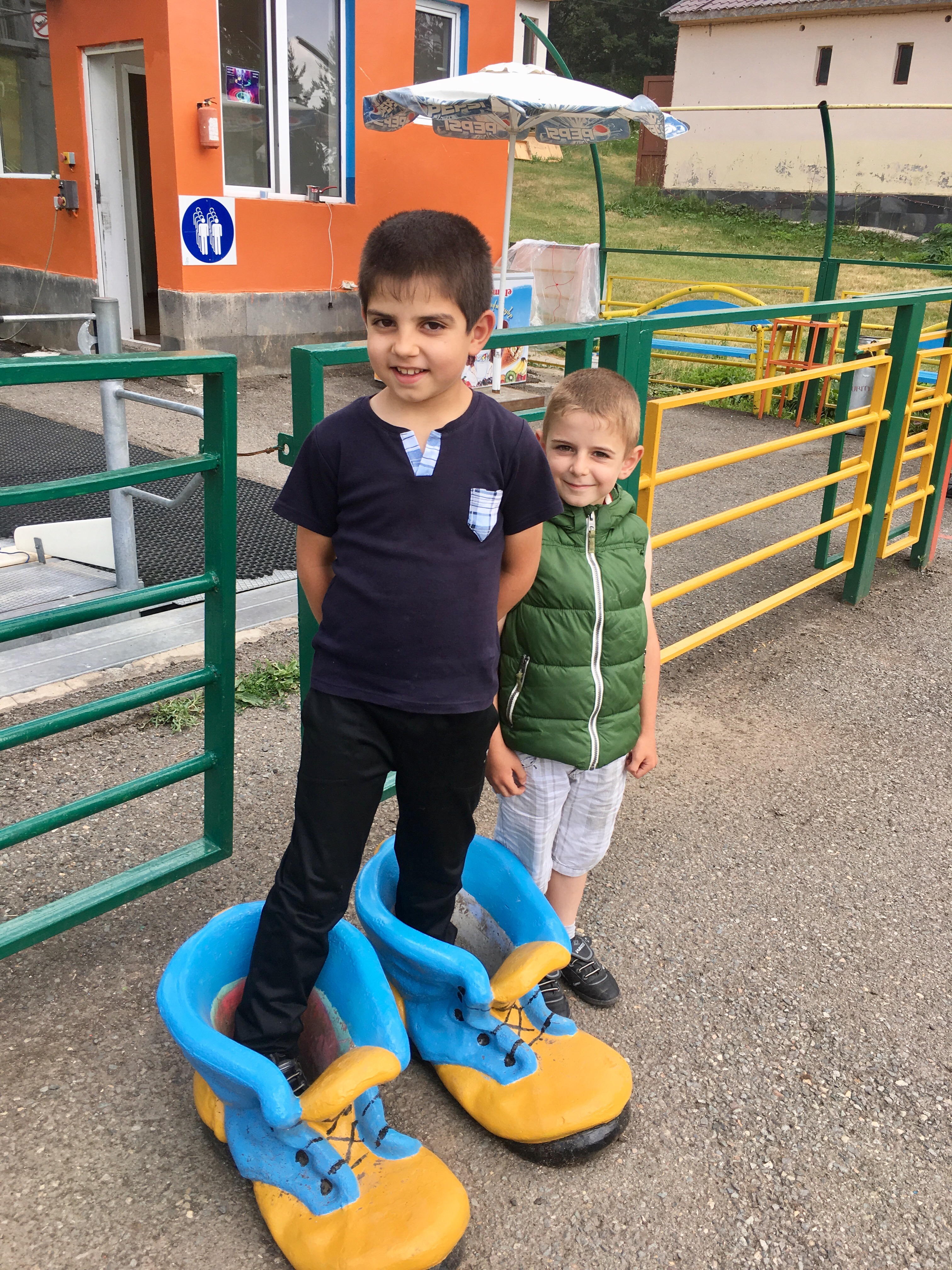
Ashok shoots out of the car and runs towards the ticket office. David follows him at speed. These boys, 10 and 8 years old, well-loved and well looked after, are afraid of nothing. May they always be safe.
Everything in Armenia looks like I built it. Skirting boards stop short of the door trim. Plastic piping pokes through jagged holes in plasterboard and tiling tails off when the money runs out. The whole country is not quite finished and in most places, interior design ambition seems to have outstripped artisanal aptitude.
Here, every man is a handyman, and every second shop is a hardware store. You buy what you need for Do-it-yourself and you do what you can. At first, the rough edges and state of unreadiness are somewhat shocking to outsider eyes. Those of us raised in a world of contractors and kite marks, bonding, insurance, punch lists and perfect finishes are inclined to turn up our noses at what looks like the work of cowboy builders. But when men and women tell you the story of how their homes started to happen, you start to see the love and pride they cemented into every structure. These couples built their houses from the ground up, adding here and there when they could, and teaching themselves as they go along. Homes are haphazard but they hold together (for the most part) and honestly, does the world need more straight lines and gleaming surfaces? Even if home improvements are more down and low than Lowes and Home Depot, housekeeping is of a very high standard. There is many a multi-million dollar McMansion in the United States that could do with a little Armenian elbow grease and bear in mind that people here–well, women here–clean their own homes. I know! Unheard of…
Well-equipped though the hardware stores are, they lack two items regularly featured in the US big box stores. This is not a culture with garden furniture, and there is no such thing as outdoor equipment for hire. The other night, I sat outside on a rickety office chair and talked to a friend from home by phone. “Sorry if it’s noisy” she said “The men are here power washing the deck”. I looked at the rusting infrastructure that screens off the stairs to our cellar. “Ah yes, power washing” I said, and felt a little wistful. I’ll be pining for a carpet steamer next.
In among the hardware stores, there are a plethora of toy shops and stationery stores. While I am sure that people here do spend more on small children than they should, it seems hard to believe that there is enough trade to keep all the toy shops going. And surely stationers must have to shift an awful lot of envelopes, biros, erasers and post-it notes to keep even the most ramshackle roof over their heads? I do love a stationery store though. In the last week I have bought water colors and brushes, rolls of two-inch tape in the colors of the Armenian flag, and some very pleasing primary school posters featuring old-fashioned illustrations of fruits and vegetables. I have my eye on some stencils and am looking for glass paints and blu-tack. It’s all-consuming.
And then there the supermarkets, where it somehow comes as a surprise to find that the personal grooming aisles are filled with familiar packaging–Proctor & Gamble, Colgate, L’Oreal and Garnier are all in evidence here. The choice of tea, coffee and confectionary is huge, but there are maybe two types of cheese–locally made salty sheep product and something resembling Edam. God knows who buys the fresh produce and the booze, for every family here seems to grow and make their own.
No-one here does what an American would consider a big weekly shop. Diapers, disposable razors and cigarettes are sold singly, as are toilet rolls, a reminder that people cannot afford to buy in bulk.
There are vending machines outside many supermarkets that sell bottles of beer, wine and even cognac along with the more standard sodas and bottles of water. In case of emergency, as my kids would say. There are machines in bigger stores where you can pay your phone bill once a month. Household bills are paid at the post office.
Pharmacies are white and green, clean and cool. Terribly reassuring. No one seems to sell feminine hygiene products and these are never mentioned. Peace Corps supplies tampons to our young women. I imagine delivery trucks piled high with cardboard tubes and cotton wadding barreling across the country. Girls here should stage a highway robbery. I don’t know what they do otherwise.
I spent the 4th of July cutting out pictures of hamburger buns, cheese slices and dill pickles. Black and white pictures, because we don’t have a color printer here. I used the pictures to teach an English conversation class about the American holiday. Students–five women aged from 15 to 50–order a burger with their choice of extras from me. Then they show and tell what they will eat. Bacon strips, tomato, red onion slices, ketchup, mustard and french fries were among the options. I left out lettuce. No-one likes lettuce and the word is not used here. I play a short video of my colleagues singing the Star-Spangled Banner. We wrap up when everyone can say stars and stripes and point to the right images on the flag. I am not actually here to teach English, although a lot of volunteers are. But English lessons are valued in Armenia and random people, hearing an American is in town, will turn up to ask to talk and learn. I am happy to help. Some of the women I have met in the last month in Armenia blow me away with their poise, determination and capacity to learn. Say magic words in English and you can conjure up a glorious future. They are determined to master the language.
At home, my family made a mattress. When I woke up in the morning, wool not long shorn from the back of a sheep, had been washed and hung out to dry. Later, it was laid out on top of an envelope of hotel-white sheeting. Much patting and teasing and prompting ensued, until the cloth was covered in a four inch thick mat of the unruly wool. Deft rolling and squeezing and pummeling and Aleta and Karina had wrangled the wool into its new cover. The quilt was rolled and carted upstairs where it was laid out on two dining tables–extensions added–and sewed with string to stop the wool shifting about. It looks like the mattress of my dreams. They will make another one tomorrow.
I am a community development volunteer, which means I work with an NGO. My focus is management skills and organizational development, just like it was in the states. I work with a more than averagely successful grant-funded organization which has offices in Yerevan and here in Goris. P&T NGO wins and administers grants from organizations including USAID, the European Commission, UNHCR, sundry foreign administrations and various branches of the Armenian national and local governments. Most of our work concentrates on civil society development training we provide for other, smaller NGOs. The training–in NGO management, Social Entrepreneurship, Communications and PR, Financial Diversification, Fundraising, Project Design Management, Managing Volunteers and Members, and Advocacy–is first-rate. Practical, engaging and very hands on. I, of course, cannot facilitate, because my Hayeren isn’t up to it. This means I concentrate on trying to improve office processes, and on PR work.
Haykush is up at 6 o’clock to clean our office. She takes care of the kitchen and bathroom, dusts and tidies the desks, empties the waste bins and sweeps and stairs and outside areas, front and back. On her way to her day’s work in the garden, she stops to stir the vats of mulberries outside my bedroom. The berries are fermenting nicely now. Haykush has beans to tend, fruit to pick and seedlings to thin. Later, she’ll make yogurt.
God knows, I am not great at systems but I have learned the hard way the value of thinking first and doing later; of labeling files and folders by date and name; and of storing only the most updated version of materials to be used for publicity. I try to touch things only once, committing to finish what I’ve started, and attempting to answer questions before they are asked. In the States, I am at the back of the class when it comes to this sort of order and organizational ability. Here, my colleagues consider me pedantic, process-oriented and positively nit-picking. Somewhere far away from Armenia Jacqui Barrett, Natalia Banalescu-Bogdan and Caela Coil are rolling their eyes…
Artur is spreading concrete on what will be the floor of my new shower. Next he will grout the floor tiles before doing a taxi shift. The work on the bathroom has been held up. We had heavy rain and our roof sprung a leak he had to fix. He needed to drive to Yerevan to get something to make the shower drain better. The next-door neighbor is too old to climb his own mulberry tree–Artur must stop his remodeling to help with the harvest.
At work, I write strategy documents in English and share them with my colleagues on Google Drive. Everyone here mistrusts Google Drive more than they mistrust lettuce. I can’t say I like it myself, but it is one way to make sure everyone is looking at the same version of the same document. Not that anyone reads my strategy papers. Even for those fluent in English, they are too fatiguing. I don’t blame them.
Natalie has cycled across town to meet her friend Sarkis. They are both teetering on the edge of puberty. Next summer, will she ride her bike? Next summer, will she be allowed to see Sarkis? Diana does her hair and her make-up and then does it again a different way. She is 19. Robert is outside playing in the street just as a four-year-old should be.
I come up with ideas to increase our visibility and illustrate our impact. We are having a big conference next Monday–200 people. We decided on the title the day before yesterday and we finalized the announcement in English, Hayeren and Adobe Indesign late last night. My friend Emily at the other end of the country has Indesign on her computer so I asked her to give me a couple of hours of her graphic design expertise. Two exhausting days later and everyone was happy. Thanks Emily.
The conference will pull together representatives from business, government and the NGOs we have been working with. I have drafted a press release for translation and want to start the conference with challenges to sector teams to attach themselves to each other with ribbon in the colors of the Hayastan flag. I can see it all now: executives and social workers and elected representatives knitted together by Armenian colors threaded through bracelets, down shirt sleeves and around ankles. It will give the TV crews something to film I tell my colleagues. They look at me in bewilderment. This is more than a language difficulty. They think I am crazy and ridiculous. By now, Jacqui and Natalia and Caela are nodding in agreement. This is the Liz they know.
I coached the female executive director of a NGO in Yerevan by skype. Another young woman who speaks perfect English. I coached another volunteer on managing her emotions as she settles into her new life in Armenia. I decided to call it a day.
Aleta spring-cleaned the living-room. She took down the curtains and washed all the windows with vodka and crumpled paper. Yards and yards of freshly laundered netting to be rehung. She made a tray of pound cake and a small batch of raspberry jam, before our raspberries spoiled. I joined her and Karina for cake, jam and tea after watching the exhausting business of the mattress. The cake was cut in perfect diamonds and the jam was still warm. This is what we do here.
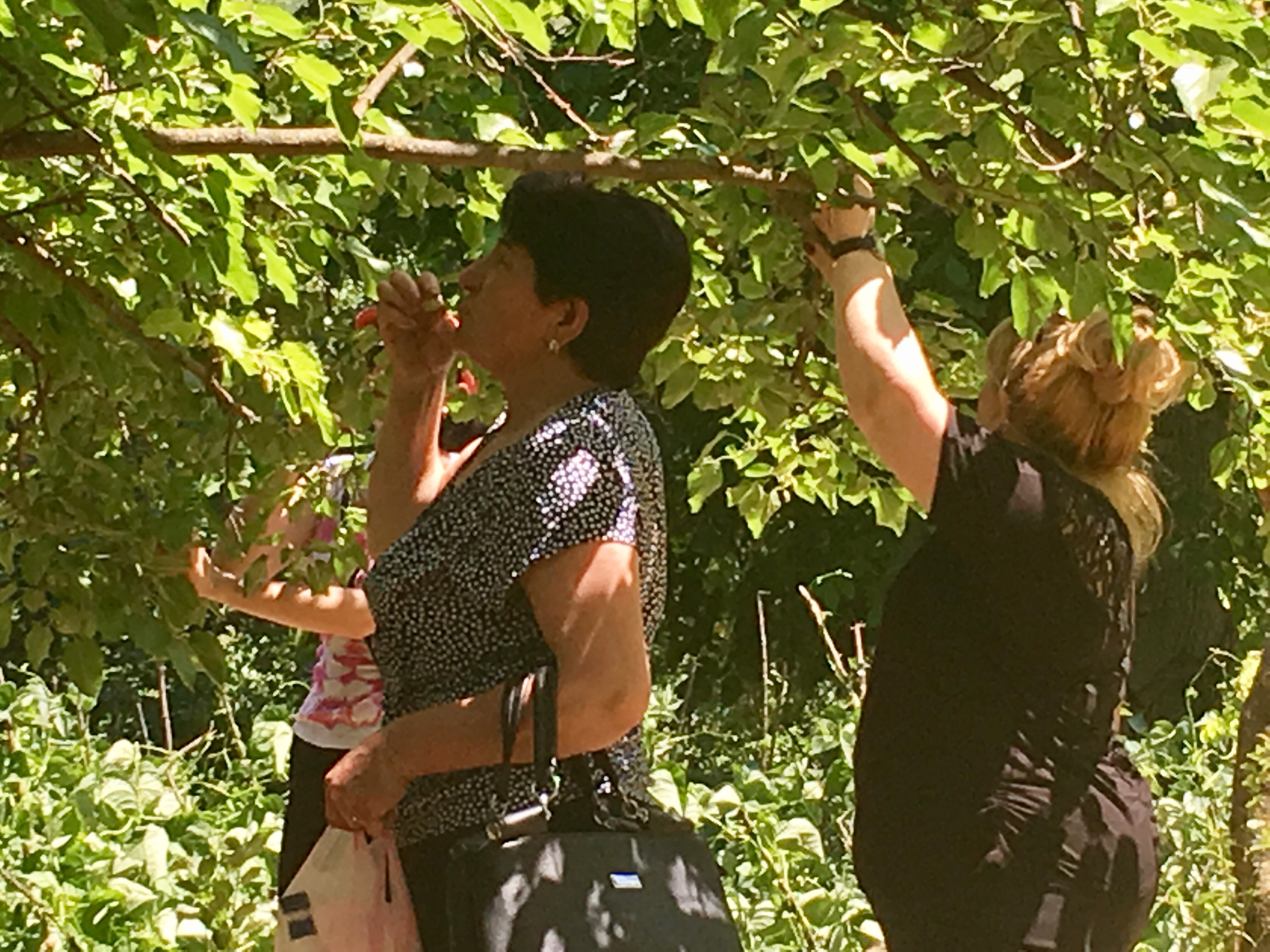
It is time to make toot vodka. Toot is the Armenian name for the mulberry– we have white and dark purple varieties here. The white mulberries, larval-looking but honied in taste, are the most prized. A couple of days ago, we spread tarpaulins on the street outside the house–passing cars were expected to swerve–and got ready to harvest. Artur climbed the tree and shook branches till the white mulberries rained. His mother and youngest daughter were the ground staff–filling old margarine crocks with fruit they wanted to enjoy later. Then Artur shook the fruit from the tarpaulins into giant metal buckets where the berries will ferment. He’ll set up a homemade still outside my bedroom. We are all saving plastic bottles–we’ll have about 70 liters to see us through the winter.
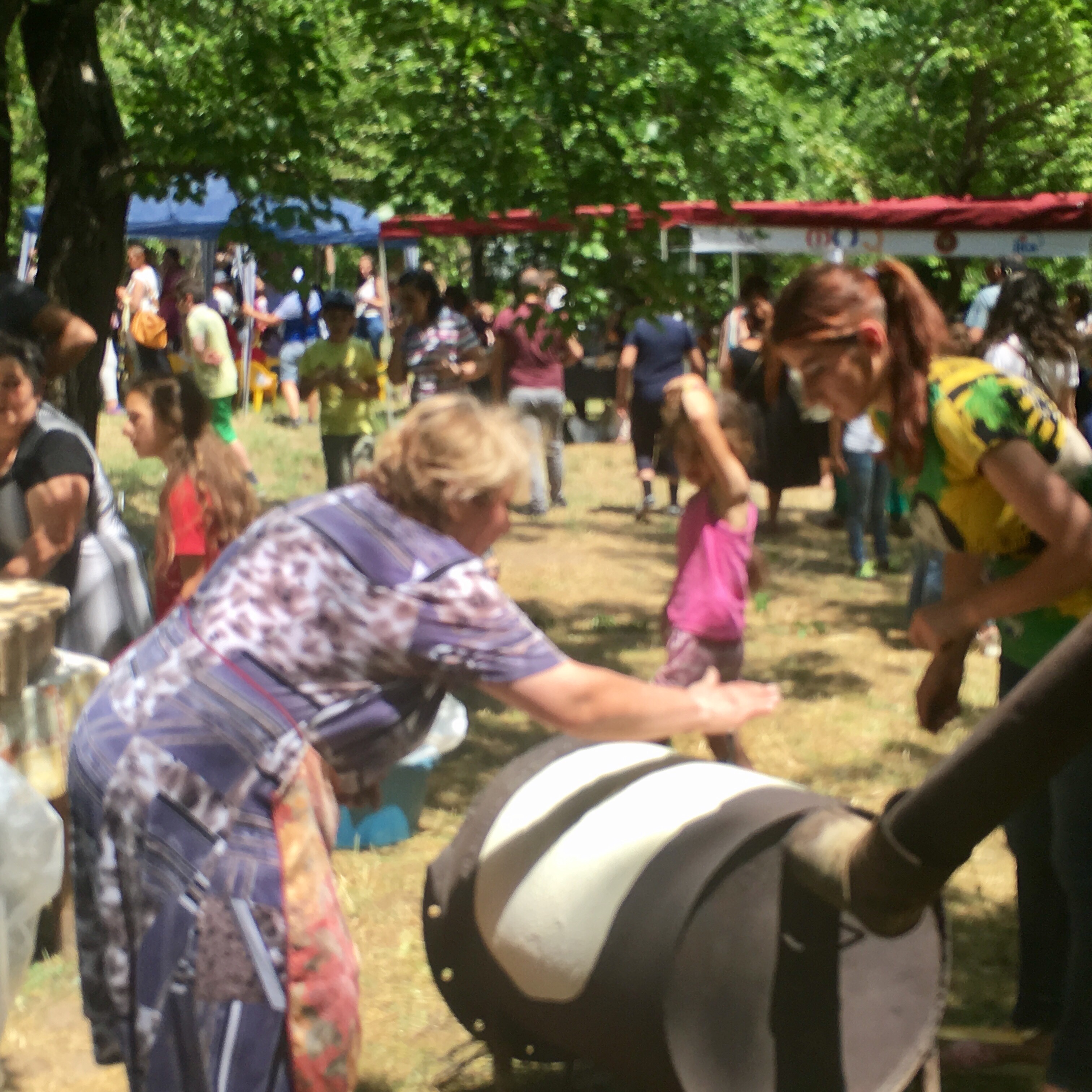
Goris had a mulberry festival this weekend, a small civic attempt to draw tourists to our town. I went to the festival with Pat, a fellow Peace Corps volunteer, also from Maryland. Like me, she came to Peace Corps in her prime, and some decades after graduating college. Like me, she helps local organizations develop strategic thinking and management skills, and helps with branding, marketing, communications and sales plans. It can be uphill work in a country where local customers have no money, and where foreign buyers are unreachable. There is no access to Paypal or Etsy and the postal service is at best capricious. There is no way of taking money direct from the diaspora and no way of being sure that shipping will work. Everyone competes for the dollars of one million tourists who visit Armenia each year. Like me, Pat likes it here, although her two years of service are nearly over. She goes home next month.
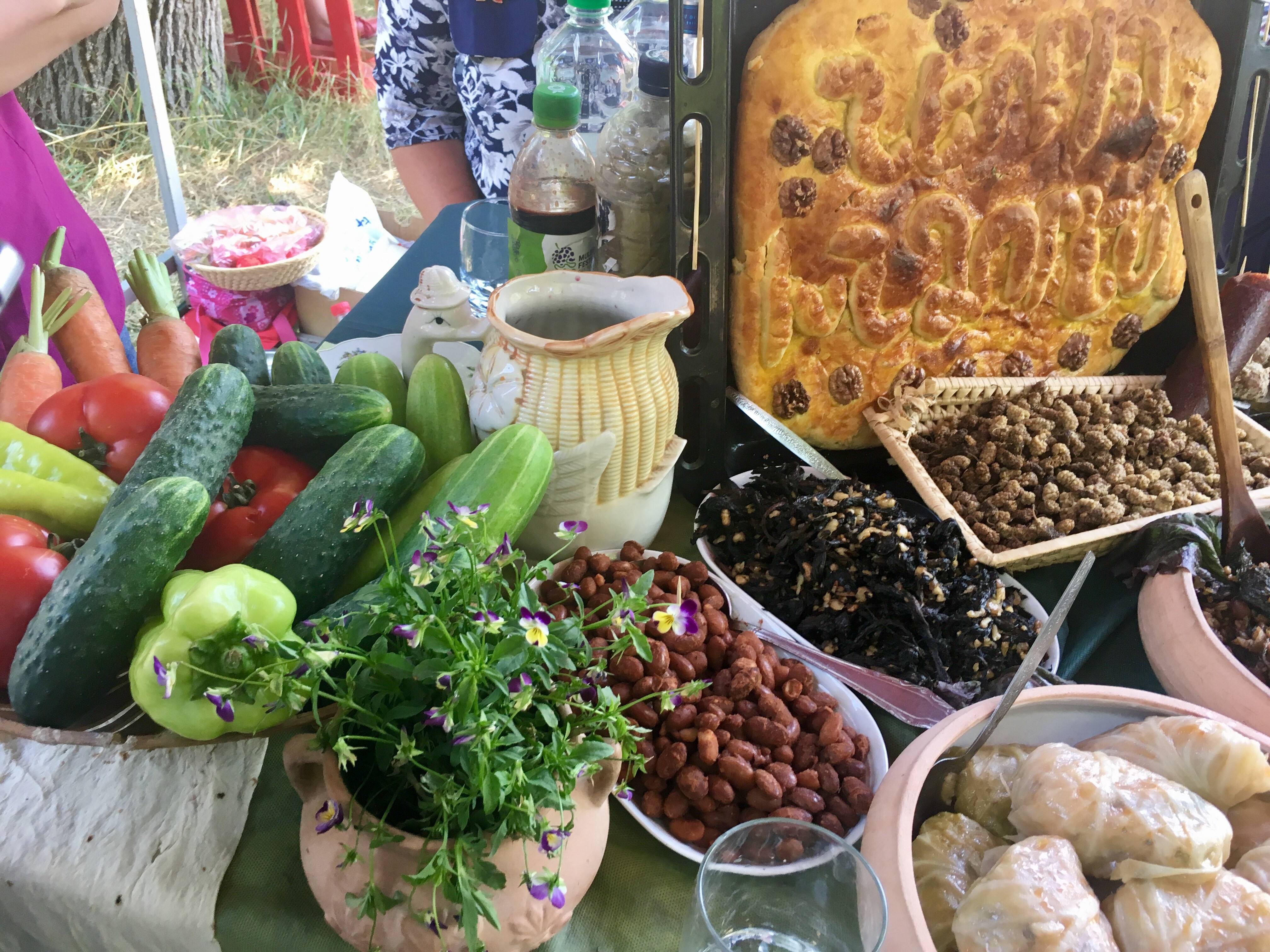
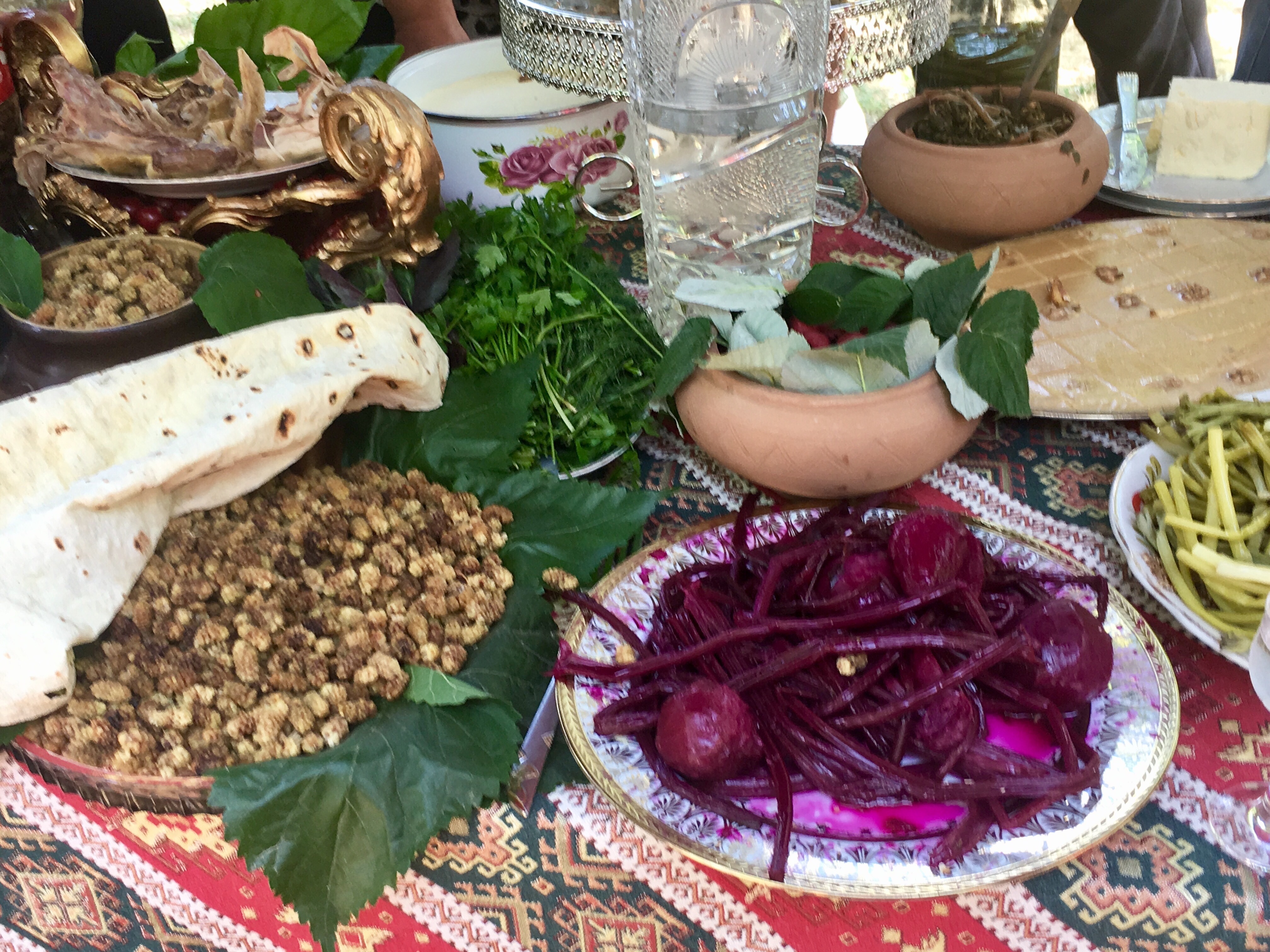
Armenians do not come easily to capitalism, perhaps because of their recent Soviet past, and perhaps because they are just too kind and generous to charge anyone for anything. At the festival, held in a bumpy, downward sloping field, they offer plates of fish stew, bean salad, dolma and beetroot vinaigrette to enjoy with free drinks. People pillage small stalls to pile their plates, picking through the food they want to try, and leaving the displays looking like Tom Jones’ dinner table several hours after Fielding’s description of the feast. It is an unholy, unhygienic mess.
The stall holders do sell packaged mulberry products– vodka, wine, a syrup that is good for the throat, and jam. A liter of wine in an old Coke bottle will cost 1000 Armenian dram– about $2. Half a liter of vodka in a water bottle costs $3. No one has bothered to switch the labels from the original bottles. I fear for the toddler who reaches into his mother’s shopping bag for a thirst-quenching glug from what looks to be a bottle of Jermuk’s finest spring water. A mouthful of mulberry ori is far from mother’s milk.
Sitting on a haybale in the shade, Pat and I watched people eating mulberries straight from the trees and kept an eye on a game of nardi– the local name for backgammon. We ate pistachio nougat and baklava while she drank a tot of vodka and I sampled the local red wine. We got chatting to a gay couple from Australia. They had just come from Iran, a couple of hundred miles south of here, and they are on their way to Georgia, many hours of travel north, after a short trip to Nagorno-Karabakh, which is just down the road. “Try the beetroot with the sheep cheese” said the taller Aussie. “And get your mulberry wine from the French guy over there.” Homosexuality is illegal in Armenia and, let’s face it, not likely to win friends in Iran. I asked the less lanky antipodean if they had felt under threat. “Not at all” he said. “Iran is surprisingly secular. It was Ramadan when we were there but no-one we stayed with was fasting. Everyone was very friendly–glad to see us. It’s not at all like you see on TV.” I fear I may never know. Current US/Iran relations mean that Peace Corps Volunteers are forbidden to travel to Tehran.
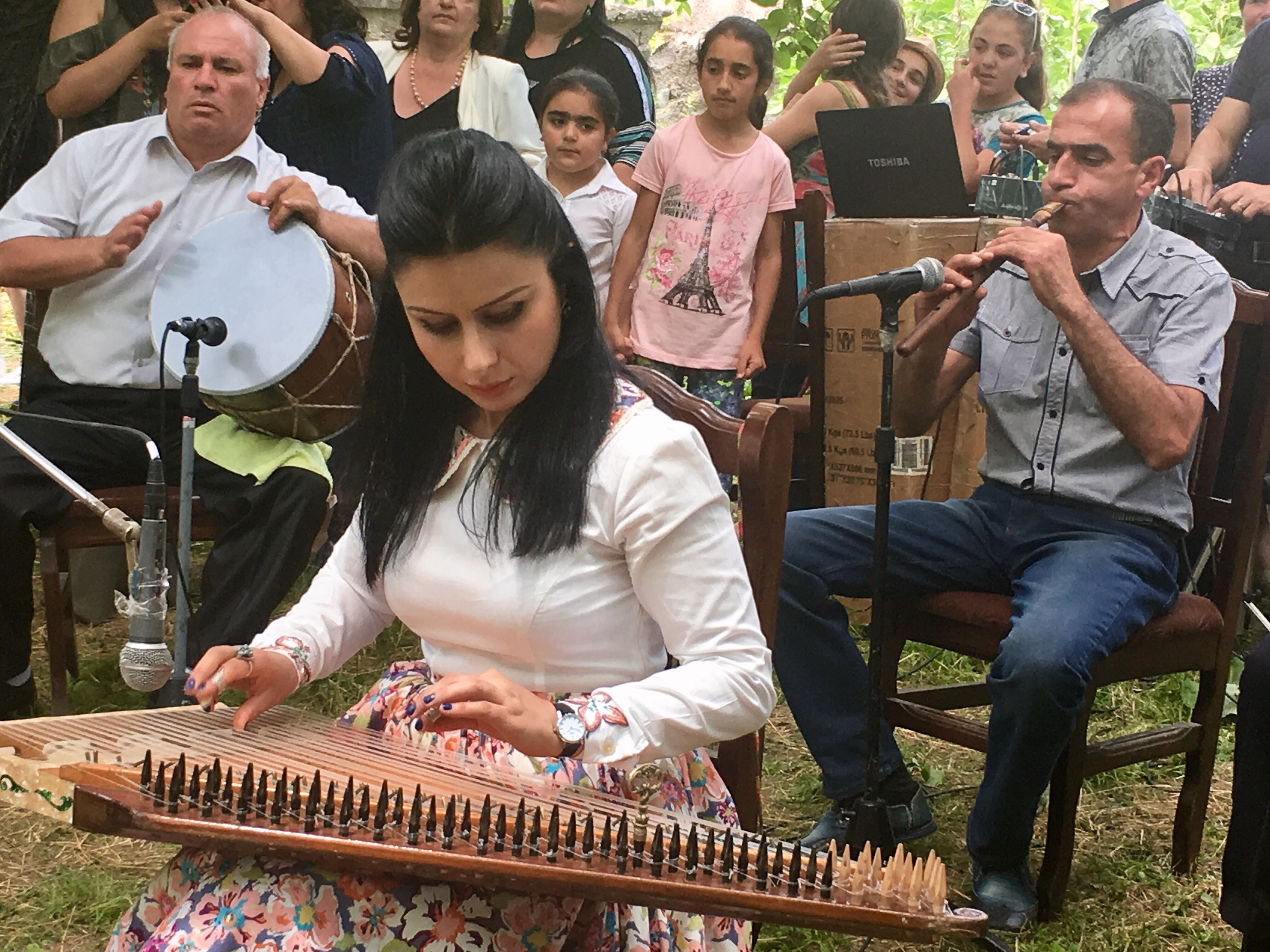
Three teenage boys rode by on a hijacked donkey. Vodka may have been involved. An Armenian grandfather showed off his overdressed baby to this American grandmother. A Japanese American with a man bun sampled the green beans, fish dolma and red currants. We ate cherries and talked to a Czech tourist. 10-year-old boys in itchy vests of Armenian design got ready to dance. The duduk player blew out his cheeks one last time. His instrument, uniquely Armenian, sounds like a mix between a gazoo and irish pipes. A beautifully melancholy sound.
The conversation started when Tatik Haykush and I were looking through old family photo albums–both hers and mine.
“Do you have any photos of Artur and Aleta’s wedding?” I asked. Haykush is very proud of her only son, and his nuptials twenty years ago would have been a long-anticipated event.
“No photos. No wedding”. said Haykush and shrugged. I goggled. This is not a country where people are casual about connubial commitment. “Are you married?” is the first question asked of any woman 17-75 and if the answer is No then people find it a worry. What did Haykush mean, no wedding?
“He just came home with her one day and said this is my woman” said Haykush. She laughed in embarrassment. Everyone else in the room guffawed.
“You realize what we just heard” said my fellow volunteer Anna, who speaks Hayeren better than I do. “There was a bridenapping here…”
Bridenappings, unfortunately, have long been part of the culture in the Caucasus. Another Peace Corps volunteer, Christopher Edling, now back in the States, conducted a survey on the custom about five years ago. He did his research in Goris and surrounding villages–the area where I now live. Working with women from Goris Women’s Resource Center he asked local woman to speak voluntarily and anonymously about bridenapping. 163 women came forward of whom 54.6% said they had some experience of an attempted bridenap, or were bridenapped themselves. Most of these women were still with the man who took them away. Of the women interviewed, 65% said they knew others who had been bridenapped too. Obviously, Christopher’s survey group were particularly motivated to speak on this topic, but still the group numbers and the percentages seem disturbingly high in this day and age, even in this very patriarchal and conservative country where women still have little autonomy.
I thought about Artur and Aleta. They will have been together 20 years in November. They have three children of 19, 13 and 4. They appear more than averagely loved-up for people who have been together so long. Artur is a mild-mannered, gently humorous man who works night and day to support his family. Aleta is feisty, irrepressible and cheerful. She is not the type you could imagine being bundled into the trunk of a car without protest. If she is unhappy in her marriage, she hides it very well.
Most of the women featured in Edling’s report had no complaints about their kidnapping. They knew and loved the assailant and the bridenapping was a romantic elopement rather than than a brutal assault and attack on their human rights. When Armenians talk to outsiders like me about this phenomenon, this is always how they will present bridenappings: love finds its way. This conservative culture couldn’t allow a woman to just move in with a man she liked the look of, and so it is necessary for her to be seen to have no choice. But not every bridenapping is a love match. 9% of Edling’s interviewees–let’s call it 15 women–reported being forcibly abducted by someone they didn’t care for. “Ruined” by the unwelcome attentions of their ‘napper, most of them felt they could not go home, and that they needed to make a go of the “relationship” in order to remain part of their own family, and the wider community. This is a horribly uncomfortable thought: perhaps 15 women walking around in the small city where I live who were raped, denied choice about a life partner, and decided to make the best of it. Unthinkable.
It is easy to comfort ourselves with the thought that this sort of behavior was “back in the day” and that we are hearing historical reports of wrongs committed half a century ago. Well, maybe. But a young male volunteer on the other side of the country reported that his (male) lunch companions were hooting and hollering about a recent bridenapping in their neighborhood just last week. It really shook him up. And he’s from small-town Georgia, so he’s not easily shocked by family matters.
According to Edling’s report, when brides–whether bruised and bewildered or cheerfully complicit–are brought home to their new family for inspection, they are generally welcomed. Concerns may be voiced about the couple being too young, or too headstrong, but the deed is done. Families will often try to convince a reluctant bride that, being used goods and all, she might as well settle down, assume her new role in the family and grow to love their son. I could find no reporting about the feelings of mums and dads whose daughters, without warning, suddenly live somewhere else. Surely, surely most would urge them to come home?
Back to Artur and Aleta. I had them both alone at the breakfast table the other day. The talk turned to weddings –they were off to a family ceremony in Yerevan.
“Did you know each other before you were married?” I asked carefully. It is hard to know if Artur ignored the question because he couldn’t understand me, because he thought it was silly, or because he didn’t want to share. I persevered and eventually Aleta understood where I was coming from.
“Oh yes, we knew each other for 5 months before”
“But no wedding?”
“No” she laughed. Artur sloped off, muttering something about a vacuum cleaner he needed to mend.
“Why not?” Always one to ask an extra, unwelcome question, my powers are particularly sharpened here. If you know only a very few words you use them how you can, and people forgive your bluntness and nosiness because they know you don’t know how to dress it up as anything else.
“I don’t like weddings” said Aleta, and pulled faces and made hand gestures to suggest that she finds them fussy and irritating and tiresome. “And it was 1997 and the country was in a terrible state–no lights, no water. No-one had any money….” She shrugged, remembering the awful years after the fall of the Soviet Union when the fledgling Republic of Armenia had to pick itself up, dust itself off, and start all over again.
I exhaled. As a matter of preference and practicality Aleta and Artur had decided to forgo a visit to the Orthodox priest, the big family party, the pouffy dress, the fireworks, the cognac and the dancing. I would do the same myself. I have no idea whether there is a piece of paper from a courthouse or if community presumption of a sexual relationship is enough to seal a lifelong deal, in the absence of a wedding ceremony. Certainly in these parts there is only married or unmarried: terms that directly correlate to sexually active and not. (You can imagine what a culture shock this is for a lusty busload of U.S. Peace Corps volunteers, working here in Armenia for two years.) Whatever the semantics, I am glad to know that Artur is not a villain, and that Aleta is not a victim. Sadly, not every couple in these parts can say the same.
That’s enough talk about marriage for now. It is staple of conversation in Armenia, much as the weather is in the UK, and the price of gas can be in the US. I have never spent so much time discussing my own marital status, and that of my children (at 24 and 27 everyone here worries that they are aging out of the market. I have no such concern). I note with pleasure that Aleta, a wife at 17, is not eager for her own 19-year-old daughter to be married. “She’s little. She’s young” she says. Diana loves sparkling dresses and full hair and make-up so it seems reasonable to assume that she will want a big wedding when her time comes. Let’s hope no ardent but aggressive admirer robs her of the occasion.
There are no newspapers and magazines to be found in Goris. And, now I come to think of it, there were none in the small local shops in my first village–although that was less surprising. In Yerevan, where I know there are some very good bookshops, perhaps it is possible to leaf through a copy of Cosmopolitan, or The Economist or Yogurt Producers Weekly, but I can’t be sure.
Although print is in decline all over the world, I don’t know if locally-produced media has gone out of business here, or if it never existed? This country has a small, spread-out and poor population and a language all its own: perhaps a daily newspaper (considered the poor man’s pleasure in Britain since the time of Pepys) has never been part of life here? I haven’t been to a dentist’s office so I don’t know if they have Russian language magazines, or none at all. When I went to the hairdressers for a highly luxurious mani/pedi, there was no way of keeping up with the Kardashians, or following the social ins and outs of Armenia’s oligarchs and their offspring. That was rather a relief.
Cigarettes, sweets and other small essentials like batteries and disposable lighters are available in corner shops and supermarkets, but there are no newspapers and magazines either domestic or international where you would expect to find them.
T
Annahit–bosom pal material?
That is not to say that there is a shortage of local journalism. There is a Press Club in Goris — I met a rather glorious woman called Annahit today, and she is one of five journalists based there. There is a National Press club in Yerevan which seems to generate a TV news story every evening: important looking foreigners spend a lot of time opining from there. I have met two people in Goris–a town where I have perhaps spoken to twenty people in total–who are photojournalists and have their own professional video and audio equipment. One of these chaps trained as a history teacher but now supplements his income from camerawork by working on the reception desk at a local hotel. There is also a woman who has a professional blue screen studio set up in the same building as our crochet collective, but I haven’t met her yet.
Across the country there are as many half a dozen TV stations–I still get them mixed up–who all have extensive newscasts before the Indian soap opera hour at 9pm. Whatever channel you watch, there is always a story featuring the President, something about Nagorno-Karabakh and the general shortcomings of Azerbaijan as a neighbor, and a tale of woe from a home or community with subsidence, or flooding, or mould or similar. The newsreaders are women with immobile faces, scary lips and nails, and strict expressions. They are undoubtedly the ones in charge. Their male counterparts are usually slightly tubby and nerdy looking. The men who do the sport are sweaty, dark of brow and jowl, and stuffed into suits that are just a little too small. Their knotted neckwear never quite meets the top button of their shirts. They become very worked up when talking about Manchester United, Real Madrid and Barcelona and always look at though they want to rip off that troublesome tie, and shrug off the too-straight jacket. Usually, they have no moving pictures of the game to show: Armenia isn’t really a player when it comes to bidding for soccer screening rights.
Last night there was a happy story about UNHCR and European Union support for Syrian refugees in Armenia. The refugees were filmed enjoying a hop-on hop-off bus tour of Yerevan. On the bus was this slogan in English: Yerevan. Feel the Warmness. They could have used a bilingual copy-editor.
As part of the Syrian story, I saw my friend Hayasa on the news– she runs Aleppo NGO here. I probably know 50 people in all of Armenia and it is almost certain that at least one of them will be on the news every night. This may be because the news programs always finish with a feelgood story and so the volunteer community is often featured, helping sick children, strolling appreciatively in nature while monitoring water quality, or challenging locals to a bracing game of something involving a ball and a net. But I think everyone in Armenia knows someone on the news every night, I really do.
Other than a shortage of information about red-carpet dresses and celebrity autopsies, I am not deprived of news from the world beyond the Caucasus. Here in Goris I have 24 hour internet access and can listen to BBC Radio 4 (the 6 o’clock news, the light relief, and the Archers) as I get ready for bed–we are three hours ahead of London. Boston’s excellent NPR speech station, WBUR, keeps me informed during the night. I have also discovered the deep joy of the podcast, thanks to a new venture launched by a friend in Washington DC. I have known Bruno Falcon, the presenter of Applying to Everything since before his voice broke. Nowadays he asks a broad range of questions in deep, velvety tones and talks to people you haven’t heard of, but who have something interesting to say. Last night’s conversation was with a therapist who shares Bruno’s love of superheroes and comic books. I can’t stop thinking about the Incredible Hulk and his response to fear…
Tom and Mike were once guests at a baby shower in Washington DC. The mother-to-be invited her guests to write down a personal motto on slips of paper. These she would save in a glass jar, ready to share with her new born when he or she attained adulthood.
Tom wrote:
Never buy art on holiday.
Mike wrote:
Never drink cheap brandy.
History does not relate how the child turned out, or whether he or she followed this valuable advice. Me, I live by these wise words.
In preparation for upcoming baby showers in Armenia, I am compiling my own list of life lessons learned. Other well-wishers will restrict themselves to աչքդ լինի լինի archkad looys lini.
May your eyes light up
or առողջ բալիկ լինի aroch balik lini
May the child be healthy
but I will be sharing the following well-meant advice.
Never wear white sandals in mulberry season. Not if you want to show a clean pair of heels.
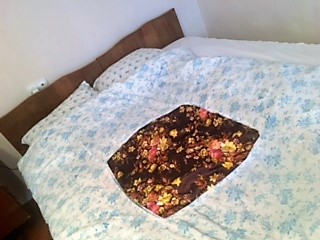
Every wash day, be grateful you live in Hayastan. Here, quilt covers are well-designed, with a large diamond hole cut in the middle of the top side. Think of the hours you save while the rest of the people of Europe are wrestling with the corners of their duvets.
Yogurt is great for the skin. The women in my house lather it on and let it dry. Then they wash it off with warm water. It’s good for getting rid of spots, and for soothing sunburn. They all have lovely complexions, so I know this works.
Hooked on Trivia? Compulsive when it comes to crosswords? Proud of your performance at the pub quiz? Don’t risk being caught out by a question on the arts in Armenia–it could come up at any time. I am as fond of a general knowledge test as the next nerd, but I will confess that, up until very recently, my mental file on all things arty in Armenia was very slim indeed. I could still easily be stumped but, in a spirit of information-sharing, I pass on such knowledge as I now have. At the very least, it may help you set fiendishly difficult questions for your foes. Ch’argi. Ձարժե It’s nothing. Khantrem. խնդեմ You’re welcome.
Artist: Martiros Saryan is founder of the modern school of Armenian art and a painter whose pictures of the Armenian landscape you may well have seen–not least on the dress I had specially made for my swearing in as a Peace Corps Volunteer. My favorite thing about the 1923 painting is not the depiction of Ararat (although I DO love that mountain), but the women dancing at my hem (there is a detail below). Women and music, plus mountains were a bit of a theme for Saryan. He lived from 1880 to 1972 and was awarded the order of Lenin 3 times. If you are unable to see me and my dress, you can always visit the M. Sarian House-Museum in Yerevan where many of his paintings are displayed.
Fashion Designer: I love the work of Edgar Artis who designs dresses using every day objects. Will my next special occasion dress be made from salad–or pencil sharpenings? Follow Edgar on Instagram to see all his fabulous creations.
Literature: The big daddy of the Armenian writers is William Saroyan who, like those pub quiz staples Oscar Wilde and George Bernard Shaw is famous for saying lots of wise and memorable things, many of them contradictory. If you need a quote about writing, madness or being Armenian, he is your man. He won the Pulitzer prize in 1940–his is a handy name to know if you are asked to list five such winners. He is quoted at the end of the Armenian film “The Promise”.
“I should like to see any power of the world destroy this race, this small tribe of unimportant people, whose wars have all been fought and lost, whose structures have crumbled, literature is unread, music is unheard, and prayers are no more answered. Go ahead, destroy Armenia . See if you can do it. Send them into the desert without bread or water. Burn their homes and churches. Then see if they will not laugh, sing and pray again. For when two of them meet anywhere in the world, see if they will not create a New Armenia.”
Poetry: I want to give a shout out to Goris’ local boy made good: Axsel Bakunts, a poet and short story writer born in Goris in 1899 and killed on Stalin’s orders in 1937. His crime: alienation from socialist society. As a schoolboy in Goris, Bakunts was first arrested at the age of 15, for satirising the town’s mayor. Not much of Bakunts work is published in English–or if it is, it is not available online, or here in Goris. Wondering how Bakunts’ writing compared to that of Jonathan Swift or Flann O’Brien, two great Irish satirists, I asked my Hayeren tutor, a native of Goris, if she knew what Bakunts had said that so enraged the town. “Probably no-one read it” she said “It was just talked about, and that was enough”. Interesting to discover that sort of thing happened even in an age before Twitter…
Here in Goris there is a rather lovely small museum commemorating Bakunts, in the house where he was born. In addition to displays of many artefacts, paintings of his mum, and so on, there is also a beautiful garden where would -satirists can sit and think creative thoughts.
Film: The Golden Apricot Film Festival takes place in Yerevan in July and so presumably my knowledge of Armenian cinema will be broadened beyond The Promise, this spring’s Hollywood take on the Armenian genocide. The film, though hamfisted and with a couple of story twists of dubious morality (tut), is worth seeing. I didn’t need a hanky though, except to stifle giggles.
Music: The Armenian duduk is to Armenian music what the uillean pipes are to Ireland and the banjo is to Bluegrass. This wind instrument made from apricot wood could be useful to know if your Jeopardy category is music for 500. A contemporary of all the chaps above is Soghomon Soghomonian, ordained and commonly known as Komitas, (Armenian: Կոմիտաս; 26 September 1869 – 22 October 1935) an Armenian priest, musicologist, composer, arranger, singer, and choirmaster, who is considered the founder of Armenian national school of music. The wailing noise of the duduk is the soundtrack for Komitas’ tragic life. Captured and deported by the Ottoman government during the genocide, he did escape with his life, only to suffer post traumatic stress disorder. He lived the rest of his days in terrible torment, in and out of pyschiatric hospitals. You will need your hanky for this music.
Martin Mkrtchyan, a sort of cross between Tom Jones, Daniel O’Donnell and Donny Osmond, manages to be much more cheerful. Recently, Elsa and I watched a recording of a big concert he gave in Yerevan’s Republic Square at New Year. Good stuff.
Much as in Ireland where I grew up, most of the songs in this ancient country but new and vulnerable republic are nationalistic–about the beauty of the land, the value of birthright, and courage in the face of enemies. It’s like living with the Wolfe Tones. The song below was sung to me by Arsen, aged six. He pumped his fist and cocked his imaginary gun as he sang. Boys here must go to be soldiers when they graduate high school and Arsen is already ready for the fight. I hope that here, as in Ireland, they will reach a level of security and prosperity that will allow their young singers to write of something other than threat and loss and war. More Snow Patrol than Stiff Little Fingers, if you like…
There is one well-known song that has an unexpected link to Armenia–Rosemary Clooney’s Come ona My House. This, it turns out, was written by the aforementioned William Saroyan and his cousin in 1939 as they motored across America. Once you know this, the plums, apricots and pomegranate in the lyrics make complete sense. The cousin later went on to have great success as one of Alvin and the Chipmunks. Saroyan wrote no other popular songs. Now if that isn’t the stuff of great trivia quizzes I don’t know what is. Listen to Rosemary and enjoy.


 Together he and the boyfriend of the English speaker hauled me upright and then steered me across the road and up the hill to the hostel. Back in the kitchen, he provided a wet towel, tissues, a glass of water, iodine and a mirror. I have reopened an old scar on my forehead (I have always been accident prone), a badly bruised nose, a thick lip and a chin with road burn. My teeth and glasses are not broken.
 When I first heard I’d been accepted by Peace Corps, my worst fear was falling. I imagined it would happen in winter, and that snow and ice would be involved. Four months in, and at the height of summer, I have already fallen twice. I have also engaged numerous friends and strangers to hold my arm on steps and narrow stretches. On the cable car in Jermuk I screamed so loudly approaching the step-off points both top and bottom that they stopped the entire contraption each time to help me off. Thank goodness it wasn’t busy, but I would have made a fuss even if it had been. I don’t do velocity and forward motion is not my friend.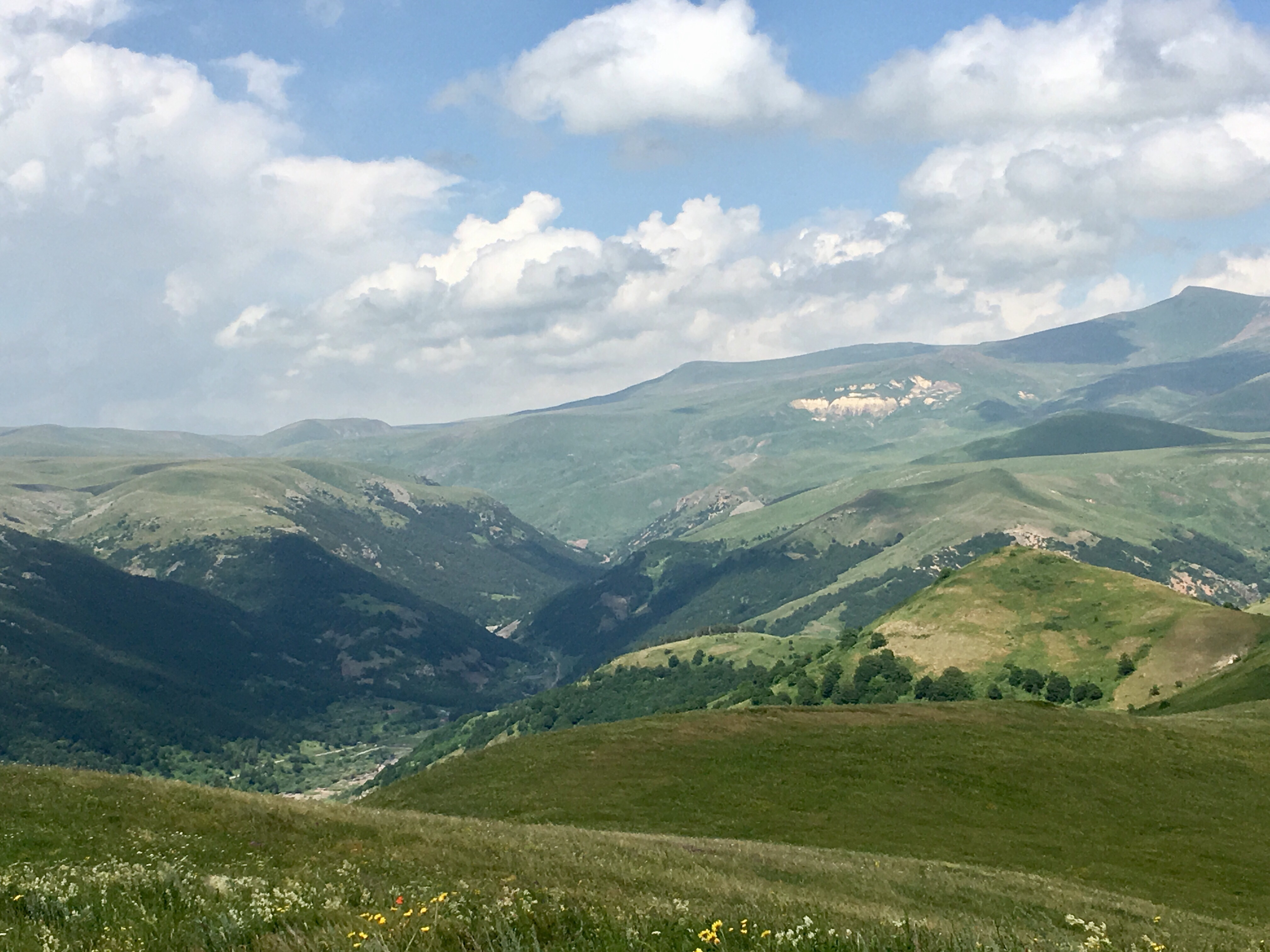








 In among the hardware stores, there are a plethora of toy shops and stationery stores. While I am sure that people here do spend more on small children than they should, it seems hard to believe that there is enough trade to keep all the toy shops going. And surely stationers must have to shift an awful lot of envelopes, biros, erasers and post-it notes to keep even the most ramshackle roof over their heads? I do love a stationery store though. In the last week I have bought water colors and brushes, rolls of two-inch tape in the colors of the Armenian flag, and some very pleasing primary school posters featuring old-fashioned illustrations of fruits and vegetables. I have my eye on some stencils and am looking for glass paints and blu-tack. It’s all-consuming.











 Literature: The big daddy of the Armenian writers is
 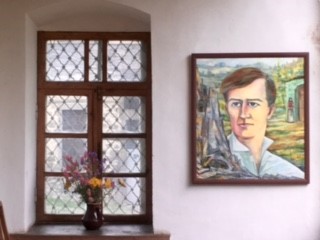 Poetry: I want to give a shout out to Goris’ local boy made good: Axsel Bakunts, a poet and short story writer born in Goris in 1899 and killed on Stalin’s orders in 1937. His crime: alienation from socialist society. As a schoolboy in Goris, Bakunts was first arrested at the age of 15, for satirising the town’s mayor. Not much of Bakunts work is published in English–or if it is, it is not available online, or here in Goris. Wondering how Bakunts’ writing compared to that of Jonathan Swift or Flann O’Brien, two great Irish satirists, I asked my Hayeren tutor, a native of Goris, if she knew what Bakunts had said that so enraged the town. “Probably no-one read it” she said “It was just talked about, and that was enough”. Interesting to discover that sort of thing happened even in an age before Twitter…




 Marigold Moment