Where am I? It looks familiar

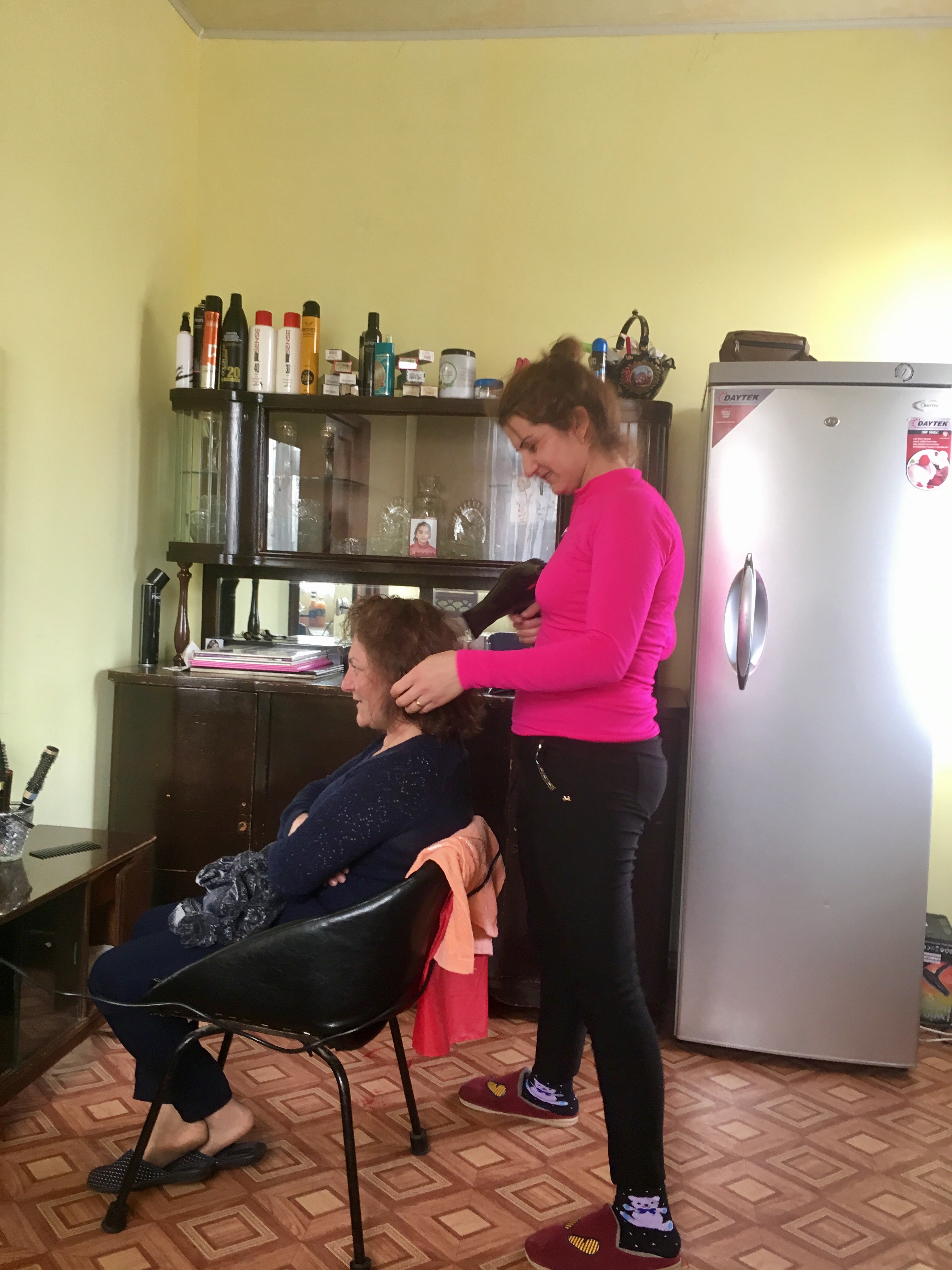
Sitting on a chair in Ani’s kitchen, I had a flashback. Ani, my new next door neighbor,was drying my hair and was about to style Elsa’s. It reminded me of when we were children in Belfast, and used to go to our neighbor’s house for haircuts. June lived at the end of our street and did hair in her spare room. One day she put my hair in rollers and styled it as though I was thirty-five. It was 1971 and shortly after my mother died. I was ten years old, and June thought I should look and behave like a grown woman.  My hair, which had hung quite happily to my shoulders,  was hair-sprayed high on my head like a Gorgon helmet. I was horrified. Luckily so was my father, who did a double-take when I came home looking like Sophia from the Golden Girls.  I combed out the stiff curls and resumed use of my bobble.

Life in this village in the shadow of Mount Ararat is very much like growing up in Ireland in the 60’s.  Women make pin money doing neighbors’ hair. Small children squeal with delight sitting on their father’s knees and holding the steering wheel for short drives. Households grow their own fruit and vegetables. Wives make jam, pickles, relish and sauce to see them through the winter. Husbands and sons are very rarely seen in the kitchen, except to eat.  Bedrooms are not heated. Everyone shares the same bathroom. People speak to each other when they pass in the street.  Kids play outside without hovering adults, and old women ask all young women when they will get married.  In the last week, my memory has been jolted many times. I feel I know where I am. It may not be very PC or 21st century to say so, but for the most part I feel fondly secure and at ease. 

I imagine for the younger volunteers, particularly the women, there is more of a culture shock. It is clear that early marriage and homemaking are the done things here. Answering endless questions about one’s marital status and prospects can be tedious.  For women used to wearing t-shirts and jeans, or going out in a tank and running shorts, it is a shock to be asked to wear a dress, tights, make up and even heels to work, and to be advised to cover up at all times.   Women– even me–are not allowed to entertain gentlemen callers in our rooms, and reputational damage may result from having a gentleman caller at all.  This is difficult for a group of people who have traveled the world sharing tents with almost-strangers and forming study groups with peers of all and any gender identities. 

Of all our 42 volunteers, I am probably the one with the least international experience. We have women who have taught in Uganda and South Korea, Guinea and Hungary. Men who have hiked across Jordan, learned Arabic in Lebanon, and camped out in Mongolia. Let’s face it, my only overseas experience has been in America itself. But what I lack in air miles and war stories I make up for in time travel. I have been here before, 40, nearly 50 years ago in Ireland. 

I can cope when I see a toddler bringing a half bottle of cognac to her father, so he doesn’t have to move. I first saw it in a hotel in Donegal in 1968.  I get it when the woman of the house says “Eat. Eat” and piles everyone’s plates high. My Aunts Annie and Lizzie used to do that, in the days before people worried about portion control or calorie counting. I remember our immersion heater, and my father getting up to turn the water on 15 minutes before we all had a wash, drying ourselves more often than not with the same scratchy towel. 

Today my Armenian language teacher, a lovely woman of 30 or thereabouts, told the story of her broken night’s sleep. She is staying with us in our border village, far away from her home in the capital city, Yerevan. At four in the morning she was woken up by mass activity in the street “my heart was thumping. I was sure the Turks had invaded and were coming to kill us in our beds. I thought  ‘it’s happening again and I will never get home'”. The noise subsided and eventually Sona calmed down enough to go back to sleep. At 6am she heard the same rampage. By now it was getting light and so she got up to look out the window. A large flock of sheep were being hastened down the street. She had to pick her way to school through piles of sheep droppings.  

Sona told the story against herself–the city girl terrified by country sounds.  But her story revealed something else: a deep-seated fear of history repeating itself; the terror of being small and vulnerable and surrounded by people who you feel will do you harm. Her story took me back to Belfast again and the nights in the early seventies when my dad would go out. I’d lie in bed taut for the sound of bombs in the city, or the welcome crunch of his car pulling into the drive. Like Sona, I was never in fact in any danger, but the fear was real.  As I said,  I’ve been here before. 

Posted in Armenia, Belfast, Borders, Cross-cultural understanding, family, Food, Northern Ireland, Nostalgia, Peace Corps, Terrorism, Village life, Women | Leave a comment

From Anne Arundel County to Armenia: Week One as a Peace Corps Volunteer.

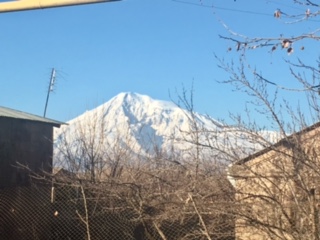
FullSizeRender (6)I have a view of Mount Ararat from my bedroom near Artashat in Armenia. The mountain, the national icon of Armenia, is now in territory claimed by Turkey, but the people here still consider it very much their own. The peak dominates the landscape, flat land that doesn’t see much rain. Every day in Shady Side, I was awed by the beauty and size of the Bay. Now I am in a landlocked country, but fortunate to look out upon another wonder of the world: Noah’s mountain, the peak where the Ark is said to have run to ground.

I live within five miles of the Turkish border, closed because of century-old tension between Armenia, and its neighbor. All around are lookout towers, small huts on stilts from where the Armenian army can stay watchful, night and day. 1915–1918, the Turks killed as many as one and half million Armenians living on land the other side of the mountain. Not for the first time in this part of the world, borders were brutally redrawn. Every day the people in this village see the mountain they can no longer climb. It reminds them of the relatives and land they lost.
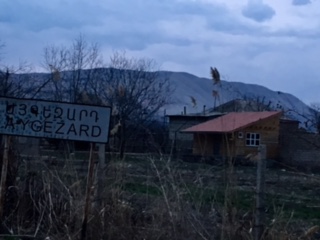
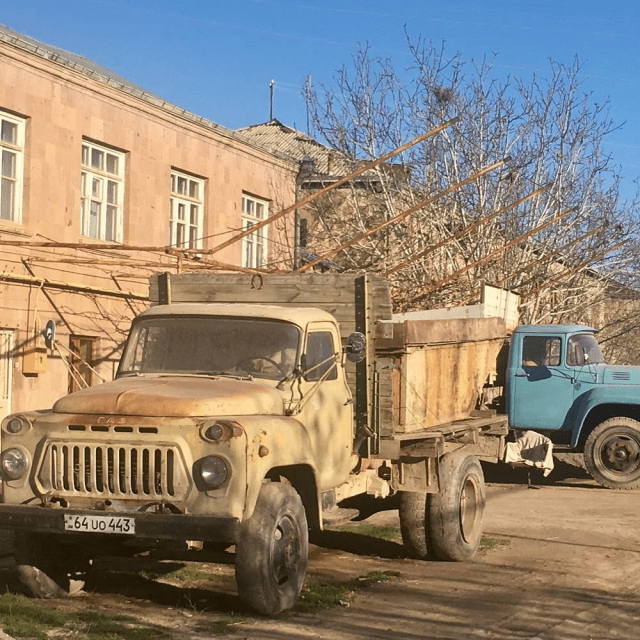
FullSizeRender (7)My village is much the same size as Shady Side and is about the same temperature at this time of year. There are a couple of small general stores, but there the similarity ends. There are no bars and restaurants. Certainly no dry cleaner or bank. The roads here are impacted dirt and there are no sidewalks. Some men work on Soviet-era cars in front of their houses. Others try to keep all-pervasive dirt off their Mercedes. As in America, people choose to spend their money in different ways. Older women sit outside in the sun, hailing everyone who goes by and taking particular interest in the sudden influx of Americans—20 of us enrolled in an intensive 10-week language program, to prepare us for two years’ service in this country the size of Maryland. Everyone knows we are here and is eager to talk. They ask questions about our families, and houses, and life in America. They marvel at American house prices. The average wage here is $300 a month. Every house keeps chickens—my host family has five—and a garden with apricot, cherry, walnut and apple trees. Sheep are never far away. Our village name translates to “Garden of Jewels” and Elsa has planted tulips outside the front door. They aren’t in bloom yet, but it won’t be long.
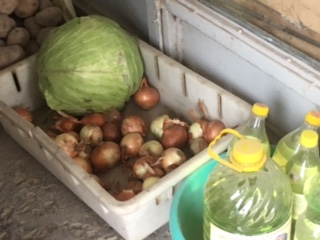
IMG_2657 (1)I am involved in a youth development program which the US Peace Corps has been running for the last twenty-five years at the invitation of the Armenian government. In order to prepare, I take language lessons for 4 hours every day, and then afternoon classes on the country’s economy, politics, social and cultural norms, and its development needs. Elsa packs me a lunch of red bean salad or coleslaw (cabbage is big in these parts); lavash (paper-thin bread ) rolled into a burrito and packed with egg, spinach and cheese; and a locally-grown apple the size of a grapefruit. An old plastic bottle is filled with water from the tap. No Pepsi or Coco Cola products in this house.

After class, I stop to mime a chat with Malan in the small local shop. Her shop is next to the hairdressers where I might splash out on a wash and blow out next weekend—a good way of getting to know my neighbors. I could easily do my hair at home though, where Elsa and Gevorg have a beautiful tiled bathroom with a hot, powerful shower. I have my own bedroom, much bigger than the one I left in Avalon Shores. Someone—I don’t yet have the language skills to find out who—has painted the bedroom walls in the manner of a French chateau. It might be Alla, Elsa’s daughter, who has taken cake FullSizeRender (4)decorating lessons. Now that I have seen what she can do with royal icing, I wouldn’t be surprised if she was the one who turned the first-floor bedroom into Marie Antoinette’s boudoir. It is quite the most beautiful bedroom I have ever slept in. The furniture is mid-century style, but lacquered, and the sheets are 70s retro. My house in South County is often described as eclectic, because it is furnished with a million yard-sale finds. It is pure serendipity that Peace Corps has placed me in the home of people who like color and pattern just as much as I do. I don’t suppose my luck can hold. In June, I will move on to another family, and another part of the country where it is likely that life will be much more basic. Other volunteers have told me about their “lick and promise” washes deploying a tea kettle and wet wipes, and many houses in this village still have outhouses. For now, I count myself lucky to have a washing machine and western toilet to use.

FullSizeRender (2)Elsa is in her 50s, like me. She is a great cook. I come home every night to omelette and fried potatoes, or pork and tomato stew, or maybe a delicious Armenian soup called sepass. This is made from yogurt and barley and is served with cilantro. Served hot and eaten with bread, it is the ultimate comfort food. There is always a chopped salad of an imaginative and colorful variety, a bowl of plain yogurt to use as a relish, and a platter of fresh dill, watercress, tarragon and cilantro. The children eat the herbs in handfuls. Dinner is served with homemade apricot juice and followed by coffee, strong and dark in tiny cups. Over dinner in the kitchen, the family quiz me about my day’s learning and laugh when I pull faces and try to act out incidents I don’t yet have the words to describe. The smallest grandchild, Gayane who is 3, knows the most English, for she listens to pre-school rhymes on her mother’s iphone. I don’t yet have a phone data plan and the house has no internet. The lack of digital access is the thing that that we volunteers find most difficult. Most of our group are in their 20s and have boyfriends, girlfriends, and family at home who expect to talk or message with them every day. It’s just not possible.

FullSizeRender (5)

After dinner, we sit in the living room and watch Indian soap operas dubbed into Armenian. At the best of times, I can be overly dramatic. It is probably dangerous that I am picking up vocabulary and accompanying hand gestures from Bollywood actors. Arsen, aged 6, watches Japanese anime, also dubbed into Armenian, a unique and ancient language dating from 450 BC. There are elections here today, Sunday (April 2) and so last night we watched a debate and town hall discussion. The political make-up of the government is not expected to change here but big constitutional change is underway—a shift of power from the role of President to the role of Prime Minister. More than that, I don’t yet know. Voting is at the local school. Later, we are going to the farmer’s market. This is an Apostolic Christian country and was the first place outside the Middle East to follow Christ’s teachings, way back in the 3rd century AD. Despite this, there are few signs of active worship in my new community. I haven’t seen a church yet—or any other house of worship. Across the country, only 3% of the population regularly attend Apostolic services.

The coffee table in the living room is always piled with chocolate, wrapped candies, pomegranate, orange slices, dried fruit and cake. Neighbors, family and friends will be in and out all evening and must be (over)fed. In Armenia, hospitality and family closeness are key: all are welcome and grown children stay close. Elsa’s daughter Alla and her husband Ararat and their children Arsen and Gayane live just a few doors away. Alla’s sister Lala and her brand- new husband Edgar live in the nearest town. Lala is working in Moscow this week, but she calls home every night. Elsa works in the house all day, and has her grandchildren after school. Gevorg, her husband, goes out to work but I have no idea what he does. I only know how to say Volunteer and Teacher and he is neither of those.

I met these people only a week ago, but it is not at all awkward to live in their home. I have watched videos of Lala’s wedding. I haven’t met her yet, but we are already friends on Facebook. (I am able to connect via my teacher’s hot spot during break at school.) Gayane and I sing “No more Monkeys…” while she jumps on the distinctly non-bouncy divan in the living room. My tablecloth with the map of America is on the table in front of the window and has a large vase of artificial roses keeping it in place. Arsen has told me about the Armenian player who is part of the Manchester United soccer team and laughed when I mixed up the word for swimming with the word for shower. He hopes to swim to America, and visit New York and Los Angeles, he says. Gervorg pretends to be a professor and bellows questions at me in louder and louder Armenian tones until I put my head in my hands and say “Che gitem. Chem haskanoom.” I don’t know. I don’t understand. There is a three-bar heater in the living room, and an overhead light. There are family photos on the credenza and a framed photo of a woman I think is Gevorg’s mother in pride of place above the flat-screen TV. Every house I have visited seems to have something similar. We volunteers have compared notes and think that photos in this style –formal, solemn and large—must be a tribute to honored, dead relatives. Elsa and Gevorg had three children. Their son, Geram, died last year. He was 26 and killed in a traffic accident in Moscow. Geyorg told me about him, showing me a snap of all three of his grown children. I looked at the photo and touched his forearm. There are no words in any language. Roads and cars and drivers here are dangerous. As in all other parts of the world, Peace Corps Volunteers are forbidden to drive. Works for me.

I have to remember to take off my shoes inside the front door and change into slippers. Notice has been taken of my lack of socks. Everyone was more comfortable today when I swapped dress pants and bare feet for a dress and panty hose. My purple dress is set off with a green, chunky necklace. Alla asks me, through pointing at her own jewelry, why I don’t wear gold: voski. After many dictionary consultations, I explained, haltingly, that it is too expensive, and I tend to lose things. The conversation turns to wedding rings. Why don’t I have one? I shrug and dip back into the dictionary. Gevorg promises to find me a good Armenian man. I feel I could do worse.

Will I enjoy two years in Armenia? It is too soon to say, but the signs are good. Ask me again in June when the irises are blooming in Shady Side, and the day lilies are about to open. Ask me when Pete is serving fresh rockfish and soft shell crabs at the Brick House. Ask me when it is my friend’s birthday and I can’t buy him a Famous Grouse or a glass of Pinot Grigio at Petie Green’s. By June though, I will have been sworn in as a fully-fledged Peace Corps volunteer (the US Ambassador may attend the ceremony, because this is the silver anniversary for Peace Corps in Armenia. This is a very big deal.) By June I will know what and where my two-year volunteer project will be. I could be working in a big town, or a tiny mountain village where it is winter for 6 months of the year, and the water and electricity supplies constantly fail. In June, here in my new home, the apricots will be ripe and it will be time to make jam. Arsen’s piano performance will have taken place at our village school, and Alla will be icing a cake for her little girl’s birthday. Ask me again then.
17632324_10154459579325382_7601925991251722998_o.jpg

Posted in America, apricots, Armenia, family, Food, friendship, Mount Ararat, Peace Corps, personal failings, travel | 4 Comments

Home thoughts from abroad


Armenia2

A little bit of love from Liz in Armenia

I didn’t hear about the Westminster bombing until 24 hours after it happened. I was in transit, and then in a place without papers, TV or internet. This saved me hours of worry because the dead and maimed had been named by the time I caught up with the news. When I saw the pictures and read Facebook reports of the fear and chaos, I had a flashback to 9/11 in Washington DC and the Al Quada atrocities in Pennsylvania and NYC that day; to the Paris restaurant bomb where my friend’s son and his new wife stepped out over the dead and injured to survive; and to the many bombs and shootings that killed more than 3000 people over 30 years in Northern Ireland.


I lived in Belfast from 1968 to 1979, and went back  there to work on and off in the 1980s.  I still shudder at the memory of the minister’s son– 12 years’ old I think–and the others blown up at the bus station I passed through every day on my way home from school. That was the IRA. I remember too the red-haired girl my age who spoke so well at her father’s  funeral: her dad shot dead in a random attack by loyalist paramilitaries. Could the same thing happen to my dad? Fear clutched at my teenage heart. I think back to the undercover police car on our street, protecting a neighbor who was senior in the RUC, and the time when 25 year old Elizabeth McCracken,who worked with my father, was killed by a bomb at the La Mon hotel, maybe 10 miles from our house. As a young journalist I interviewed a man hit in the head by a British soldier’s plastic bullet. He had a crater in his skull and permanent headaches. He was hard to interview because he had difficulty remembering and ordering his words.  So much loss.

Why am I telling you all this? Well, to indicate the deep damage terrorism does– not only to those hurt and bereaved, but to those on the periphery. The blood seeps everywhere and leaves an indelible stain.

Passing though Paris Charles De Gaulle Airport last week, I heard of the peaceful death of NI Deputy First Minister and former IRA strategist Martin McGuinness. I did not mourn his passing. By the time I clicked into my computer 24 hours later posts on my Facebook feed were full of praise for his part in the Northern Ireland Peace process. From what I saw, it took two Northern Ireland-born journalists– the Spectator’s Jenny McCartney and NBC’s Bill Neely –to temper the adulation for McGuinness’s work in the last 20 years with a reminder of his early days, directing, if not himself detonating, bombs, and sending street fighters on killing sprees. (See their journalism below.)

https://www.spectator.co.uk/2017/03/what-martin-mcguinnesss-eulogisers-would-like-to-forget/

http://www.nbcnews.com/news/world/ex-ira-commander-martin-mcguinness-leaves-divided-legacy-analysis-n738006

Like me, Jenny and Bill come from the Protestant tradition and were raised and educated in varying degrees of affluence in Belfast. They are about my age. Martin McGuinness was born 10 years before us. He was Catholic and brought up in Derry at a time when voting rights were skewed in favor of educated Prods, and when people living in poverty were denied jobs because they had a Bogside address.  He had a lot to be angry and vengeful about. He was right that much needed to change in Northern Ireland.  In Belfast in 1968, (of course influenced by my family– I wasn’t THAT precocious) the tween me supported the peaceful protests of the civil rights movement. But if I had been in Martin’s DM boots, would that have been enough?  I don’t know. Would I have picked up a placard or a kalashnikov? I can’t say I’m certain.  I don’t like McGuinness’s choice but I understand what drove it.

For the record, neither did I  mourn the recent death (quiet, peaceful) of Northern Ireland First Minister Ian Paisley. Mr Paisley did not himself commit acts of violent terrorism, but his words in the ’60s, ’70s and ’80s were often dangerously inflammatory and I have no doubt provided fuel for loyalist paramilitary firebombs. His hands were clean, but his tongue was a terrorist weapon. His speeches and preaching fired up disgruntled working class Protestants who, with their jobs at the shipyard fast disappearing, needed territory and hegemony to feel powerful and relevant. I find Paisley harder to understand than McGuinness. Just as Trump is not my President, so Paisley was not my Protestant.

It is good of course that both McGuinness and Paisley bought into the Peace Process, working with the British, Irish, American and European governments — and Nobel prize winners John Hume and David Trimble, loyalist paramilitary leader David Ervine, countless church leaders, and endless community advocates–to agree an uneasy truce that saw them work together fairly well for 20 years largely blast-free years. Thank you for that, gentlemen.

But can one belated right undo countless, terrible wrongs? Think of the lives and time and money that could have been saved if angry people could have sat down and talked in 1968, instead of leaving it for thirty years…

When I and my siblings fought as children my dad would always say “You’ll have to make it up in the end so you might as well make it up now.”  We never listened to him and I don’t suppose the world’s most recent batch of terrorists, or those still to hatch, will heed these words either. It will mean more broken lives, broken hearts and broken countries.

Sit down and talk about it, damn you, and stop blowing up our iconic buildings and best people. There’s something in it for you. There is no such thing as suicide peacemaking. You’ll likely live a long and happy life.  I’ll get Bill Clinton to speak at your funeral.

Posted in America, Northern Ireland, Politics, Terrorism | Leave a comment

Tarragon soda and salad with sorrel

Milhous is my beef-up buddy. It will be his role to stiffen my spine and strengthen my resolve when I have a wobble in the Caucasus. For more than thirty years he has provided bracing advice and general bucking up every time my bottom lip trembles, wherever in the world I happen to be. Milhous is also my bulk-up buddy. He likes his tuck, and has pressed me to a pudding more times than it seems decent to report. 

On vacation in the former Soviet Union in the year of Chernobyl (we travel well and widely, but not always wisely) we finished each day with ice cream, cake and champagne and tried to convince ourselves that an evening game of chess would work off the calories. Strangers to Cyrillic script, we quickly came to recognize the shape of the Russian word for restaurant. We pronounced the word as “pectopah” and made sure to try a new one every day. 

At my “soft landing” resort this week in Armenia, all the signs are in Armenian, English and Russian. Seeing Pectopah yesterday, I resolved to have an extra plate of everything on offer  in honor of  Milhous. 

Milhous is particularly partial to soup. He’d be happy here. So far, I’ve had a delicious yogurt soup with barley, and a lentil soup made with beef stock. I passed on chicken soup with rice yesterday, and missed last night’s bortscht. (Milhous is tutting, but there will be more beetroot soup in my future.) At lunch today, I had a vegetable soup with yellow split peas. 

The soup is served with lavash, a paper-thin bread. The salad bar always has beets and grated carrots. Twice I have enjoyed Aveluk, a kind of sorrel, native and particular to Armenia. Like collard greens, it can’t be eaten raw, but is delicious boiled, seasoned, cooled and served with yogurt.  Yogurt, sometimes with dill, is offered as a savory supplement at every meal. So is cheese, white and salty. I am delighted to say that fried potatoes also feature a lot–breakfast, lunch and dinner. Tonight’s dinner delights included an eggplant salad, and a side dish of beetroot tops. Delicious. 

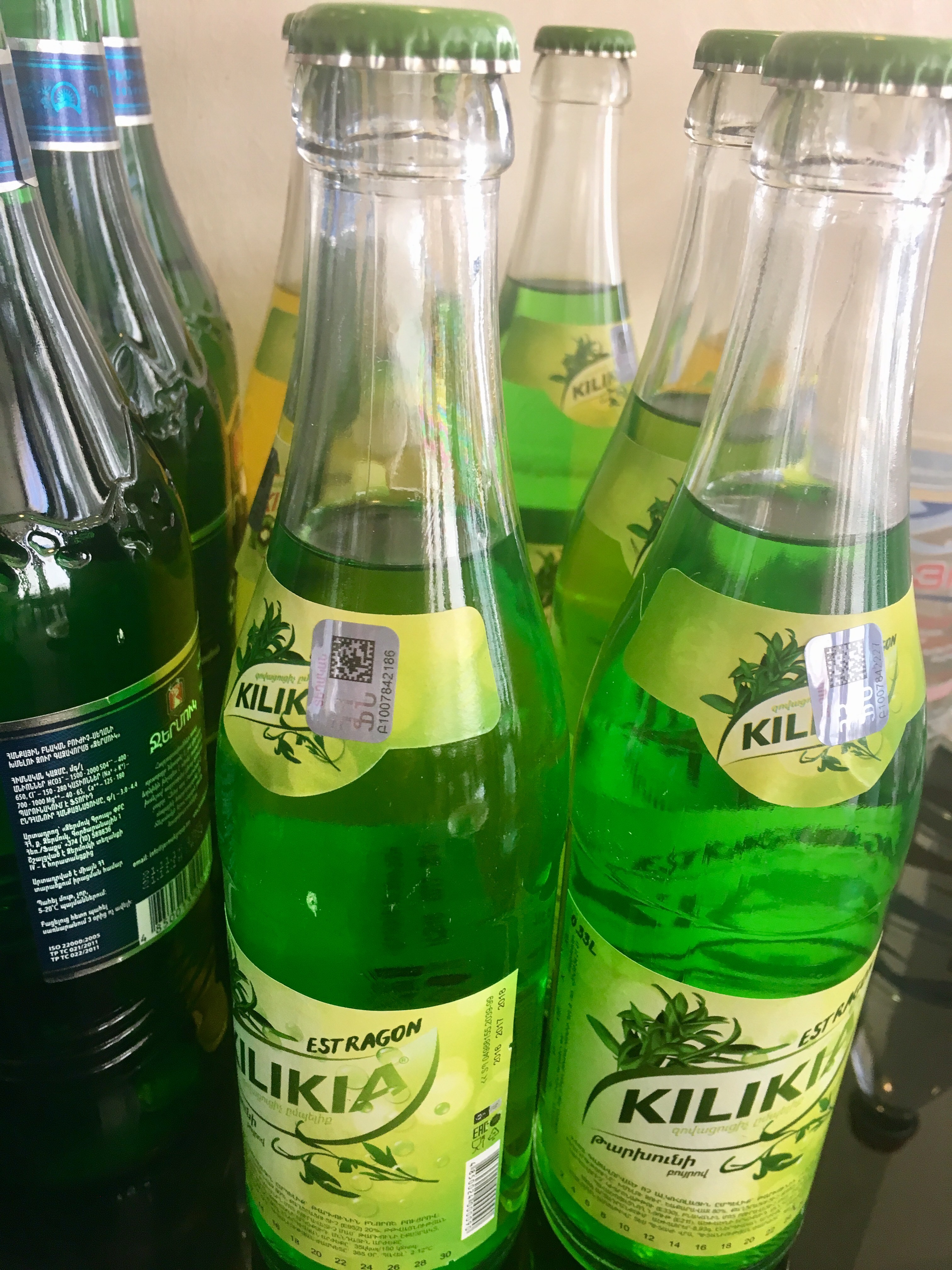
It would be ridiculous to opine about a whole nation’s cuisine based on two or three days at one hotel, but here are my findings so far: local Granny Smith apples are the size of grapefruits. Grapefruits are pink.  There are a wide variety of cloudy fruit juices and lightly carbonated drinks that are not made by those global brand name companies that dominate everywhere else. One fizzy drink is flavored with tarragon. It is a terrifying shade of green. I liked the herbal flavor but found it too sweet to drink. 


Nursery puddings are a staple of our breakfasts here in the mountains. Creamed rice yesterday, semolina this morning. Tapioca cannot be far away…

Back in Washington DC, I have been lucky to spend time with the food writer Marian Burros whose books feature many Armenian recipes. Chances are, you won’t be able to find aveluk in a store near you, but you could do worse than check out Marian’s books and do some Caucasian cooking, wherever you are in the world. Raise a glass to Milhous as you clean your plate. 

Aveluk

Posted in Armenia, Cooking, Food, Milhous, Peace Corps, travel | 2 Comments

From Washington DC to Yerevan

You’ll have heard of the Smithsonian of course. And the Lincoln Memorial. And the US Capitol. These are the icons and institutions for which Washington DC is rightly famous. You will not have heard of the Hyatt Place hotel, built where an unlovely part of New York Avenue meets rundown North Capitol Street. This is a hotel struggling to do business in one of the worst parts of America’s national capital. I want to give the Hyatt Place staff and management a shout-out, because they are doing a great job against unfavorable odds.

When I heard we would be staying at the hotel for our volunteer staging, I will admit my heart sank. The stretch of street, which for years has been known only for its gas stations, liquor stores and homeless population, has no good restaurants and is not the sort of place that invites visitors to take an evening stroll, an outdoor phonecall, or anything other than a speeding Uber.

untitledI was pleasantly surprised by the hotel. The rooms are large and well appointed. The beds are super comfy and the hot water is instant and plentiful. The bar serves great food 24/7 (try the hummus trio). But the hotel is really distinguished by the excellence and attitude of its team. Reception staff greet guests with a warm hello every time they see them pass. The check out guy manhandled my luggage today without complaint— the bell hop was busy at the time. A number of us were confused about breakfast times this morning and turned up 40 minutes late. We inquired about leftovers and were passed great plates of waffles, bacon, egg, biscuits and fried potatoes through the kitchen serving hatch, all without complaint. The coffee guy stopped his clear up, righted the urn, and left the maple syrup sitting until we’d finished eating.

Signs in the elevators implore guests to root for the hotel as it perseveres through the slow and painful regeneration of the area between Union station and Union Market (both of which are worth a visit) in Washington D.C.  The image on the poster implies that guests may be disturbed by ongoing neighborhood construction, rather than rolling drunks and pushy panhandlers. But the overall message is clear: give us a chance, we are trying really hard to make this work. I hope they do. I am on their side.

While I am doling out kind words, praise to Air France with whom we flew first to Paris and now to Yerevan. Airplane food included a very respectable celeriac remoulade, Camembert and prune tart. Pasta was served with tomato sauce, feta and fresh basil. There was free champagne. Shat Hamove as we say in Armenian– very tasty.

In a post-prandial line for the toilet in the plane, I struck up a conversation.

“Are you Armenian?” I asked the man in front of me. My tongue’s first formal outing in this strange new language.

He said that he was, and offered me his place in the queue.

“I am grateful” I said, and was flattered when he said “oh, you speak good Armenian.”

“Yes”. I wasn’t preening:saying “oh you are too kind. I speak only a few words” seemed much too complicated to try out just then.

I explained we are volunteers from the US Peace Corps. I told him I was American and Irish. He liked that.” Irlandatsi.”.

I pointed at the bathroom and named it, rather like a toddler being potty trained. He nodded encouragingly. “Shat lav. Shat lav”. It sounds scatalogical to ears attuned to English, but it just means ‘very good’.

A few minutes later, I told him I was happy, satisfied and grateful. He showed polite interest but wisely asked no follow up questions

We said goodbye and he took his turn in the stall.

A successful exchange on bathroom matters.  It is the beginnings of a good start.

Posted in America, Armenia, eating out, Peace Corps, travel, Washington DC | 2 Comments

For my daughter, with thanks

Shadyside (45 of 265)a

Superhero cape not featured

Ever since she was nine years old, my daughter has held my hand when we are out and about. She does this to stop me tripping or, worse, running  headlong into traffic. Her caution is well-advised for I can fall over my own feet, and  don’t tend to follow road rules well.

Star knows I get dizzy and disoriented when I am stressed, and that this causes me to fall over and bang into things even more than usual. I did this on Saturday and she dealt with it firmly. “Sit down over there so you don’t hurt yourself. I’ll do it.” she said,  as I tried to wrangle wet wipes and dry shampoo and siracha sauce into a recalcitrant hold-all. “Look where you’re going” she said as she steered me and my tray to the sushi counter at the Chinese buffet, and successfully maneuvered me back to our booth without a nasty spill. “I got this” she said as she wheeled two enormous suitcases into the hotel and commandeered the bellhop. I was very grateful, and tried to say so, in a series of anxious, tearful bleats.

In truth, I hadn’t really expected my daughter to be the person to drop me at the door to my new life. In my head, I thought I’d bundle my bags into an Uber and arrive at the Peace Corps staging hotel, all independent and self-sufficient. She doesn’t get up early. She has stuff to do at weekends. She doesn’t like goodbyes.  How wrong could I be? On Friday night she organized a surprise farewell dinner at a favorite restaurant. On Saturday she turned up bright and early to grapple with the packing, and, following a hasty last lunch ( “Something light. Can you eat some sushi?”) she drove me to DC, parked the car, dismissed the valet, and stood with me in the check-in line. Naturally, all the other Peace Corps volunteers assumed she was the one on her way to adventure. This was partly because of her age, but also because I was rocking pathetically and sniveling more than a little–the kind of embarrassing mother who shouldn’t be let out of the house.

In truth I forget that she is grown up, and not only practical and capable, but also mature and empathetic. Since I first mentioned this Peace Corps carry on, she has been a trooper. She hasn’t questioned my desire to do it. She hasn’t tried to persuade me to stay home. This weekend, she bit her lip, squared her shoulders and set about giving me a good send off. I am amazed by her. I am proud of her. I will miss her more than I can say.

Shadyside (29 of 265)a.jpg


Posted in Armenia, family, Great weekends, joy, Mother/daughter dynamic, packing, Peace Corps, personal failings, travel | 7 Comments

Amnesia and Arafat: The World According to Barkis

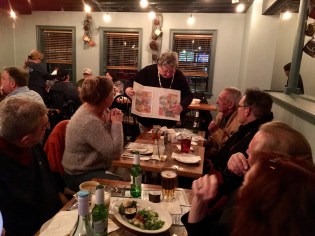
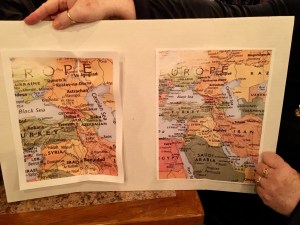
IMG_2515Margie, a docent and all-round decent person, led the learning at my going-away dinner. Her project board featured maps of Armenia. A pop-quiz quickly confirmed that no one knew where it was. Kevin was closest and Michael (who couldn’t join the party until after his nightly viewing of Jeopardy) was also in the ballpark. As Barkis said later “You probably know where you’re going, but the rest of us have no idea.” In fact, I am only inches ahead of him.MCZC6158
 

With one week to go, I am trying to get real but am still much clearer about what I am leaving behind, than where I am going to. With my house rented, I have been staying with friends and neighbors. What will it be like moving in with people I don’t know? Will I ever again enjoy a shower as warm and powerful as Karen’s? How will my new bed and pillows compare to the bliss of Peggoty’s spare room? I have started to count last times: the last time I will have a dress hemmed at the dry cleaners. The last time I can afford a blow-Shadyside (91 of 265)adry. The last order of crab dip and rockfish (there are only freshwater fish in Armenia.) The last time behind a steering wheel. (Peace Corps does not permit volunteers to drive.) The last time I will sing Jingle Bells with my granddaughter…

Niya and I were in Target the other day and cut through the diaper aisle with our cart. “I don’t wear diapers” Niya announced loudly “I’m a big girl. I wear pull-ups.” Other shoppers nodded approvingly. She adjusted her volume to reach a wider audience “Grandma wears diapers.” People smiled uneasily. I do NOT wear diapers. At least not yet. Based on advice from current Peace Corps volunteers, this may be a mistake because, for Americans in Armenia, it seems unfortunate intestinal incidents are pretty much guaranteed. I stocked up on Wet Wipes and will let you know if a pass on padded panties turns out to be an error of judgement. Something for you to look forward to.

Which brings us to Doo Doo shots, an Armenian drink I learned about today, featuring vodka and all the other ingredients of a Bloody Mary, without the space-wasting tomato juice. This, with Mulberry vodka and apricot brandy, are also mentioned in warning dispatches. Best be wary. The Armenians also make wine and have evidence that wine has been made in their mountains for at least 6000 years. Today’s grapes are from a strain of vines believed to have been planted by Noah shortly after he disembarked the Ark. A mention of Noah, brings me back to Barkis, still musing on my upcoming adventure: “You are off to Amnesia” he said “and you’ll see Mount Arafat …”. Margie clearly has more work to do.

ENCQ5315


Posted in Armenia, drinking, errors of judgement, friendship, packing, Peace Corps, travel | Leave a comment

 Pack up your troubles…

“If you haven’t got it by now, you don’t need it–just relax.” This advice came from a Peace Corps Volunteer (PCV) currently serving in Armenia. It is three weeks before my own service begins. 

Ah yes, relaxing. In preparation for Peace Corps I have variously relaxed my hair (in a failed attempt to make it low maintenance), attempted, on demand, to relax my most private parts (those Peace Corps medical checks are VERY thorough) and coaxed my digestive system into an unnatural calm. Yes,  I have completed a ten day Paltrow-approved “master cleanse”which involved gallons of  water, lime juice, maple syrup and cayenne  pepper, supplemented only by a pint or two of warm, salted water first thing each day. The aim was to unblock my internal drains and give my colon a rest. Good for the overall health, apparently, and helpful for a lifestyle reset. Of course I did it to lose weight. (I’ve been back home for two days but I can’t yet confirm how well this worked– I am staying with people who don’t have bathroom scales, so well-regulated are they, and, yes, relaxed about their steady and satisfactory poundage. Imagine…)

In Jamaica on retreat (no goat curry, no conch chowder, no jerk chicken– just a glass of water for me please),  I also worked hard at the yoga and meditation relaxing thing. It is fair to say I am not a natural. While others focus on a spot on the horizon and stand in tree pose, thinking only of the space between their vertebrae, I wobble, teeter and sometimes entirely collapse as I mentally pack and unpack my bag (s) for Armenia. Should the Scrabble come out of its carrying case? Does it make sense to bring Siracha? Can you ever have enough pairs of microfiber knickers? 

My yoga teacher, the excellent Lisa Tai gave me a Thai massage or two and tried to get my chakras aligned for two years of character-building action. Regular readers will be unsurprised to learn that my solar plexus chakra-it’s all about me and my personal power– is perhaps a little over-swelled and unhelpfully puffed up. My heart chakra on the other hand is a sore, stunted, puny, under-performing thing. I am to flow what the Hoover Dam is to the Colorado River: totally blocked. 

This said, a stay in Jamaica is relaxing, what with all that One Love and Don’t Worry carry on. Even traveling in a Toyota mini van built for 11 but carrying 24 couldn’t dent my chill factor. I wobbled when I noticed that there were no seat belts and that the driver was almost certainly stoned but a quick chorus of Could You Be Loved? and I soon stabilized. 

I also relaxed my shower schedule in an attempt to prepare for basic bathrooms and a shortage of hot water. My daughter told me I smelt disgusting yesterday and rolled down the car windows to further emphasize her point. I had missed only one shower, perhaps two. On reflection wearing Birkenstocks still damp with seawater may have contributed to the problem. Still, must pack more wet wipes…

With the exception of all-important personal hygiene items, my shopping for Peace Corps service is now done. I have now only to decide what to leave out. This weekend will be all  about the must-have and would-like-to-have-if- there’s-room piles. Can I make myself pack duct tape and twist ties and implements for eyeglass repair?  Or will a two year supply of Lancôme Genifique serve me better in the end? Should I rip the cover off the crossword book to save weight? What will I do about all those cardigans? Advice is welcome, but will not necessarily be followed…

Posted in Armenia, joy, Peace Corps, personal failings, shopping, travel | Leave a comment

Learning to Travel Light

download-1My straight-talking sister, having requested an update on my whereabouts, texted me just one word: gypsy. My guess is that she did not mean this in a “respect for the Romanies”, or even a “banjo-playing, gaily- coloured flounces, and horse-drawn caravan” sort of way. Instead she was tutting because I am camped out in the spare rooms of a succession of respectable homeowners, and creating an eyesore. For all she knows, I am hanging my laundry on hedges to dry. (I am not. I haven’t washed anything in well over a week, and Washington DC is not well endowed with hedges).
All this moving around is proving quite useful in terms of paring down my packing.   It doesn’t take many flights of stairs or much maneuvering  on tight landings before I start to think that perhaps I can live without that top I paid too much for, the clogs I rarely wear, and the tablet with the broken screen.

A new round of cut backs is in progress, for, although I have reduced my walkabout wardrobe by more than half since I became itinerant last Spring, I still have to find room for new purchases from the Peace Corps packing list: things I have never owned before like a puffer jacket, silk thermals and a head lamp (for walking home along uneven roads after nightfall. Yikes). All this alien, arctic, outdoorsy stuff forms the Winter pile on the sofa in my current place of rest. Beside it is a mixed pile of clothes for next week when I will be touching down in British Columbia. Vancouver demands wet weather gear and comfy shoes. In Victoria, I’ll need to dress up for a family occasion– smart skirt and good shoes. Next to all of this is a pile of Summer clothes for a trip to Jamaica in a couple of weeks.  A flowery dress and lime green canvas shoes jostle for space with what I plan to wear for yoga. (It would be overstating the case to describe this tangle of black outsize cotton as yoga-wear).  Expect to hear more about the yoga holiday later–it’ll be a stretch. 🙂

Back in my borrowed basement, each piece of clothing knows it has to pull its weight. Anything not worn and re worn while away will be relegated to the thrift shop pile when I return . A fashion anorak (if that is not a contradiction in terms), a pair of brown leggings (never worn) and an orange cardigan (what was I thinking?) went that way yesterday. The thrift store pile is there as a dark warning to the rest of the wardrobe: shape up or ship out.

The cull will continue until I pack for Armenia in early March. Clothes that make the cut, plus a sleeping bag, towels, sheets and a bumper book of crossword puzzles will have to fit in two suitcases and a carpet bag. Packing parquetry.

Each time my hosts see me leaving with a bag their eyes brighten: perhaps she’s moving on and we can reclaim our floor space?  Fear not mes bravs, the female foundation wear will be folded up and put away, the shoe mountain will subside. It won’t be long now I promise.


Read how other people do it:

http://travelingev.com/peace-corps/packing-list/

https://aliainarmenia.wordpress.com/packing-list/


Posted in America, Armenia, clothes, know thyself, packing, Peace Corps, personal failings, shopping, straight-talking sister, travel, Uncategorized | Leave a comment

On being American 


I am back in America and am in language rehab, trying to practice US pronunciation (to-MAY-to)  and to remember to say sweater instead of jumper. I have landed not far from Plymouth Rock and am staying with a descendant of the Winslow brothers,pilgrims from the U.K. who came over on the Mayflower and the Speedwell.  There is no better place to consider what it means to be an American, and the responsibilities of any settler or citizen to shape the future of this country.

My US passport is just a year old. If I were to tell a parent from Honduras, or a PhD student from India, or a Syrian escapee that I was eligible for US citizenship for fully 10 years before I applied, they would feel my head, and hold theirs in their hands. I have what many have died for, fought for, dreamed of, and been denied.  What took me so long? It’s a reasonable question for the benefits are easy to see:  free access to the most powerful country in the world (at time of writing). Entitlement (ditto) to social security, and Medicare.  The chance to live in a country founded on the principle, if not yet the everyday practice, that all are created equal, and have inalienable rights to life, liberty and the pursuit of happiness. Additionally citizens have the right to vote in what has been one of the world’s most admired democracies. So really, why did it take me so long?

I was born in Northern Ireland, a UK citizen also entitled to an Irish passport. All through my childhood people fought over flags and nationality. I came to see national allegiance as an ugly, divisive thing. Ask continually what your country can do for you, and slag it off forbye. Deny history and geography and people’s sense of themselves. Impose identity. I fled from it all and was glad to have a European passport that offered a bloodless, bureaucratic way of showing up in the world. Then I came to America sixteen years ago. I immediately loved the newness of the country, the in-built Constitutional focus on creating the future, not defending the past, the sense of possibility and the scale and brightness of the big, blue sky in Washington DC.   That was in 2000. So what took me so long to become an all-in American?

I am a notorious commitmentaphobe. I lurked in the shadows of American life, developing  something of the accent and eating the food,  but never asking what I could do for the country that gave me a home, children and all sorts of opportunity. What was it about last year that gave me the kick up the backside necessary to write my check, get my photos taken and swot for my citizenship exam?

First, my work brought me into close contact with uniformed leaders from the US Department of Homeland Security. As part of their on-boarding, like every federal government employee, they must swear an oath to support and defend the US Constitution. Not the President. Not the Congress. Not the courts, nor the police, nor the military. I observed that the best of those I worked with did not leave their responsibilities behind when they took off their work shirts. What America stands for and looks like today and tomorrow they see as their business, morning, noon and night. Their views on what and how can differ, but each of them sees it as their ongoing and individual responsibility to be part of a collective citizenry that will”form a more perfect Union, establish Justice, insure domestic Tranquility, provide for the common defense, promote the general Welfare, and secure the Blessings of Liberty to ourselves and our Posterity”. They take the idea of America seriously and the best of them agonize over the tensions and ambiguities inherent in the preamble to the Constitution They seek to play their part in the ongoing story of America. They weigh competing interpretations of constitutional values constantly and carefully.  They see value in dissent.  On many issues, I almost certainly do not interpret the Founders’ vision exactly the way they do, but I am forever grateful to those  (mostly) Republican, (mostly) men with  (mostly) guns for showing me value of productive, positive, participatory patriotism.  The Americans I worked with were future-focused, inclusive, grateful, and mindful of their role and responsibilities in service of their own country, with their international neighbors, and in the wider world. To keep themselves ‘honest’ they use the frame for government crafted the best part of 250 years ago to guide their decisions and action. They appreciate that the country has built-in checks and balances demanding ongoing consensus-building, and respect for difference, in order to prevent a return to the old days when a despot ruled.  I was moved and inspired by the faithfulness of these whole-hearted citizens to making the dream of America come true.

Then a vote became important to me.  In my case, I hoped to be part of a movement propelling the first woman into the role of President. I wanted to try to conserve what I see as progress in the last eight years. I was disappointed this time. I will have other votes to cast. I respect the electoral process and the views of voters that don’t match mine. I really do. I am glad though that the Bill of Rights gives me the opportunity to get out, stand up and speak out for the America I want tomorrow– and in defense of those foundational and enduring Constitutional safeguards that can be threatened when, as now, one party has dominion in the administration and legislative branch, and thus control over the composition of the Judiciary too.

Then there were my children and their children –American through and through. My tendrils are supported by a trellis that is both starred and spangled.  Now it matters less where I came from than where and how my new shoots take root.

So I am American. An American who thinks that the temperature of (we) the people must be constantly taken and heeded to ensure the “consent of the governed”, so important to Washington and his troops.  An American for whom the words on the Statue of Liberty still have resonance.

“Give me your tired, your poor,

Your huddled masses yearning to breathe free,

The wretched refuse of your teeming shore.

Send these the homeless, tempest-tossed to me.

I lift my lamp beside the golden door”.

Emma Lazarus, 1883–The Statue of Liberty

As Americans we are to be part of ongoing change– leading it, campaigning for it, challenging it, shaping it, supporting it and enacting it. The last 240 years have seen new states added to the original 13, new groups of voters enfranchised, and millions of new citizens from all over the world. Ignorant mistakes have been corrected and bad laws repealed. Just as the country is changing now, it will change again, zig zagging toward that more perfect union. America will be 250 years old just two Presidential terms from now. It is our Republic, if we can keep it. I’m in. This is something worth fighting for.

Posted in America, Politics, Washington DC | 2 Comments