Armenia the Beautiful

Video credit: Peace Corps Volunteer Olivia Route.

Olivia’s short film about her springtime in Armenia is less than five minutes long and worth watching. Everyday for the last couple of months she has recorded a few seconds of footage on her iPhone. She used only two seconds from each sequence in her final cut. The result is pacey, comprehensive, personal and universal– a true record of her volunteer experience here, and a cheerful introduction to authentic Armenian life. Just like Olivia herself, the film is  spirited, clear-eyed and warmed by respect and gratitude for those she meets.  I love it.

I watched videos made by other volunteers before I arrived in Armenia. Most of these were profoundly depressing, detailing malfunctioning bathrooms and grim walks to dilapidated schools. “I don’t see much that looks beautiful” I confided to a friend before I left home. I wondered  how I would cope without the Chesapeake Bay, and my irises, and the bits and pieces that brighten the Barron abode. I said a regretful goodbye to my table lamp with the tulle tutu shade, and my retro red glass trinket bowl hauled all the way from Sydney, Australia. I rubbed my face one last time in the velvet quilt I brought home from India last year. I printed pictures of the irises and packed them along with photos of the children.

When I arrived in the Ararat region, my first impression was of dust, dull brown dust. The roads are made of it. The cars are covered with it. It gets on to and into everything. Then I saw the concrete–rough grey walls on half finished houses. I noticed that the women wore clothes of durable jersey usually grey, black and brown. My village name means “garden jewel” but in late March there was precious little sign of gem tones anywhere. But you live somewhere–anywhere– and begin to love it. In loving it, you see it with new eyes. Here, Ararat helps.


Seeing Ararat is like glimpsing God. It gives succor to the spirit, and uplifts the soul. Days with Ararat are marvelous and make possible great things. In months with low clouds, it is possible to doubt the mountain’s existence, or to forget that it is there at all. Then a shift in the sky reveals the peak and it is not possible to look away.  Today Ararat filled the background– dazzling sunlight on pristine snow –while I shopped at the farmers’ market. Last week in the same place there was no sign of the mountain at all. It is not the only time Ararat has taken me by surprise. Twice, in different places, I have been walking home from school and have rounded a corner suddenly to see the mountain. Both times I stopped and gasped. On other days I have loitered in the same places and strained to see but the glory is denied. To have lived in Ararat’s light has changed me, I believe. The Psalmist had it right: lift your eyes to the mountains and you will find strength.

IMG_3300It turns out Armenia has irises too, just like the ones at home. Maybe even better. There are hoopoes I see every day on my walk to school but haven’t yet been able to photograph. There is lilac. On the drive south from Ararat to Syunik Marz there are small cairns of stones, built perhaps by shepherds or by hikers taking a moment to remember someone close to them, and be glad. There are sweeping views of undulating mountains shaded in blues, and greens and greys. It is  like the West coast of Ireland, but on a larger scale, and there is no yellow, purple or brown. If there is gorse, heather and peat here, I have yet to see it.


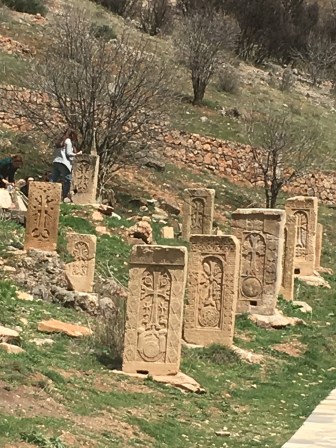
IMG_2858While Armenia is blessed with every natural beauty but the sea, there is man made beauty too. These people can torture scrap metal into shapes that stun: great  things they have wrought in front of schoools and around parks. Windows are screened with iron sunbursts and doors are shrouded with lace the weight of lead. Then there are the khachkars, stone carvings from single-figure centuries: sandy, intricate and surprisingly enduring for stone so soft.

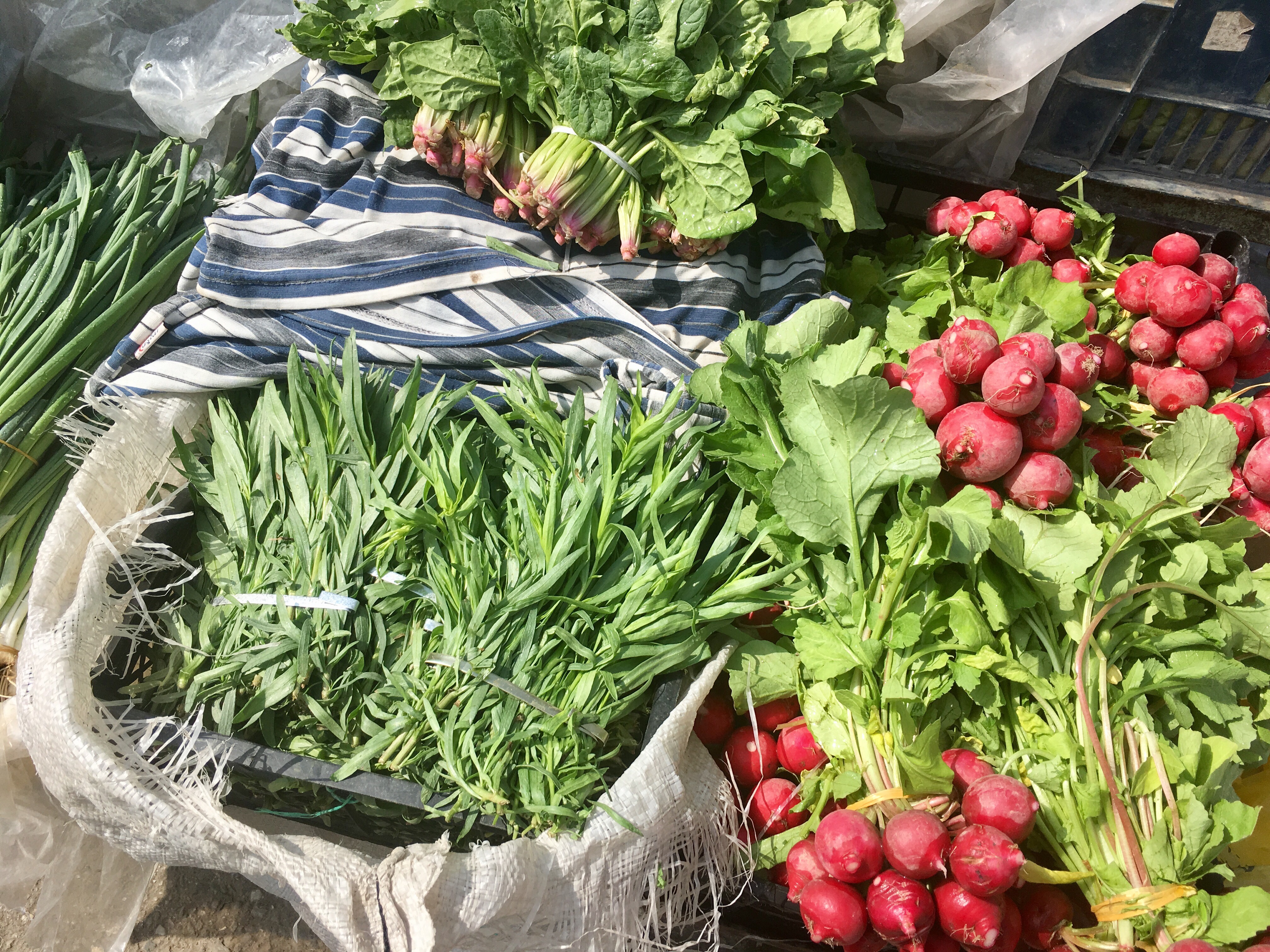
The women I am lucky to know take pride in setting a beautiful table here. China is always used at mealtimes. It matches, and it isn’t chipped. Glasses usually have a gilt band. Tiny coffee cups are candy colored and edged with gold. Inside houses there may be concrete walls half-primed and never painted. Tiles may be cracked or missing on floors or bathroom walls. Living room furniture may be covered with hardwearing polyester in stoic browns. But the kitchen table will have a gold and cream oilcloth cover and sweets will be served in a Royal Doulton-type bowl. Preserves are set out in small glass dishes and you will be invited to help yourself to apricot, raspberry and black currant jam with a dainty, ornate spoon. Slices of fresh-cut cucumber glisten green-white. I am sure Armenian radishes inspired the complexion of Snow White in the Disney film.


There is ugliness too of course. Abandoned, rusting cars, people shouting at their children, litter left on hedgerows, and corrugated iron roofing on dilapidated hen  houses curtained with blue plastic sheeting. There are seventies Soviet buildings and sex-selective abortions and dogs that bark all night, perhaps because they know someone will come to shoot them soon. Young men are dressed up as soldiers and equipped with remaindered guns. Corruption is as common as ketchup, served up everyday. Streets and towns are empty of shops and customers, for all the paid work is thousands of miles away, in someone else’s country.

But the kindness of the people blinds incomers to all of this. The woman with gold teeth who offers to pay your fare on the bus, because you are a volunteer, and don’t earn much. The host who makes spas because you are sick, and insists you drink your tea with a healthful honey made from pine cones. The English teacher in the supermarket who stops to sort out a mix-up over baking ingredients. The cab driver who forces the garage owner to find a USB and charge a dead phone, so you don’t miss a particularly good view of Ararat. The 8 year old who demonstrates ballet moves on her bike, providing an escort home every night from school. The grandfather who walks tenderly behind a crippled child playing ball in the street, ready to catch him if he falls. The teacher who decorates a miserable looking classroom so an American far from home has a lovely birthday. These people, and many other things, are what makes Armenia beautiful. Come and see for yourself.

Posted in Armenia, Beauty, Caucausus, Cross-cultural understanding, family, Food, joy, Mount Ararat, Peace Corps, Social niceties, Syunik Marz, travel, Vacation spots, Village life, Women | Leave a comment

Knickers, twisted

No wash today

If there is a nuclear accident here in Armenia I could be in more trouble than most. First, I have managed to lose — or simply failed to pick up–the very expensive, giant horse pills which Peace Corps issued, and which we are meant to swallow as the cloud goes up. They  are potassium something, wrapped in silver foil covered with red Xs, and are about the size of sofa coasters If you see them, don’t eat them, unless of course things turn nasty near you. 

Armenia has an old Soviet era nuclear power plant at Metsamor, about an hour from where I now live. It was built in 1976 and, although it produces about 30% of the country’s electricity, there is very little money to maintain it. Peace Corps assures us they do not post volunteers within 20km of the site. This cordon’s limits must be based on some intelligence, but I know not what. 

    In accordance with Peace Corps instructions, I have packed my emergency evacuation bag to be grabbed in the event of war, earthquake or the aforementioned nuclear mishap. I have a warm cardigan, a torch, American dollars, my passport collection, medical supplies and two pairs of drawers. I don’t know why I bothered with the knickers because I would rather die of radiation burns than risk a showdown with medical experts in the ones I packed.  Luggage restrictions imposed by  Peace Corps mean I have a limited amount of underwear to hand–2 weeks supply in a country where rinsing, wringing and pegging out is often impossible due to lack of running water. It seems a shame to leave the best bloomers on emergency standby and make tired pairs work overtime. I worry about it, but the bottom line is that I think I have made the right decision: best to have my best for everyday and gamble against an unscheduled scandal in unsuitable scanties.

    “But why not buy additional undies now you are safely (?) settled in Armenia?”  My sister’s voice rings in my ear. “I know you are–ahem–more substantial than the average Armenian woman, but surely you could buy something stretchy to cover all eventualities?”  

    Well I could of course, but bear in mind that the Peace Corps stipend is $3 a day—-1500 dram. That kind of money doesn’t cover much, in nether regions or otherwise.  For this amount, a person can buy a  bottle of good Armenian wine– in a glass bottle, with a label and everything, but gusset-lined goods imported from China cost rather more.  

    You may think that standards are surely permitted to slip in a country where washing machines are rare and tumble driers unheard of, but all the evidence suggests that Armenians take a visit to the doctor very seriously. Yesterday I bumped into a neighbor about my age on her way to the doctors’ office. Despite the dust and the heat of the day, she was dressed in a very crisp navy and white dress, belted black jacket, shiny candle glow tights and shoes with a block heel. Bear in mind that all the

    Scale photo of author with average-sized Armenian woman

    women in our neighborhood habitually wear dark pants and sweaters with thick socks and flat mules. Sometimes the older ones top this off with a fluffy dressing gown. Shoes are quickly ruined by the dusty tracks and potholes make any kind of heel inadvisable.  My neighbor made a point of telling me that her daughter had reminded her to smarten herself up, what with the doctor and all.  I took this as her way of assuring me that her foundation garments were both impeccable and irreproachable. These things matter. 

    Posted in Armenia, clothes, Embarrassment, errors of judgement, laundry, Mother/daughter dynamic, Nuclear power, personal failings, Social niceties, straight-talking sister, travel, Underwear, Village life | 1 Comment

    A Sweet Solution to Armenia’s Problem with Abandoned Cars 

    Grand Candy is perhaps the greatest secret Armenia keeps from the world. 

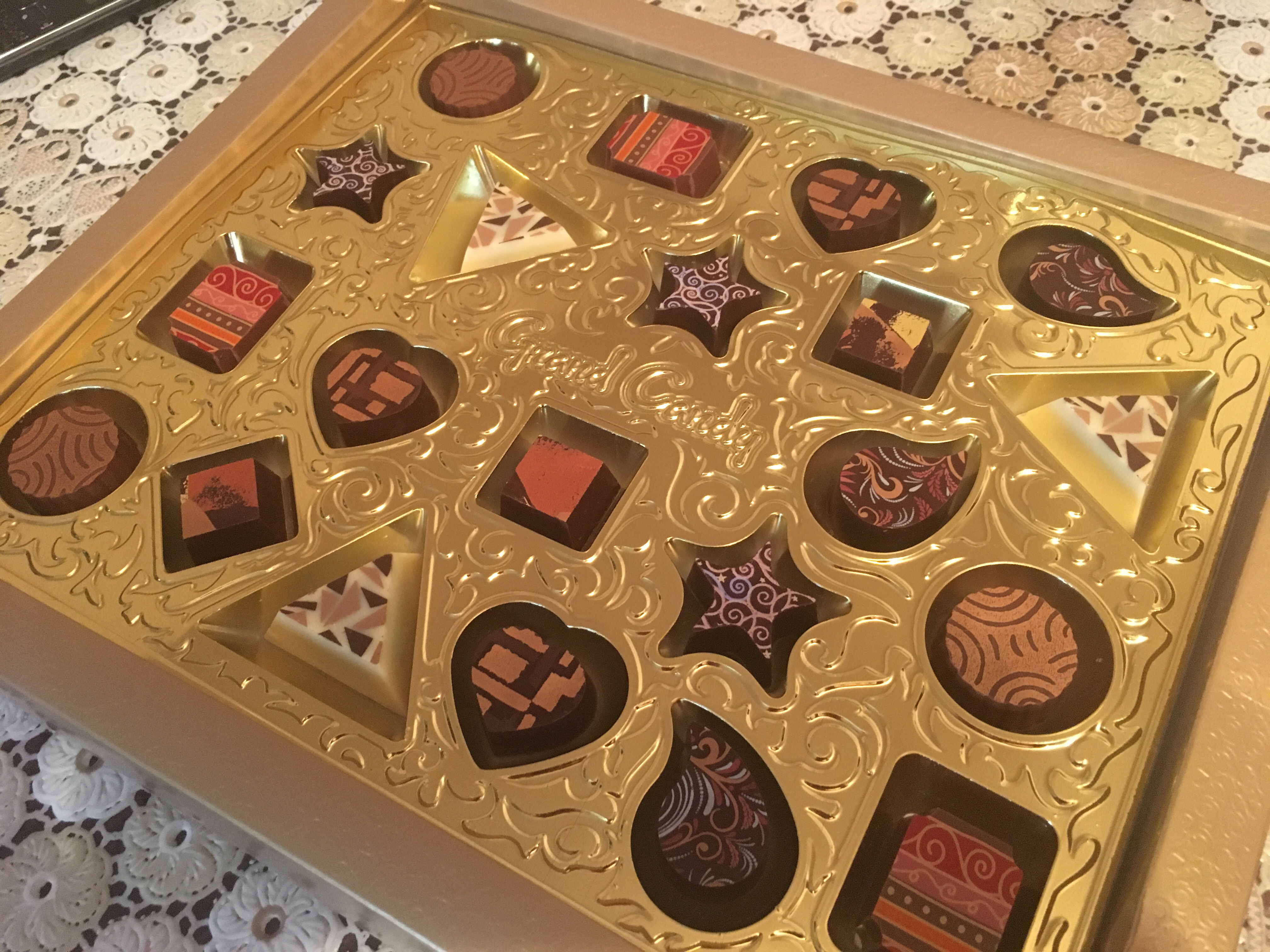
    The company, makers of wrapped, loose candy, boxes of chocolates, gallons of ice cream and mounds of pastries–have been keeping Armenian consumers sweet since 2000 and now have 40% per cent of the confectionery market here. Sure, you can buy the products of Nestle, Mars and Ferrero Rocher in Armenia, but you wouldn’t, you really wouldn’t. Not when there is a Grand Candy dark chocolate kiwi creme on offer. 

    This loglike candy is emerald green jelly on the inside and wrapped in green and purple paper.  I would post a picture but I greedily ate all that I could find, and then had to surreptitiously dispose of the mound of crumpled wrappers.  Trust me, the kiwi creme is the one to dig for when the confett bowl is produced, which it is when coffee is served, when people come round (which they do often), and when people need cheering up. Grand Candy has more than 400 lines of candy,  but, after comprehensive sampling and testing, I feel confident that the chocolate kiwi creme is the very best.  

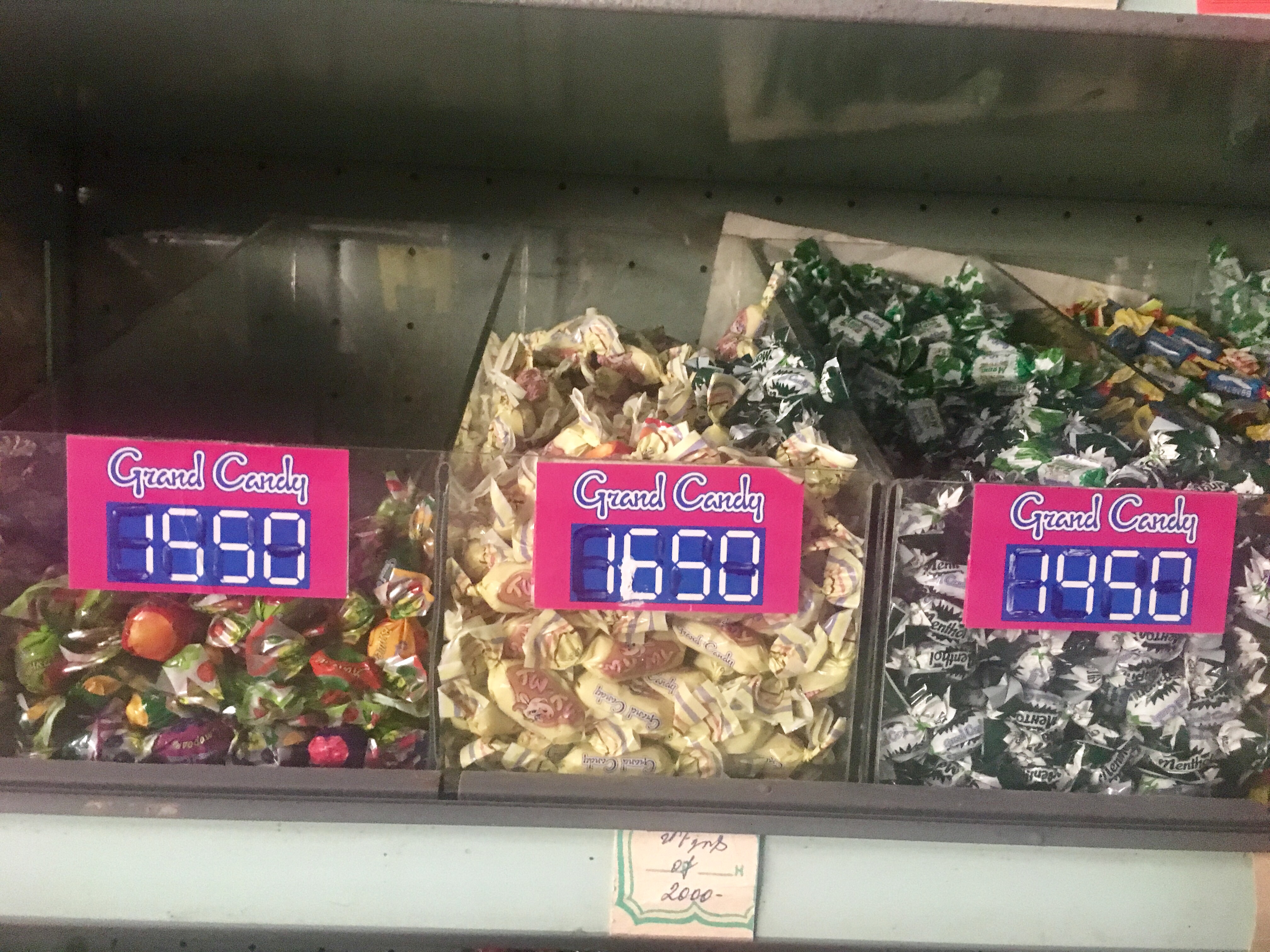
    Shopping at an Armenian supermarket, one of the thrills is inspecting the rows and rows of Grand Candy bins, selecting the sugary delights that will fill your family’s candy bowl– the center piece of any Armenian coffee table– for the coming week. Confusingly, all the confectionery lines are slightly different prices. This means each variety has to go in its own separate bag. There is no point in having just two or three pieces of caramel or nougat or truffle in its own bag and so of course you end up buying a pound or two of everything you like. At Easter we lumbered home from a shopping trip with Grand Candy by the sackful. 

    In Yerevan, there is a Grand Candy megastore and a Grand Candy restaurant. It is possible to do a tour of the Grand Candy factory and I will get there soon. The sites are easy to find, for their glass is colored in boiled sweet colors– yellow, purple and green.  They advertise extensively on TV, making me long for something sweet during the very few moments when I am not already eating something they produce. Cheery Grand Candy vans decorated in sugar pink and white are seen in every village, replenishing shop supplies. Grand Candy pride themselves on their ability to package candy to match the season or a current trend–Christmas, a film release or smiley faces. 

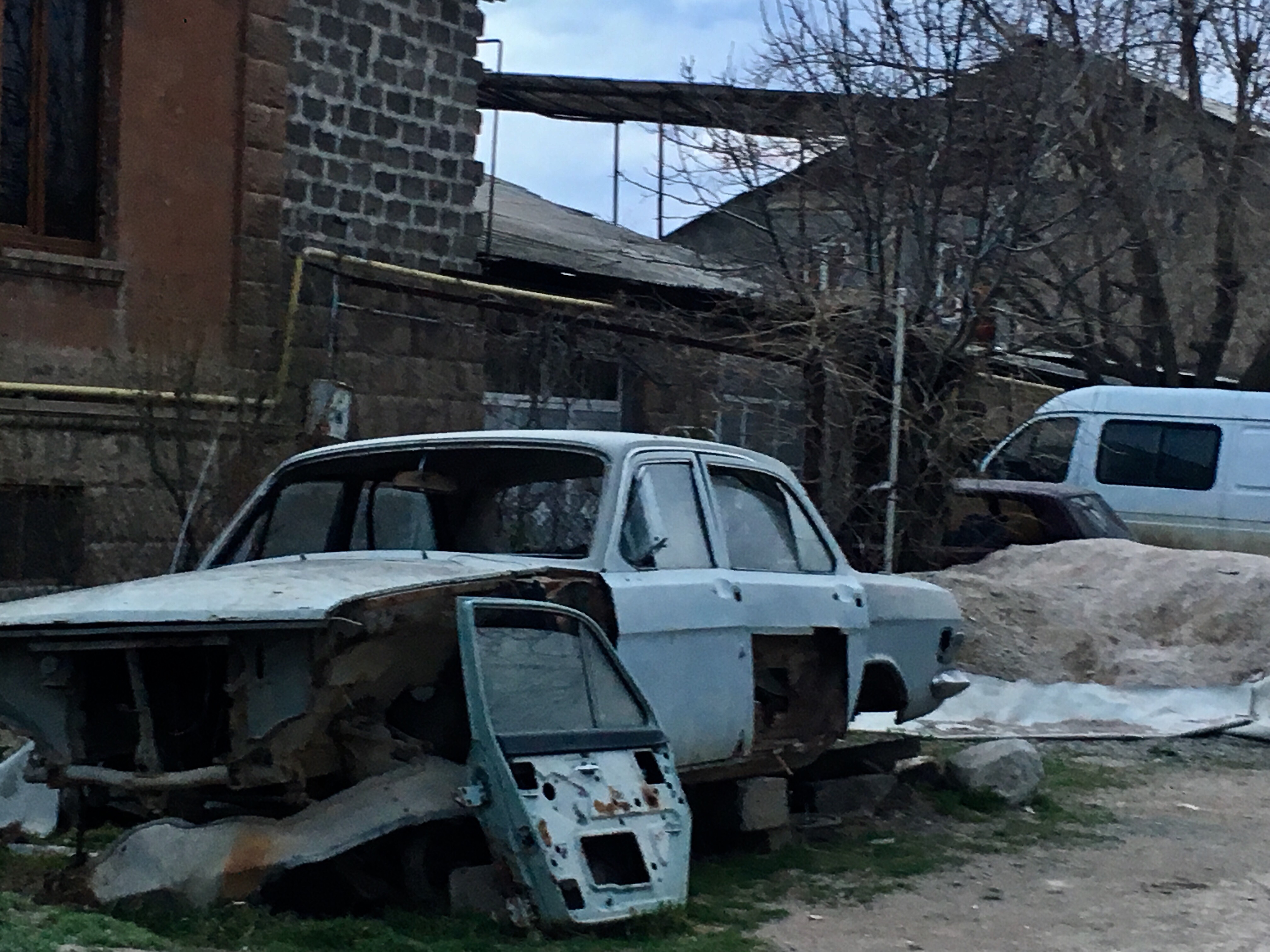
     The fact that they have their own printing equipment and graphic design flair has given me an excellent idea I am happy to share with their marketing team: On every corner of every street in rural Armenia there rusts an abandoned car. These eyesores would provide great frames for giant candy wrappers. If Grand Candy were to wrap every abandoned car in the country in colored cellophane it would vastly improve the look of villages, turning each hamlet into Candy land. People would be happy. Sales would rocket. Do it Grand Candy. Do it. 

    Posted in Advertising, Armenia, Candy, Food, Grand Candy, Marketing, shopping, Social niceties, travel, Village life | Leave a comment

    Lost for words. No happy endings. 

    Let me start by saying that I know English is a nightmare to learn, what with all our irregular verbs and silent letters and eccentric colloquial quirks. Compared to English, Armenian is easy. Most verbs conform as though drilled by Soviet paymasters. There is none of that irritating gender stuff they insist on in French. In all but very few cases, the infinitive is used for the past tense, together with the relevant auxiliary. Armenian is a language that relies on efficiency and the exercise of common sense. Except when it doesn’t. 

    I am here to grumble about the definite article (TDA) and a couple of other irritations designed to trip up students of East Armenian. TDA is an eh sound when its noun ends with a consonant. It is a nuh sound when its verb ends with a vowel. These grunts are heard after the end of the noun, and before the verb and auxiliary. Are you with me so far? This is where it all takes a turn for the worse.  The pesky definite article attaches to proper names when the person bearing the name is the subject of the sentence. So no Liz but rather Lizeh. No Sara but rather Saran. Or Sarahn because the wretched h is silent, although very important to its owner. Elsan oorakh e. Elsa is happy. Elsan im inkereh e. Elsa is my friend. Inker also takes you know what, because of the possessive. Who knows why? Not me. 

    In Armenian, when you talk about a place, you add um on the end.  We had this dinned into us early on. I live in Washington DCum. I study at schoolum. I spend time at Peace Corps HQum. But of course , most of the time one talks about a place, it is because one is going there. Except then of course the bloody um, um disappears. “Direction. No um” says my teacher Sona (also known as) Sonan several times a day. I fly to Washington DC. I walk to school. I go to Peace Corps HQ on Friday. No um. 

    And don’t start me on plurals. If I talk about volunteers doing or being something I  say khamavornereh. Plural ending for multisyllable word and TDA tacked on to the end of the noun. If, however, I specify two volunteers, or any number of volunteers, the plural mysteriously slips away. Yerkoo khamavor. Two volunteers. 

    I have been known to showcase TDA and my knowledge of plural endings when discussing shopping lists. The beetroots, the eggplants, the mushrooms. “Why would you use the plural and TDA?” asks Sona, mystified. “But you said….?”  “Yes, but not at the shuka or supermarket. Not necessary”   Well, that’s cleared that up then. It’s just like English. I need beetroot, eggplant, (but) mushrooms. 

    Then there’s the negative, which swims around in a sentence depending on whether it applies to a verb or an an adjective. Ch’em siroom kaylel. I don’t like to walk. Sovatz ch’em. I am not hungry. 

    Ch’e gitem (irregular). Ch’em haskanoom. I don’t know. I don’t understand. 

    Posted in Armenia, Cross-cultural understanding, Education, Language, Language learning, Learning, personal failings | Leave a comment

    A Still Morning

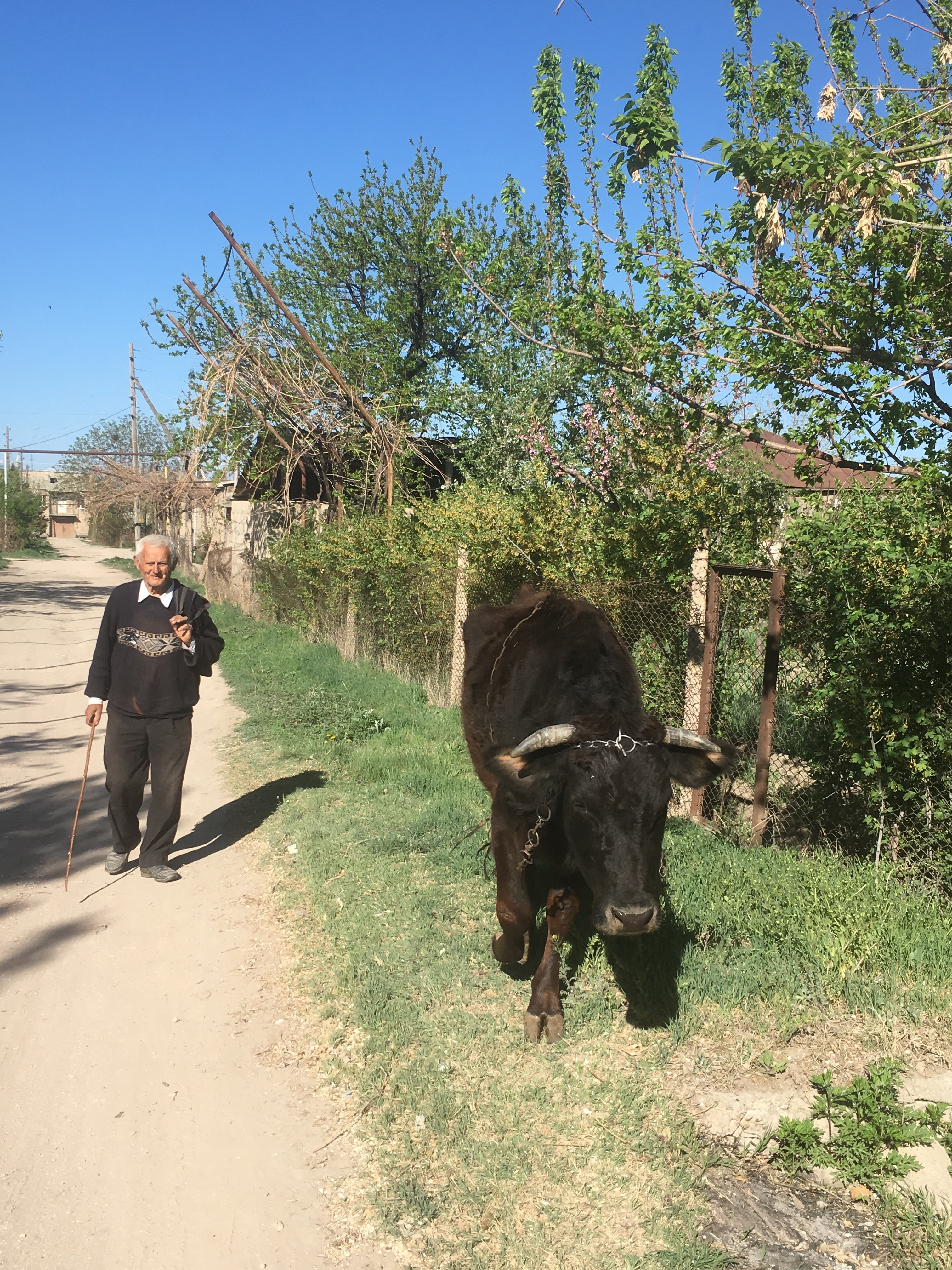
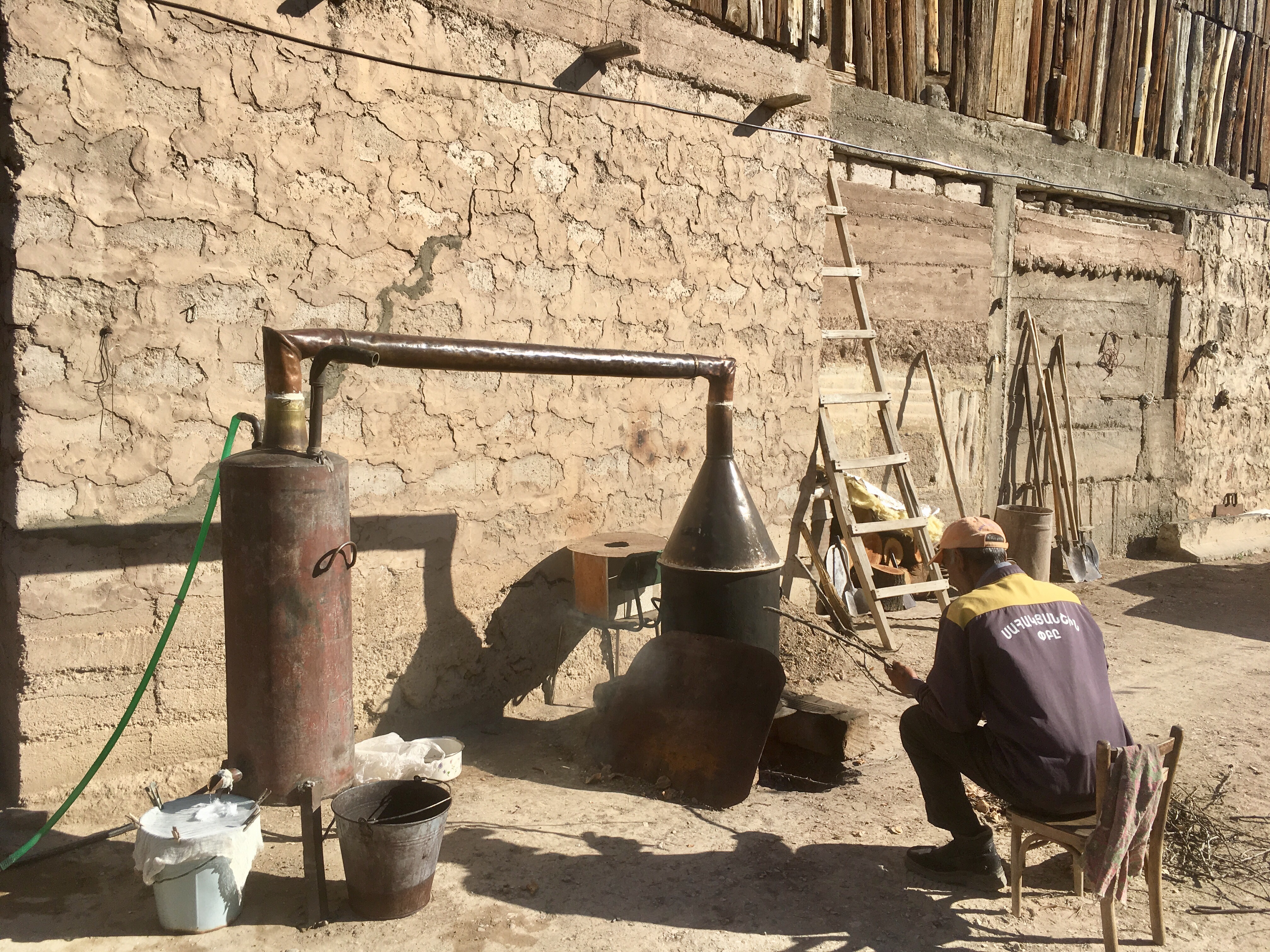
    The people across the road have a still and this morning are making 70 liters of grape vodka to sell at the market. I know it is good because after breakfast I went over to test the product. I ran a freshly showered finger under the stream trickling into the cotton covered bucket and rubbed it over my teeth and gums. Good stuff. I skipped to school and passed a man with a cow along the way. If you can see them, they were definitely there. 

    Posted in Armenia, Cooking, drinking, Homebrew, Moonshine, Village life, Vodka | Leave a comment

    Some dance to remember. Some dance to forget.

    IMG_3006IMG_2858.JPGWe are not allowed to travel after dark. We may not leave our villages without permission. We will never drive a car in our country of service. The rules governing the lives of incoming Peace Corps Volunteers are strict and exist because of painful experience gained all over the world. When we need to venture further than the local school for a Peace Corps activity, we are driven in a Peace Corps minivan and returned home safely in the late afternoon. This week though, we had enough language to strike up a new relationship with our driver, and so we now have an eclectic mix of music as we ride. We have car-danced to Gangster Paradise, and some folky Armenian pop. I was astonished to find myself singing along to the Eagles’ Hotel California with a van load of 20 somethings. I, of course, know all the words, but would have been prepared to hide this knowledge if it would have helped my image any. I needn’t have worried: they all knew it and sang loudly with no apparent irony. The old, denim-clad and hairy must be new again? The millennials also sang along with Celine on My Heart Will Go On and On. I sat that one out. A girl knows her limits.
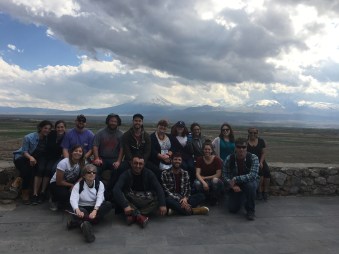
    After a month in our villages and only in our villages the Peace Corps suddenly deemed we were fit to be let out last week It has been a social and cultural blur.

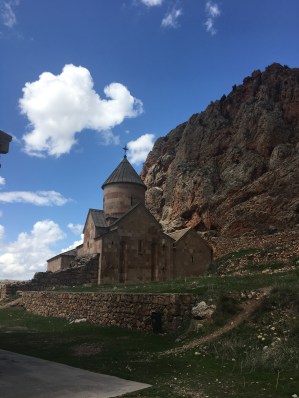
    IMG_2838.JPGWe went to Norovank, an ancient church and monastery built on a hill and surrounded by deep gorges and snow-topped mountains. Norovank was built by one of Armenia’s most esteemed architects, Momik, back in the 13th century. Legend has it that the king challenged Momik to build the church if he wanted to marry the king’s beautiful daughter. Momik was keen on the princess and so rose to the challenge. Sadly the marriage never took place although the church still stands: Momik was killed by the king once the building was completed.
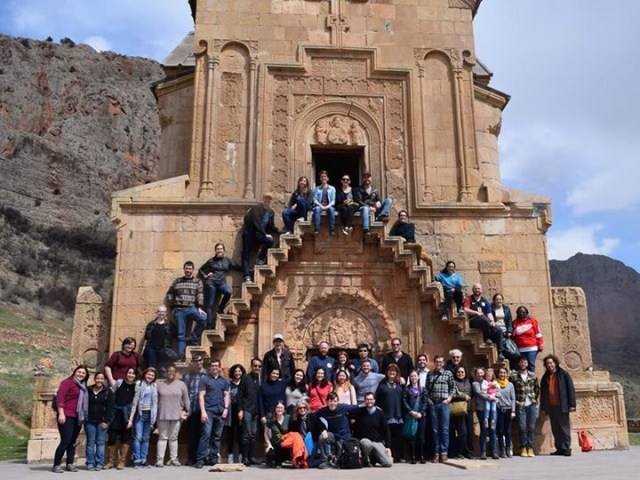
    The church is still used today. It has two stories, the second of which is reached by a set of perilous outdoor stairs. The graveyard is filled with ancient engravings—celtic-looking endless knots known as hatchkars (cross stones). Visitors come from all over the world to see the engravings, some of the few that survive from Momik’s time. In taxis from Yerevan, they grumble about the distance and the need to inhale hard for oxygen in the high mountains. Why are there no historic sites on accessible main roads, they ask with a gasp. On the way to Norovank, we crossed a peak from which it is possible to see the mountains of Iran, Azeri territory, and Turkey. This small country’s neighbors live close at hand and over the years have often turned up uninvited. They have not always left Armenia quite as they found it. Across the years’ many of Armenia’s apostolic Christian churches have been raided and looted and destroyed and so it is only the most remote and mountainous that survive.

    IMG_2938

    Later in the week, we had a field trip to a second ancient site—Khor Virap. This used to be in a remote location, but now finds itself less than 10 miles from the Turkish border. Things change, though GPS coordinates remain the same. Here is where the man later known as Saint Gregory spent an uncomfortable 13 years imprisoned in a narrow, dark, underground well. A widow fed him from time to time. The king who had imprisoned IMG_2999Gregory eventually went mad, as those with evil ways are prone to do. The widow mentioned that it might be a good idea to free Gregory. He was hauled out of the pit and immediately, and rather generously, returned the king to health and vigor. The king wisely decided to throw his lot in with Gregory and together, back in 301 AD they made Armenia the first Christian nation. The first church was built on the Khor Virap site in 642. The one that stands today dates from 1622. We saw twins christened at Khor Virap. They both screamed lustily throughout. Gregory was also known as Gregory the Illuminator. You can buy a copy of his biblical illustrations at the gift shop, along with some hirsute dolls in Armenian national costume.
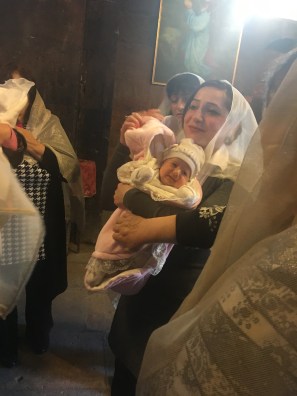
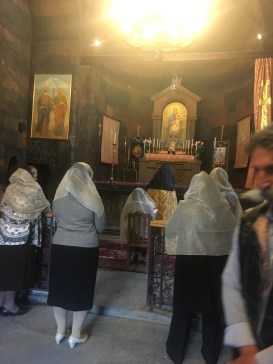
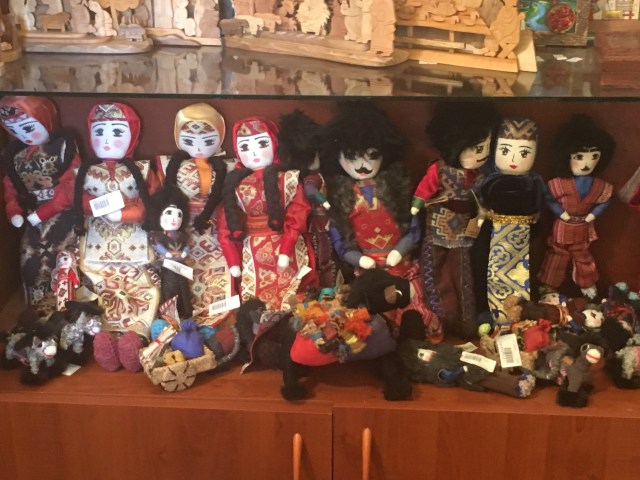
    IMG_2979IMG_2974


    On the home front too, there has been a lot of toing and froing this week. Lala, the newly married daughter is home from Moscow for a few days. Her husband didn’t come. He is a decorator and is busy with work. On Easter Sunday all of the Ararat region seemed to visit the graves of family members, sitting in a village traffic jam to get to the cemetery. In low-fenced plots, men lit small fires in metal pans and sprinkled incense on the flames to honor the dead. Women placed flowers, mostly carnations, at the foot of gravestones engraved with life size photos of the lost. It is important that the flowers are left in odd numbers—usually bunches of three, or five or seven.

    IMG_2986


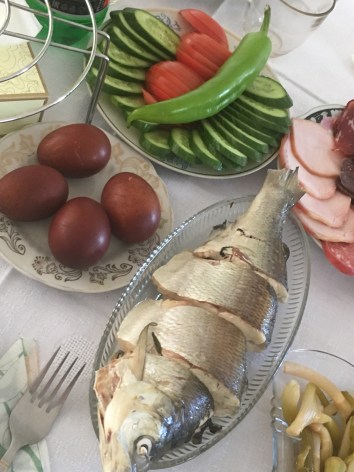
    There were more than 30 people at our house for dinner. Elsa had been preparing for some days: fresh water fish, and Easter pilaf—rice prepared with butter and raisins—plus the usual herbs, tomatoes, cucumber and chopped salads. Bowls and bowls of eggs, dyed a rich brown with onion skins and then decorated by me with my favorite gold Sharpie and some chicken stickers I brought with me from an American craft store.

    IMG_2930

    A fellow Peace Corps Volunteer who rooms with Elsa’s sister was seated with me at lunch. We and a couple of doughty Aunts were put at the end of the men’s table. For us, homemade red wine was poured into tiny cordial glasses which we drank daintily. Hanna and I refilled ours as often as we decently could. I probably had 13 thimblefuls by the end. Not enough to do any harm. The men drank vodka shots with their meal. Vodka here is cheaper than bottled water and is often 75%. That’s percent, not proof. It’s rocket fuel and by the end of the lunch there were casualties. A couple of Elsa’s good tablecloths will never be as white again.

    In the kitchen at the (real) ladies’ table, alcohol was not served. Many pastries and chocolates were consumed with strong black coffee in exquisite, tiny cups. For women, any kind of drink, hot or cold, seems to involve fairy-sized receptacles. They are strangers to mugs. At the children’s table in the living room, kids knocked hard boiled eggs together end to end to see who could break whose—it seemed to be a good luck thing, combined with a “mine is better than yours” type challenge. (Think conkers if you are British.)

    Tonight (Sunday) the house is full of people again. They have been coming in waves from about 6pm, more than 30 across the evening. Elsa has yet to sit down. First we had dolma—ground beef, onion, garlic and rice wrapped in cabbage leaves and steamed—plus greens that looked like groundsel cooked up with egg. This was served with lavash and the usual salad bits and pieces. Acorn cups of sweet wine for any woman who wanted it. A bottle or so of vodka for each of the men. Coffee and homemade cake with chocolate butter frosting and a banana and chocolate cream center. Coffee was served. Then a shift change—a raft of neighbors replaced relations who had to hit the road for home. Tea with lemon, a refreshed plate of cakes and fancies. About 9pm a third contingent turned up and the salads appeared again, plus a yogurt drink—Tan—served cold with fine -chopped scallions and cucumber. (Refreshing but keep the Colgate handy.) Women are sitting in the kitchen eating black sunflower seeds—they nip the kernels with their teeth and then place the husks on the side of their plates in a ladylike maneuver I have yet to master. No spitting is involved. In the hallway, Geovorg continues to entertain the men who come and go, smoking and drinking vodka shots with them all. He appears completely sober. I don’t know how he does it.

    IMG_2817


    I am the only one who has to get up tomorrow. Everyone else is at home because it is commemoration day for the 1915 Genocide. On Friday, our group of volunteers went to Yerevan to see the memorial and to visit the museum commemorating the deaths of one and a half million Armenians at the hands of Turks who, facing the downfall of the Ottoman Empire, wanted power and land a century ago. World leaders plant trees at the site. Armenian school children lay flowers at the eternal flame. Holy music plays. On the way to the museum, we sang and danced in the bus, causing the van to shake. After the tour we stood in silence and looked at Mount Ararat from the roof of the museum, the enduring symbol of life and land that was lost. We didn’t sing on the way home.

    IMG_3011


    Posted in Armenia, Borders, Cooking, Cross-cultural understanding, family, Food, friendship, Great weekends, joy, Mount Ararat, Peace Corps, Politics, shopping, travel, Village life, Women | 1 Comment

    Border Post: Part One

    I have been thinking a lot about borders. This is the first post in a series of four that threatens to be quite boring, but which is at least topical. Brace yourself and persevere if you can. 

    Borders are like boiled eggs. Some are hard, some are soft, some are easy to crack, and soldiers are often involved.  Borders also resemble pancakes, having two sides. They may also be compared to other people’s mothers in that you may occasionally cross them, but you really only care about your own. This last is not true in my case.  As a penance for my peripatetic life I find I have four borders to worry about just now. The one that divides Ireland North and South. The one that runs between the United States and Mexico. And the two jagged seams crudely stitched between Armenia and Turkey, and Armenia and Azerbaijan. All of these borders make news at the moment and, as sure as eggs are breakfast fare, you will hear more of them all.


    ireland-mapThis post is about the Northern Ireland border, created in 1922, meaning that the island previously known as Ireland split into two, with the northern portion continuing to be governed by the United Kingdom, as it had been since 1801. 26 counties on the island of Ireland became a free state, an autonomous country we now know as the Republic of Ireland.

    The border that separates the North from the South of Ireland runs East/West from Newry to Enniskillen and then South/North up through Fermanagh and Tyrone to Derry, an arbitrary line in slurry.

    From its earliest times, the new border was supervised in a slightly lackluster way by British and Irish customs officials. Many perfectly ordinary people went backwards and forward everyday, going from home to work and back, or visiting  their fields, family and friends. No one was much exercised about excise. Id may be requested, but there is no passport control.

    In the 1970s the area bordering the border was always referred to as Indian country by my dad.  (Forgive my father’s non-PC turn of phrase. We knew no better then.) From Belfast on our way south to Dublin or west to Donegal we were told to roll up our windows and lock car doors. It was the same on the way back.  My dad’s concern was that gun wielding guerilla fighters camped out in scrubby fields surrounding border towns would hijack our sedate Ford sedan and stack the back seat high with kalashnikovs, gelignite and unsold copies of Republican News to use as firelighters. This never happened. But the IRA weren’t the only ones hiding out on damp lanes and thorny hedges. A friend of mine, a Newry boy, took his girlfriend for a walk along a quiet border lane one summer evening in the mid ’70s, and persuaded her into a field for a little lie down. Just as he rolled towards his lovely, he found himself almost eyeball to eyeball with a British soldier in camo gear in Action-Man pose in the long grass, gun pointing.

    “I can’t move” the soldier said “so you’re gonna have to.”

    Undercover stopped ardent lover. In addition to their men on the ground (literally) the British  army also had heavily armoured towers at intervals along the border, ugly look-out posts from which to scan the landscape for men with bombs and guns.

    In recent, happier years, with dips and dives between British sterling and Irish punts or Euros,  people have taken advantage of a very soft border to smuggle siphoned petrol and herds of cattle, where once (at least according to my father, based on his memory of the ’30s and ’40s) they used to trade in watches and pounds of butter.  Everyone buys drink and stocks up on Marks and Spencer’s mincepies at Christmas. There are new worries now though.  The United Kingdom is leaving the European Union, which means Northern Ireland goes too.  The Republic of Ireland is a stalwart EU member. The UK has strict immigration laws and limits on refugees to whom it is prepared to offer asylum. The border between Ireland North and South could become the backdoor way into Britain. Will the Jungle move from Calais to Drogheda? Where will visitors to Britain clear British security?  At Irish ports? Or British airports? Or on our own wee border? Will people in Northern Ireland (the clear majority of whom  voted to stay in the EU in the recent British referendum)  choose to exercise their right to Irish citizenship in order to remain part of Europe, rendering the idea of Irish partition a nonsense altogether?  No one knows. Northern Ireland’s politicians are in a complete funk about a lot of things and offer no clear way forward. The Republic’s government certainly does not want its newish South North infrastructure (paid for by the EU) to become a corridor for pass through refugees headed to Belfast and thence to mainland Britain. Whatever they say, the Irish politicians wouldn’t want a gift of Northern Ireland either. Not for the first time, it is all a bit of a mess.

    Here, at a safe remove, I am interested in the way that a political and territorial question hotly debated for nearly 100 years– whether there should be a border within the island of Ireland– is suddenly and dramatically changed by asking a different question: will the United Kingdom vote in or out of Europe? It voted out. Priorities are changing for the two islands that lie just to the west of mainland Europe. Get ready to redraw the maps. Again.

    Posted in Belfast, Borders, Cross-cultural understanding, errors of judgement, Northern Ireland, Politics, Terrorism | 2 Comments

    Spin the Bottle and Speed Dating, Armenian Style

    We have played Jeopardy and a saliva-free version of Spin the Bottle. We have danced to mnemonic rhymes. We have brought in family pictures and discussed them at length. We have done it all in Armenian as part of our intensive language learning. Classes take place for 4 hours a day, five days a week, including Saturday mornings. This goes on for 10 weeks and then we are taken to a Hansel and Gretel type forest and left to fend for ourselves–well, sort of. So far, we have tackled the possessive pronoun, the past (through the present perfect) and the future. I would tell you that the future is bleak, but I don’t know that adjective (?) yet. Language, it turns out, is easy to pick up when you have an imaginative, energetic and expert teacher who is determined that we will swim (lorhal–think phlegmy French sound in the middle) not sink (suzvel) when we are released into our different and diverse Armenian communities for two years’ service in June.  


    Sona is a fabulous teacher. The usual drilling and white board writing is supplemented with lots of moving about and raucous laughing. This week we did a speed dating exercise with three of our group of five women given stick-on moustaches to help them get into the roles of Grigor, Gagik and Armen. The aim was to practice our vocabulary on likes and dislikes. It was hilarious. We go on forays to the school tuck shop to ask the price of things. We fish two or three kids out of regular classes to talk to about their birthdays. For homework, we ask our hosts to tell us what time they make coffee, or drive to work, or call their Aunts. Conversations involving Aunts and Uncles are particularly complex in Armenian, because it is necessary to specify whether the said relative is the sister or brother of either your father or mother. Depending on gender and genealogy, they must then be referred to as My father’s sister or my mother’s brother etc.  That tricky possessive again. One American dared to ask how to refer to a woman married, for example to one’s father’s brother: an Aunt by marriage. I have many of these, and love them. Apparently in Armenia though such a person is never spoken of– an interesting glimpse into family dynamics. 

    Our teacher Sona is the one on the end with long black hair (yerkarr sev mazer)


    The standard of teaching in our villages is particularly impressive when you stop to think that the Peace Corps teachers have no access to a photocopier or printer. When we learn our numbers through playing Bingo, Sona has had to hand produce the bingo cards. When she provides handouts, she writes them out five times, one for each of us. She is in class every morning at 8am pinning up visual aids prepared the night before. She has a PhD. Sona, and all the other language teachers– all women aged between 30 and 60– leave their homes and their families for 10 weeks to support our learning in remote villages. Like us, they live with local families. We get a fabulous service, delivered with verve, creativity and a smile. They miss children’s school concerts. Husbands’ birthdays. Mothers’ hospital appointments. I can’t imagine it. I certainly don’t know how to say it in Armenian yet. It’ll come. 

    Posted in Armenia, Cross-cultural understanding, Education, Language, Learning, Village life, Women | Leave a comment

    Jam tomorrow. Lavash every day. 

    One of the great things about living in Armenia is that there are no rules about breakfast. In my past life,  I was used to being denied cherry cake before noon and nobody liked it when I finished off cold pizza or last night’s curry at 8am. I have a family member who simply can’t abide leftovers. He wouldn’t last long here. 

    Breakfasting at the base of Mount Ararat, we pull everything available out of the fridge and put it on the table.  It has become my practice to start every day by constructing a sandwich of apricot jam (homemade), feta-like cheese (often homemade) and fresh tarragon (homegrown) wrapped in lavash (made in vast quantities by the lady across the street). I call it my Full Irish Breakfast because it is green white and gold. The licorice taste of the herb goes perfectly with the sweetness of the jam and the sharpness of the cheese. I commend it to you. 
    Bean salad with vinaigrette and chicken, corn and pepper salad in mayonnaise were on the breakfast table this week, as were reheated spaghetti and chicken nuggets.  I ate the beans but gave the mayonnaise a wide berth: Peace Corps staff and other seasoned volunteers have shared stories of fragile Americans who tangled too soon with aging egg-based products, with explosive results. I didn’t get to the spaghetti and chicken this morning, being distracted by the halva and mushroom pilaf. Elsa packed the chicken and pasta for my lunch, chopping and mixing it before rolling it in lavash. If you are a fan of Discovery ID you will know dead bodies and other things that villains wish to hide are almost always rolled up in rugs before being smuggled past innocent bystanders. Lavash is the Armenian equivalent of the rolled rug. 

    The people two doors down have a cow in their back garden and so fresh milk, heated to kill any germs, is often served. My concern isn’t the lack of pasteurization. I just don’t much like milk, either hot or cold. I prefer tea, which here is always served without milk. Sometimes homemade black currant jam is offered, to be used as a sweetener. The first time I was passed a small dish of berries and a spoon, I ate the whole plate as though it was a dessert. No-one batted an eyelid, but I have since watched entire families share what I devoured, spooning only five or six berries into each cup of tea served.  Oh dear. Embarrassed of Armenia. 

    Sometimes a new dish appears at breakfast. Spinach pan fried in butter and supplemented by a lightly beaten egg is a favorite of mine. It’s good freshly made and hot, and surprisingly palatable when it turns up again at dinner, this time cold. 

    In every house, sheets of lavash the size of medieval shields are bought in bulk from specialist neighborhood bakers and stored in a cool, dark and perhaps slightly damp pantry in each Armenian home. The piles are thick enough and long enough to make a comfortable bed for a small princess. Before it is served, the lavash is cut into slices the size and thickness of a Sunday magazine double spread. These sheets are folded in two and piled high in the breadbasket that always sits on the kitchen counter. I have noticed that the basket is always topped up before it is empty. There must be lavash in the bottom of ours that is older than some of my fellow volunteers. 

    I keep forgetting just how young that is. In a  language lesson today we had to ask each other questions about people we liked and disliked– something to do with objects and possessive pronouns. Thinking to stick with an Armenian theme, but move past the Kardashians, I asked my class mates what they thought of Charles Asnavour. Blank stares ensued. I sang a bar or two of She. Nothing. When I YouTubed the song I discovered it was a hit in 1974, more than 40 years ago. Depressing. 

    Charles Asnavour sings She

    Posted in Armenia, Cross-cultural understanding, family, Food, Mount Ararat, travel, Village life | Leave a comment

    He Got This


    This story is my son’s and is shared with his permission. 

    I cried today for the first time since arriving in Armenia. It was only a tear or two, and it wasn’t because I felt isolated and far from my family.  I cried because I heard from my son.

    I didn’t see Tony in the month before I came to Armenia. He was completing a rehab program that didn’t allow visitors. He and I  were permitted a phonecall on the day I left for the airport, but I hadn’t heard from him since. I knew that was the rule of his program, but still I wondered and worried about him. Did he stick with it? Did he have what he needed? Did his sister drop off what I asked her to, and did it get to him?

    tony2Being unsure about Tony’s well-being has been a feature of the last six years or so. DNA translates as Drink, Narcotics and Addiction for Tony. Add heartbreak and deep seated pain, plus a need to self-medicate some mega mood swings, and from his late teenage years it was clear he’d need a sidewalk to call his own. At times, he has chosen not to be in touch, sliding from homeless shelter to street corner, with none of us around. At times I have chosen not to see him. Occasional exchanges have been painful, non-productive and potentially explosive for us both. He had a baby and I found out about her from Facebook. He got in trouble with the law and I knew only because the summons came to my house, the nearest thing he has ever had to a permanent address. Through it all, he never asked for anything, and insisted on his right to live his life his own way. He is nothing if not proud. I have always loved and admired his spirit, even when I am mad with him, and sick with fear for him.

    Since New Year, Tony has been working to save his own life. The chance to join a residential rehab program came after successful completion of thrice daily meetings, a series of clean urine tests and successive successful outpatient appointments. I was content not to see him before I left Washington DC because, for the first time in years, I knew where he was, and that he was safe and (getting) well.

    Tony contacted me today — coincidentally Mother’s Day in Armenia, something he couldn’t have known—to let me know that he will move into a transition program this week. In the photo he sent he looks as though someone smoothed all the crags and fissures and  crevasses from his features.  He has always been an astonishingly good looking person, but in the last years his skin and eyes have dulled. In today’s photo he was shining. 

    tony1It was not until this year that I heard Tony label himself as someone with a chronic illness,someone who knew himself well enough to know he needed help. The words stabbed me, but his ability to say them was vital. His upcoming return to the outside world will be tough, even with the support of the transition team. My own experience of giving things up has not been an unqualified success and so I really admire his determination and his courage. I am thrilled that he has not lost his ability to hope and dream. Tony has it in him to be a wonderful father, partner and family member. He is a natural teacher, leader and advocate. Through music and poetry he can show his heart and touch anyone’s. Through jokes and acting crazy he can bring joy to everyone’s day. Through his ability with a basketball he can nurture and mentor others, and give anyone a good game. He is an amateur cook who, with training,could do really well in a professional kitchen. He is a skilled handyman for whom IKEA flat packs hold no fears. He’d be a great grassroots politician.  All of this is possible now, and anything else he wants.
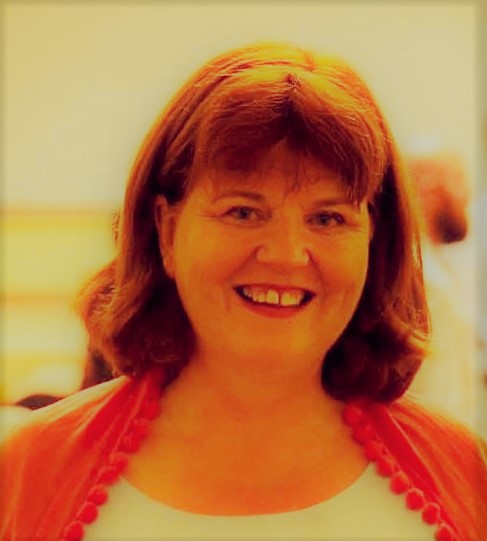
    Six months ago, I really feared Tony (27) would not see his thirtieth birthday. In my head, I’d rehearse his obituary and his funeral. I’d think how to talk to his daughter about her dad. Now, I really, truly believe that he can have his life.  Recovery will be slow, there may be setbacks and for a long while it will be all-consuming. But the boy who used to say he was afraid of nothing now knows what can do him harm. He has already paid a price — shattered health, fractured family, stalled career and delayed development. With luck, his worst is behind him. His future can offer a W9, a driver’s license, a passport, a rental agreement and a wedding day.

    It is probably just as well that I am thousands of miles and several time zones away. I have a tendency to fuss, and try to take over. I call him Darling and that annoys him. This opportunity is Tony’s to realize. I am cheering him on in Armenian.

    Թոնի ջան, վստահ եմ, որ ամեն ինչ շատ լավ է լինելու xxx

    Good job Tony, I know everything will be great. You got this. xxx

    Posted in Armenia, down and out, drinking, family, joy, Recovery | 1 Comment